You have said yes to things you did not have the capacity for. You have apologized for needs that never required an apology. You have rehearsed a simple "no" for twenty minutes before a conversation and still ended up saying "sure, that works" instead. And afterward, that familiar tightness — not relief, just quiet resentment at yourself for caving again.
If that is a pattern you recognize, the issue was never that you do not know boundaries matter. It is that somewhere underneath the logic, a deeper, older story is still running the show — one that equates a boundary with rejection, disappointing someone with being unlovable, or your own needs with being too much. In the self-improvement and manifestation community, this is understood as a self-concept issue rather than a discipline issue. You do not need to try harder to say no. You need the underlying identity of someone whose no is simply respected, including by themselves.
Boundary setting affirmations work at exactly that layer. They are not about memorizing a script for the next uncomfortable conversation. They are about slowly replacing the subconscious belief that your worth depends on your availability with a settled, quiet knowing that your needs are valid without justification, your no is a complete sentence, and protecting your peace is not selfish — it is simply how a person with healthy boundaries operates.
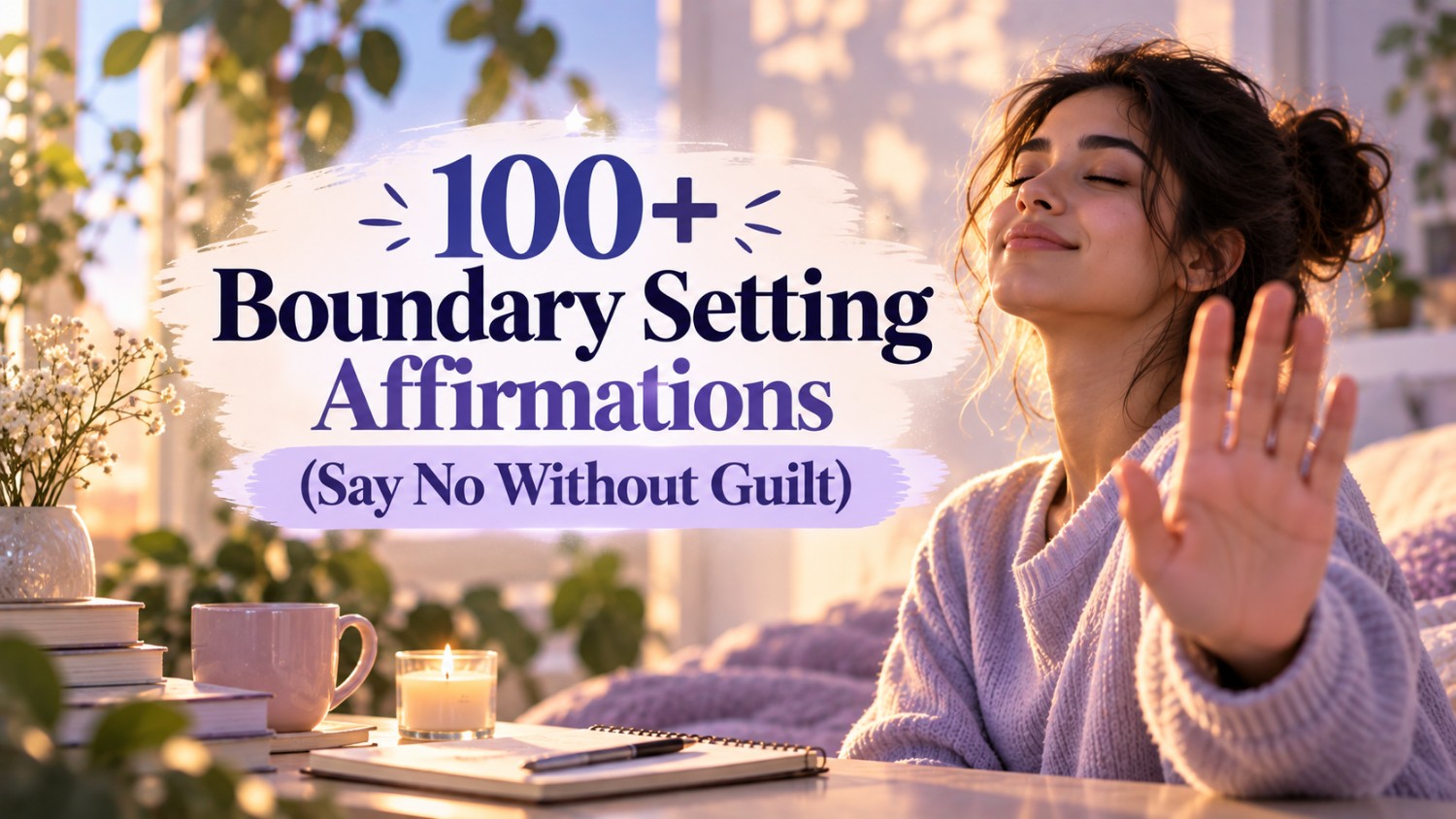
These 100+ affirmations for setting boundaries and saying no without guilt are organized by the specific inner work they target — core identity, saying no itself, self-worth, releasing people-pleasing, protecting your time and energy, living as the boundaried version of yourself, and self-compassion. Find the ones that land. Say them until the guilt gets quieter than the boundary does.
How to Use These Boundary Setting Affirmations
Say them before a conversation you are dreading, not just in the abstract. If you know a difficult ask is coming later today, a few minutes with these affirmations beforehand can shift you out of the anticipatory guilt spiral and into a calmer, more settled place to respond from.
Notice which ones create resistance, and use those most. If "I do not owe anyone an explanation for my no" makes something in you flinch, that flinch is not proof the affirmation is wrong for you. It is usually proof you have found exactly where the old people-pleasing identity still has a grip.
Say them like facts, not hopes. There is a real difference between "I wish I could say no more easily" and "my no is valid and complete." The second is spoken from the settled certainty this practice is actually built around — treating the boundary as already true, not as something you are still working up to.
Pair affirmations with one small, real boundary this week. The inner work opens the door. One real, lived instance of holding a boundary — even a small one — gives your subconscious the evidence that the new identity is not just words.
Stay consistent even on the days it feels like nothing is shifting. Many in the self-improvement community describe the guilt around boundaries as one of the slower patterns to fully rewire, since it is often tied to years of learned people-pleasing. Consistency over weeks, not a single powerful session, is what tends to move this one.
Boundary Setting Affirmations: Core Identity
The foundation. These affirmations build the deepest subconscious layer — the automatic, underlying belief about who you are in relation to other people's needs, expectations, and reactions.
- I am allowed to have boundaries.
- My boundaries are valid simply because they are mine.
- I am someone who protects my peace without apology.
- Setting boundaries does not make me difficult. It makes me honest.
- I am not responsible for managing other people's reactions to my limits.
- My needs matter as much as anyone else's.
- I am allowed to take up space with my preferences and my limits.
- I do not have to earn the right to say no.
- I am a person with boundaries, not a person who occasionally sets one under pressure.
- My boundaries are an act of self-respect, not an act of rejection toward others.
- I trust myself to know what I can and cannot hold right now.
- I am allowed to change my mind, even after I have already said yes.
- My limits deserve the same respect I give everyone else's.
- I do not need permission to protect my own energy.
- I am someone who is easy to respect because I am honest about my limits.
- Healthy boundaries are simply part of who I am now.
- I release the belief that being agreeable is the same as being good.
- My relationships are stronger when my boundaries are clear, not weaker.
- I am allowed to disappoint someone and remain a genuinely good person.
- I am becoming someone whose boundaries are simply understood and respected.
Saying No Without Guilt Affirmations
For the specific moment the word needs to leave your mouth. These affirmations target the guilt reflex directly — the instinct to soften, over-explain, or take it back the second you feel resistance from the other person.
- "No" is a complete sentence and I am allowed to use it as one.
- I can say no without providing a justification.
- Saying no to this does not make me a bad person.
- I release the need to over-explain my no.
- I am allowed to say no even when I have no specific reason.
- My no does not require anyone else's approval to be valid.
- I can disappoint someone and still sleep peacefully that night.
- I say no calmly, clearly, and without excessive apology.
- I do not owe anyone an explanation for protecting my time.
- Saying no to this is saying yes to my own wellbeing.
- I am allowed to say no to things I said yes to before.
- My no is not rejection. It is simply information about my limits.
- I can hold my no even when someone pushes back.
- I release the guilt that used to follow every no I gave.
- Saying no gets easier every single time I practice it.
- I do not need to feel guilty for having limits.
- I trust my no even when I cannot fully explain it.
- My no protects something valuable: my time, my energy, my peace.
- I am allowed to say no without softening it into a maybe.
- Every no I hold with confidence makes the next one easier.
Self-Worth and Deserving Respect Affirmations
Boundaries are only as strong as the self-worth underneath them. These affirmations for self-worth build the belief that you are worthy of respect independent of how much you give, do, or accommodate.
- I am worthy of respect without having to earn it through overgiving.
- My value is not measured by how much I do for other people.
- I deserve relationships where my limits are respected, not tested.
- I am enough without constantly proving it through self-sacrifice.
- My worth does not decrease when I say no.
- I am allowed to be loved and also have limits.
- I deserve people in my life who respect my boundaries the first time.
- I am not "too much" for having needs.
- My self-respect matters more than being seen as endlessly agreeable.
- I am worthy of taking up space with my preferences.
- I deserve to feel safe saying no in my own relationships.
- My worth was never dependent on my availability to others.
- I am allowed to prioritize myself without guilt.
- I deserve the same grace and patience I extend to everyone else.
- I am worthy of relationships that do not require me to abandon myself.
- My needs are not an inconvenience. They are simply needs.
- I deserve to be chosen by people who do not need convincing to respect me.
- I am allowed to believe I am enough exactly as I am, limits included.
- My self-worth is not up for negotiation in any relationship.
- I deserve peace more than I deserve everyone's approval.
Releasing People-Pleasing Affirmations
For unwinding the deeper pattern underneath the guilt. These affirmations for people-pleasing recovery target the belief that keeping everyone comfortable is your job.
- I release the belief that I am responsible for everyone else's happiness.
- I am allowed to stop performing agreeableness to feel safe.
- Other people's disappointment is not my emergency to fix.
- I release the habit of saying yes before I have even checked in with myself.
- I am not obligated to shrink myself to keep others comfortable.
- I release the fear that boundaries will cost me the relationship.
- I am allowed to let people be upset with me.
- I release the need to be liked by absolutely everyone.
- My peace matters more than someone else's momentary approval of me.
- I am unlearning the belief that my value is tied to being useful.
- I release the guilt that shows up before I have even done anything wrong.
- I am allowed to disappoint people who only valued my compliance.
- I release the pattern of over-apologizing for things that need no apology.
- I am not responsible for anticipating and preventing every reaction.
- I release people-pleasing as my default and choose authenticity instead.
- I am allowed to stop explaining myself to people who were never going to understand anyway.
- I release the old belief that conflict avoided is peace gained. It is not.
- I am learning that real relationships can hold my honesty.
- I release the exhausting habit of managing everyone's feelings but my own.
- I am becoming someone who chooses honesty over automatic agreeableness.
Protecting Your Time and Energy Affirmations
For the boundaries that show up in your calendar, your inbox, and your everyday capacity. These affirmations anchor the identity of someone who treats their time and energy as genuinely finite and worth protecting.
- My time is valuable and I am allowed to protect it.
- I do not have to be available to everyone, all the time.
- I am allowed to rest without justifying it to anyone.
- My energy belongs to me first.
- I am allowed to leave conversations, spaces, and situations that drain me.
- I protect my time the same way I would protect anything else I valued.
- I am allowed to say no to requests that exceed my actual capacity.
- My calendar reflects my priorities, not everyone else's expectations of me.
- I am not obligated to respond immediately to every request.
- I release the pressure to always be reachable.
- I am allowed to choose rest over obligation when I genuinely need it.
- My energy is a resource, not an endless supply.
- I protect my mornings, my evenings, and my peace as non-negotiable.
- I am allowed to say "not right now" without guilt.
- I choose where my energy goes with intention, not obligation.
- I am allowed to unplug without explaining why.
- My time off is not something I need to earn.
- I protect my focus the way I protect anything important to me.
- I am allowed to slow down without falling behind on being a good person.
- My capacity is mine to define, not anyone else's to dictate.
Law of Assumption Affirmations for Living as a Boundaried Person
For claiming the boundaried, guilt-free identity as already real — the way this kind of inner work is described throughout the self-improvement and manifestation community, where the settled assumption comes first and the outer behavior follows.
- I have already become someone for whom boundaries feel natural.
- The version of me who says no with ease already exists. I am simply living as her now.
- In my desired reality, guilt does not follow my boundaries. Ease does.
- I assume the identity of someone whose limits are simply respected.
- My subconscious already knows I am allowed to have boundaries.
- I am not trying to become boundaried. I am already operating as her.
- The guilt I used to feel is old data. It does not reflect who I am becoming.
- I trust that the people who belong in my life can hold my honesty.
- I have released the old identity that equated boundaries with selfishness.
- I am living, right now, as the version of me who protects her peace easily.
Self-Compassion Affirmations for the In-Between Moments
For the days the old guilt still shows up, even with the work you have already done. These affirmations offer the grace this process genuinely requires
- I am allowed to be a work in progress with my boundaries.
- It is okay if saying no still feels hard sometimes. I am unlearning years of habit.
- I am proud of myself for the boundaries I held today, however small.
- I meet my own slip-ups with compassion, not self-criticism.
- Healing this pattern takes time, and I am exactly on schedule.
- I forgive myself for the boundaries I did not hold today.
- I am gentle with myself as I unlearn old patterns.
- Every attempt at a boundary counts, even the imperfect ones.
- I am allowed to grow at my own pace.
- I am doing genuinely difficult inner work, and I honor that.
Why Boundary Setting Affirmations Work
Most advice about boundaries focuses on the words — the exact script for the conversation, the tone to use, the phrase to fall back on. That is useful, and it is also frequently not the actual obstacle. According to many voices in the self-improvement and manifestation community, the real block sits underneath the script entirely: a subconscious belief, often formed early and reinforced for years, that your worth is tied to your usefulness, your agreeableness, or your ability to prevent other people's disappointment.
Affirmations work on that deeper layer specifically. They are not a substitute for the practical skill of holding a boundary in real time — that still takes practice, and it can feel uncomfortable no matter how much inner work you have done. But repeated, felt affirmation practice is understood throughout this community as a way of gradually replacing the old belief with a new one, so that the discomfort of a boundary eventually feels like healthy friction rather than genuine danger.

Create Your Boundary Setting Subliminal
Assume the identity of someone whose limits are effortlessly honored. Create your custom subliminal in two minutes to claim your fulfilled reality.
Create My Subliminal ✨5 Aligned Actions to Support Your Boundary Setting Practice
Affirmations shift the belief. These actions give your nervous system the evidence to build the new pattern on top of it.
Practice one small boundary this week, on purpose. Not the hardest one you can think of — a small, low-stakes one. Evidence of a boundary held, even a minor one, does more for the underlying belief than a hundred affirmations said in the abstract.
Delay your yes. Replace an automatic "sure" with "let me check and get back to you." This single pause breaks the people-pleasing reflex long enough for you to actually consult your own capacity before committing.
Notice the guilt without obeying it. Guilt after a boundary is common and does not automatically mean you did something wrong. Many in this community describe learning to feel the guilt, name it as an old pattern, and hold the boundary anyway.
Write down every boundary you held this week, no matter how small. A private log of small wins gives your subconscious something concrete to reference besides the old story that says you always cave.
Reinforce the identity overnight, not just during the day. A few minutes of affirmations in the morning is a strong start. Many in the manifestation and subliminal community pair that daytime practice with a personalized audio track played during the pre-sleep window, when the analytical, guilt-prone mind quiets and the subconscious becomes more open to accepting a new belief. With InnerBloom subliminal maker, you describe your exact boundary-setting goals — the specific relationships, the specific patterns you are releasing, the identity you are building — and the platform generates a personalized affirmation script from your own words. You review every line, choose a calming background sound, and download a lossless WAV file you can play as you fall asleep, reinforcing the guilt-free, boundaried identity at the layer where the old pattern actually took root.
Frequently Asked Questions
Do boundary setting affirmations actually help with the guilt?
Many in the self-improvement community describe consistent affirmation practice as genuinely shifting the underlying belief that boundaries are selfish or dangerous, which in turn reduces the automatic guilt response over time. Affirmations work alongside, not instead of, actual practice holding boundaries in real conversations — the two together tend to move faster than either alone.
How many boundary affirmations should I say each day?
Ten to fifteen that create a real reaction — either quiet relief or a slight, productive stretch — tend to work better as a daily practice than mechanically reading through all 100+. Choose your core set from the sections above and rotate in new ones as specific situations come up.
Why do I still feel guilty even after saying these affirmations?
Guilt around boundaries is frequently described throughout this community as one of the slower patterns to shift, particularly for people with a long history of people-pleasing. Feeling guilt after a boundary does not mean the boundary was wrong or that the affirmations are not working — many practitioners describe learning to hold the boundary through the guilt rather than waiting for the guilt to disappear first.
What is the best time of day to practice these affirmations?
Before a conversation you are anticipating is one of the most practically useful times, since it shifts your starting state before the moment actually arrives. The pre-sleep window is considered especially effective for the deeper identity work, since the analytical, guilt-generating part of the mind is quieter and more receptive at that time.
Can affirmations help with people-pleasing in general, not just saying no?
Yes — many of the affirmations in this guide, particularly in the people-pleasing and self-worth sections, target the broader pattern underneath boundary struggles specifically, including over-explaining, over-apologizing, and prioritizing everyone else's comfort automatically. Boundaries are simply one visible expression of that deeper pattern.
How is a subliminal different from saying these affirmations out loud?
Saying affirmations out loud is a conscious, active practice — useful before a specific conversation or as a morning ritual. A subliminal delivers the same affirmations passively, usually beneath calming background audio during sleep, when conscious resistance and guilt-based thinking are naturally at their lowest. Many people use both together, reinforcing the same boundaried identity from two different angles across the day and night.
The Bottom Line
The guilt you feel after saying no was never proof that the no was wrong. It was old evidence from an old story — one that equated your worth with your availability, long before you had any say in believing it. That story can be unlearned, the same way it was learned: through repetition, through evidence, and through consistently choosing the identity of someone whose limits are simply respected, starting with how you treat your own.
Say these affirmations daily. Hold one small boundary this week. Let the guilt get quieter every time the boundary holds anyway. And when saying no finally starts to feel like relief instead of risk, trust that — because in your desired reality, that is simply who you already are.
Disclaimer: This article is for motivational and mindset purposes only. The affirmations and practices described are personal development tools used in the self-improvement and manifestation community and are not presented as scientifically proven methods. No specific outcomes are guaranteed or implied. Individual results vary. This content does not constitute psychological or therapeutic advice. If boundary struggles are connected to a difficult or unsafe relationship, please consider speaking with a qualified therapist or counselor. InnerBloom Subliminal Maker is a personal development tool, not a medical or therapeutic service.
Found this helpful? Share it with someone who needs it 💜