You have tried scripting because everyone said it was the foundational technique, and it felt like homework. You have tried SATS because it is supposedly the most powerful tool in the entire law of assumption framework, and you fell asleep before the scene ever settled in, or you stayed too alert to ever get drowsy enough to enter it.
You have wondered whether you are just bad at manifesting — when the actual answer might be simpler: you have been using a technique that was never built for the way your mind naturally processes information in the first place.
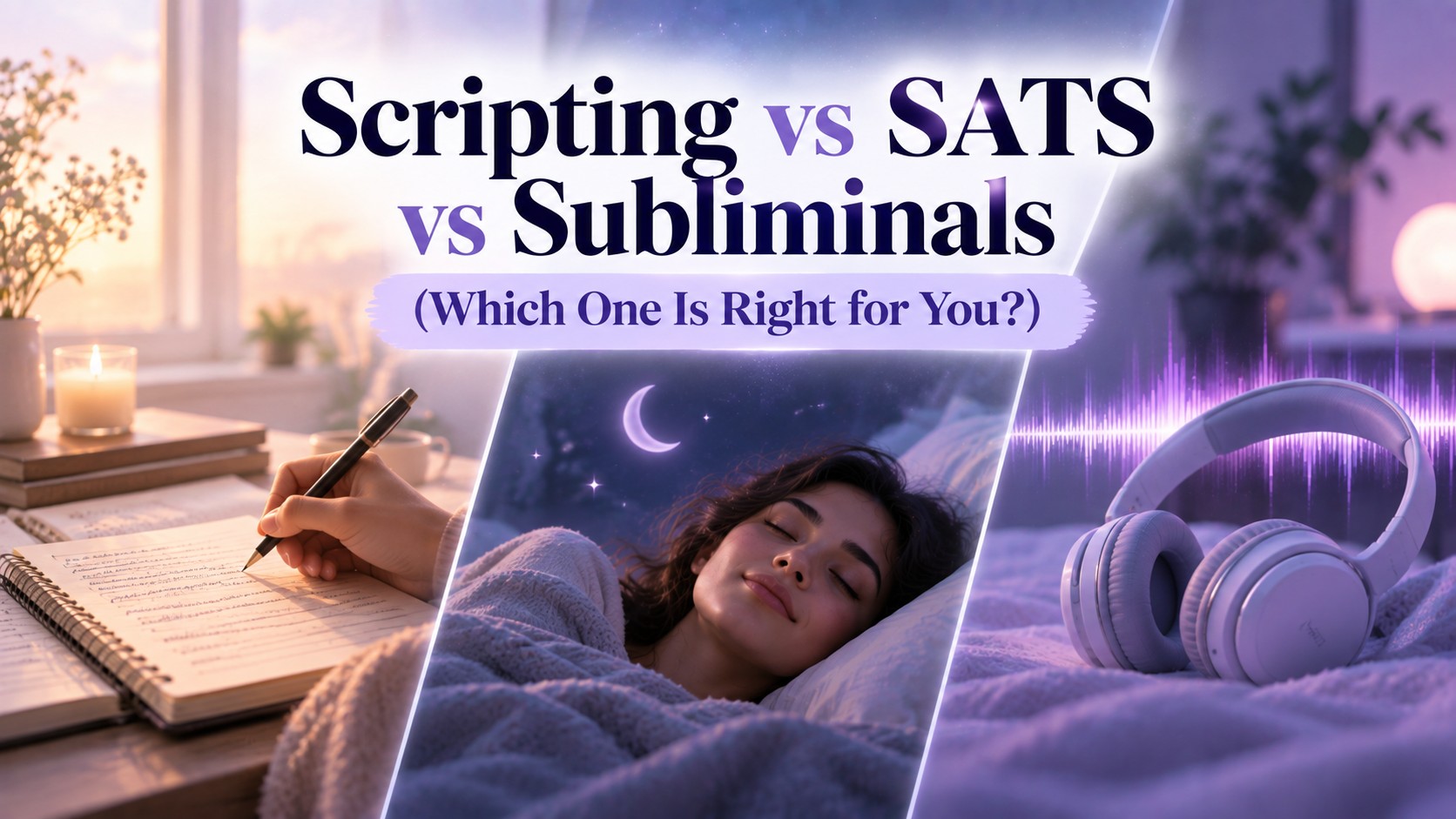
This is the real, researched breakdown of scripting vs SATS vs subliminals — not which one is objectively "the best," because that question does not have a single answer, but which one is objectively the best for you, based on how you already learn, focus, and retain information in every other area of your life.
Why "Which Technique Is Best" Is the Wrong Question
Ask ten experienced practitioners in the manifestation and law of assumption community which technique is most powerful, and you will get several different, equally confident answers. That is not a contradiction. It reflects something the wider manifestation community has increasingly organized around: every technique belongs to one of a few underlying families, and each family works through a genuinely different psychological mechanism.
Broadly, manifestation techniques fall into three functional categories. Repetition-based techniques — affirmations and subliminals among them — work by embedding a belief through deliberate, spaced repetition, wearing a groove into the subconscious over time. Embodiment-based techniques — scripting and SATS among them — work by generating the actual felt sense of already having the desire, using imagination and language to produce a real emotional state. Ritual-based techniques mark a clean, symbolic break from the old story to the new one.
Scripting and SATS both sit primarily in the embodiment family, but they reach that embodiment through very different channels — one through written language, one through visualized, felt scenes. Subliminals sit in the repetition family, reaching the subconscious through sound rather than through active mental construction at all. Which of these channels actually works for you has far less to do with willpower or belief, and far more to do with which sensory channel your mind already defaults to when it is trying to learn or remember anything.
The Learning Style Framework Behind This Guide
This is where a well-established model outside the manifestation world becomes genuinely useful: the VAK framework — Visual, Auditory, and Kinesthetic learning styles — used for decades in education to describe the channel a person's mind naturally prefers when absorbing new information. A visual learner retains information best by watching, reading, and picturing. An auditory learner retains information best by listening and hearing it spoken. A kinesthetic learner retains information best by physically doing, feeling, and experiencing something directly, rather than by watching or listening to it described.
Most people are not purely one type — nearly everyone uses a blend of all three, with one or two channels dominant. But that dominant channel matters enormously once you apply it to manifestation, because scripting, SATS, and subliminals are not interchangeable tools that happen to have different names. They are, functionally, a written technique, a visualized-and-felt technique, and an audio technique — which maps almost perfectly onto the visual, kinesthetic, and auditory learning channels.
Scripting: Built for the Written-Language Processor
Scripting is the practice of journaling your desired reality in present tense, as though it has already happened — describing your life, your feelings, and your circumstances from the perspective of the version of you who already has what you want. It is widely considered one of the foundational manifestation techniques, often taught before SATS or subliminals, because writing forces specificity in a way looser mental practices sometimes do not.
Scripting is built for people whose minds naturally process through language and the written word. If you are someone who thinks in full sentences, who clarifies a vague feeling by writing it down, who remembers something better once you have physically written it rather than just thought it, scripting is very likely to be your strongest tool. The act of constructing sentences about your desired reality does double duty — it generates the emotional embodiment the technique is aiming for, and it clarifies exactly what you actually want, which is often murkier in your head than it becomes once you try to put it into words.
Where scripting tends to struggle is with people whose minds do not naturally organize themselves through language — people who find a blank page intimidating rather than clarifying, or who read back what they wrote and feel nothing, because their processing style was never primarily verbal to begin with.
SATS: Built for the Visual-Kinesthetic Imaginer
SATS, or State Akin to Sleep, is the practice of holding one small, vivid, first-person scene in your imagination as you drift toward sleep — feeling the sensory reality of the wish fulfilled rather than describing it in words. It is widely regarded throughout the law of assumption community as one of the most direct techniques available, precisely because it bypasses language entirely and works through felt, sensory imagination instead.
This is a technique built for people who are strong visualizers and who process emotion somatically — through felt sensation in the body rather than through thought or language. If you can close your eyes and genuinely see a scene, feel a texture, hear a specific voice say a specific sentence, SATS gives you a direct route to the embodiment that other techniques have to build up to more slowly. This is also exactly why SATS is notoriously difficult for people who do not naturally visualize well, or who process feeling primarily through words rather than sensation — for that person, "picture the scene and feel it as real" is a genuinely unfamiliar instruction, not a simple one.
It is worth naming the technique's other well-documented challenge honestly: even among people who are strong visualizers, SATS asks you to walk a narrow line between drowsy enough to bypass resistance and awake enough to hold the scene, and many practitioners across the community describe falling asleep before the scene has had a chance to settle in, night after night.
Subliminals: Built for the Auditory Processor
A subliminal delivers your affirmations acoustically, layered beneath a calming background sound, typically played during the pre-sleep window or through the night. Unlike scripting and SATS, it does not require you to actively construct anything in the moment — no blank page, no visualized scene, no felt sensation you need to manufacture yourself. It simply requires you to listen, which makes it structurally the most passive of the three, and, for a specific type of processor, the most effective.
This is the technique built for people whose minds retain information best through sound — people who remember song lyrics effortlessly, who learn better from a podcast than a textbook, who find a lecture easier to absorb than the same material in written form.
According to many voices in the subliminal community, this audio-first delivery also solves a problem the other two techniques can create for auditory-dominant people specifically: the mental effort of actively writing or visualizing can itself become a barrier, something that has to be gotten right before the "real" work can happen. A subliminal removes that barrier by delivering the repetition directly, without requiring active construction at all.
Subliminals are also, structurally, the only one of the three techniques that continues working after you fall asleep — scripting and SATS both depend on your active engagement, which ends the moment you lose consciousness, while an audio track keeps playing and delivering the same affirmation through the hours that follow.
A Quick Self-Check: Which Technique Matches How You Actually Learn
Answer honestly, based on how you already learn in daily life, not how you wish you learned:
When you need to remember something important, do you naturally write it down, picture it, or say it out loud / listen to it repeated? Writing points toward scripting. Picturing points toward SATS. Listening points toward subliminals.
When you're upset, do you process by journaling it out, replaying a mental scene, or needing to hear something calming? Journaling points toward scripting. A replayed scene points toward SATS. Needing to hear something points toward subliminals.
Can you close your eyes and vividly picture a memory, complete with sound and feeling, or does your mind stay mostly blank? A vivid picture points toward SATS. A blank or vague result points toward scripting or subliminals instead.
Do you retain podcasts and audiobooks as well as you retain books, or is reading always stronger for you? Strong audio retention points toward subliminals. Stronger reading retention points toward scripting.
If you land clearly in one category, that is very likely your primary channel, and the corresponding technique is worth making your foundation. If you land across two, that is common, and it usually means a combination will serve you better than forcing yourself into a single technique the wider community happens to be currently discussing most.
Why Most Experienced Practitioners End Up Combining Techniques
This is worth being direct about: nearly every serious voice in the manifestation and law of assumption community eventually lands on some version of the same conclusion — the most effective practice is rarely one single technique used in isolation. It is usually two or three techniques from different families, layered together, each covering a gap the others leave open.
A common and genuinely effective combination looks like this: scripting to clarify the desire and generate the initial written detail, SATS to embody that same scene right before sleep, and a subliminal to carry the identical affirmations through the hours of actual sleep that follow, when neither scripting nor SATS can continue working on their own.
Rather than choosing a single winner between scripting, SATS, and subliminals, many experienced practitioners treat the three as complementary stages of the same underlying process rather than competing options.
How InnerBloom AI Bridges All Three
This is exactly the bridge InnerBloom was built to close, particularly for anyone who has already identified scripting or SATS as their instinctive starting point but wants the follow-through a purely active technique cannot provide on its own. You begin the way you would with scripting — describing your desire, your specific scene, your exact desired reality, in your own words. InnerBloom subliminal maker takes that written intention and builds a complete, present-tense affirmation script around it, the same core material a scripting practice would produce.
From there, instead of the practice ending with words on a page, InnerBloom converts that script into a personalized subliminal — your own scripted language, delivered acoustically, playing beside you through the exact pre-sleep window SATS is built around and continuing through the sleep that follows it. For an auditory-dominant processor, this is the technique in its most natural form. For a visual or kinesthetic processor who scripted their scene but struggles to sustain it once sleep arrives, it becomes the audio layer that keeps the same scene reinforced long after conscious visualization gives way to rest.
You do not need to be a strong visualizer to benefit from it, and you do not need to enjoy journaling to use it either. You describe the desire once, in whatever words come naturally to you, and InnerBloom carries it the rest of the way — through the SATS window, through the night, in the one sensory channel available to you the entire time you are asleep.

Turn Your Script Into a Subliminal
Turn your written manifestation script into effortless personal audio. Create your custom subliminal in two minutes to embody your desired reality.
Create My Subliminal ✨Frequently Asked Questions
Which is better, scripting, SATS, or subliminals?
There is no single technique that outperforms the others for everyone — according to how this is consistently discussed throughout the manifestation community, the most effective technique is the one that matches your natural learning style and that you can practice consistently. A strong visualizer will typically get more from SATS, a natural writer more from scripting, and an auditory processor more from subliminals.
Can I use scripting, SATS, and subliminals together?
Yes, and many experienced practitioners in the law of assumption community consider this the most effective approach overall — using scripting to clarify the desire in detail, SATS to embody the scene before sleep, and a subliminal to continue reinforcing the same affirmations through the night, when the other two techniques can no longer actively work.
How do I know if I'm an auditory learner for manifestation purposes?
If you retain podcasts, audiobooks, songs, and spoken information as well as or better than written material, and you find listening more natural than journaling or actively visualizing a scene, that points toward an auditory processing style — which is exactly the channel subliminals are built to work through.
Why do I keep falling asleep during SATS?
This is one of the most commonly discussed challenges throughout the SATS and law of assumption community, and it is not a sign the technique has failed you — it reflects the narrow window SATS asks you to hold between drowsy enough to bypass resistance and awake enough to sustain the scene. Many practitioners pair SATS with a subliminal specifically to keep the same affirmation reinforced through the hours after the scene has naturally given way to sleep.
Is subliminal audio a replacement for scripting or SATS?
Most practitioners in the community treat a subliminal as a complement rather than a full replacement — scripting and SATS both involve active, conscious engagement that produces its own benefit, particularly the clarity scripting provides and the embodiment SATS generates. A subliminal extends that same intention into the passive, listening channel, especially useful during sleep, when neither of the other two techniques can continue on their own.
What if I don't know my learning style?
The self-check questions in this guide are a reasonable starting point, but the most reliable method is simply trying each technique for a few consistent days and noticing which one felt natural rather than effortful — scripting that flows easily, a SATS scene that holds itself without straining, or a subliminal that you actually look forward to pressing play on each night, are all signs you have found your primary channel.
The Bottom Line
Scripting, SATS, and subliminals are not competing for the title of best manifestation technique — they are three different doors into the same underlying subconscious work, built for three different ways a mind can naturally process information. The reason a technique has felt like effort rather than magic might never have been about belief or consistency. It might simply have been the wrong door for how you are actually wired to learn.
Find the channel that matches you — written, visualized, or heard — and build from there. And if your honest answer is "a bit of all three," that is not indecision. That is exactly what most experienced practitioners in this space eventually land on anyway.
Disclaimer: This article is for informational and personal development purposes only. Scripting, SATS, subliminal audio, and other practices described are mindset and self-concept tools used in the manifestation and law of assumption community and are not presented as scientifically proven methods. The VAK learning style framework referenced is a widely used educational model; research on its predictive value for learning outcomes specifically is mixed, and it is presented here as a practical, informal lens rather than a clinically validated assessment. No specific outcomes are guaranteed or implied. Individual results and experiences vary. InnerBloom Subliminal Maker is a personal development tool, not a medical, therapeutic, or educational assessment service.
Found this helpful? Share it with someone who needs it 💜