You tie a small piece of red string around your wrist, close your eyes, and hold your intention for a moment before you go about your day. It feels older than a TikTok trend, because it is. Long before this method had a hashtag, versions of this exact object — a red thread, worn at the wrist, carrying meaning far beyond its color — existed across cultures that never spoke to each other, separated by oceans and centuries, all reaching for the same idea: that something this small could carry something this significant.
This is the complete red string manifestation method guide — where the practice actually comes from, how different traditions have used it for very different purposes, how the modern manifestation and law of attraction community adapted it into an active tool, and why a growing number of practitioners now treat the string as only half of a complete overnight practice.
The Real Folklore Behind the Red String
The version most people encounter first traces back to Chinese folklore's Red Thread of Fate, sometimes called the Red String of Destiny. According to the legend, an invisible red string is tied by Yuè Lǎo, the old lunar matchmaker deity, around the ankle or finger of two people destined to meet — a thread that may stretch, tangle, or fray over a lifetime, but is said to never fully break. It is, at its origin, a soulmate legend, not a manifestation technique. In the original folklore, the connection is already fated; the string simply makes visible a bond the universe decided long before you had any say in it.
But the red thread as a spiritually significant object is far older and far more widespread than any single origin story. In Jewish folk custom associated with Kabbalah, a thin scarlet or crimson wool string, worn on the wrist, is used as a talisman believed to ward off misfortune brought on by the evil eye. In Hindu tradition, a red string known as kalava is tied around the wrist during religious ceremonies by a priest or elder, symbolizing blessing and protection, with married women traditionally wearing it on the left wrist and unmarried women and men wearing it on the right.
Across Chinese, Hindu, Buddhist, and Jewish traditions alike, a red string at the wrist has independently carried the same core themes for centuries: protection, connection, and intentional meaning deliberately placed onto something worn on the body.
This is genuinely worth knowing before you tie your own, because it means the modern red string manifestation trend is not inventing something new so much as it is gathering several ancient threads — literally — into a single, popularized practice.
From Fate Symbol to Active Manifestation Tool
Here is the honest nuance most viral content skips entirely: in its original folklore, the red thread of fate describes something already decided, not something you actively summon through intention. If two people are destined to meet, the traditional legend holds, the string ensures they will find each other regardless of what either person does. Strictly speaking, that is closer to a fate concept than a law of attraction one.
The modern manifestation community's version of the red string method is a reinterpretation, and it leans on a different but genuinely well-established concept: anchoring, a technique borrowed from neuro-linguistic programming, or NLP.
The theory behind anchoring is that repeatedly pairing a specific physical sensation — touching a bracelet, for example — with a deliberately generated emotional or mental state creates an association strong enough that, over time, the physical sensation alone can trigger that state on its own. In this reframing, the red string is not passively waiting on fate. It becomes an active, physical anchor point for whatever intention you have deliberately charged it with, whether that is love, abundance, protection, or a specific desired outcome.
How to Practice the Red String Manifestation Method
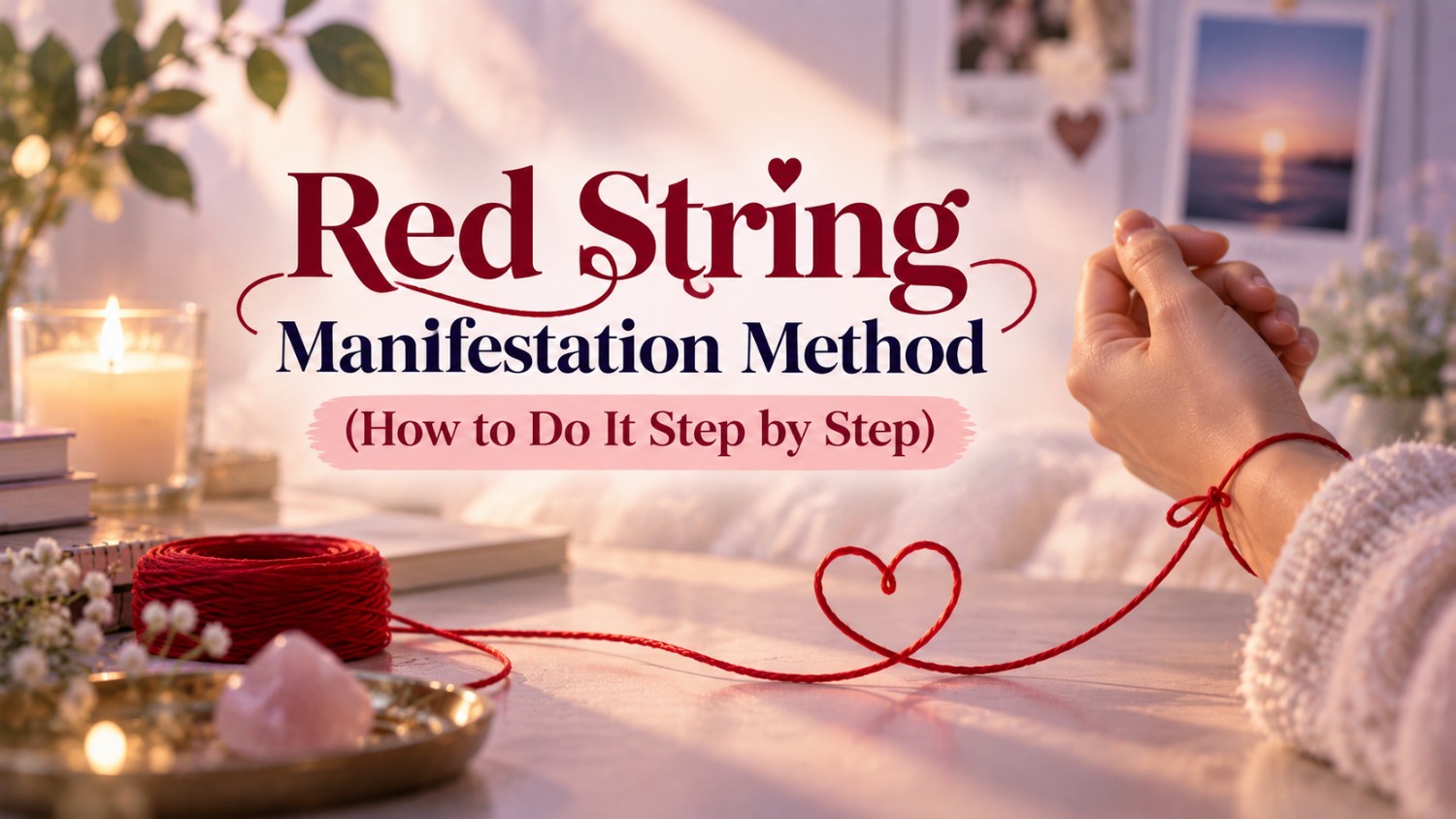
Step 1: Choose your string and your wrist with intention. A simple, natural red string or thread is traditional. Many in the modern manifestation community follow a loose convention where the left wrist is associated with receiving — protection, incoming blessings — and the right wrist with sending an intention out into the world, though these associations vary meaningfully by tradition and source, so treat this as a starting point rather than a fixed rule.
Step 2: Charge the string before you tie it. This is the step that actually does the subconscious work, according to how the technique is described throughout the manifestation community. Hold the string, close your eyes, and visualize your desire in as much sensory detail as you can — see it, feel it, hear it, as though it is already real. Some practitioners layer in a brief spoken affirmation while holding the string, pairing the physical object with the felt sense of the wish already fulfilled.
Step 3: Tie it with a clear, specific intention in mind. Rather than a vague wish, many practitioners recommend holding one precise thought as the knot is tied — the exact outcome you are anchoring the string to represent.
Step 4: Use it as a touchpoint throughout the day. Whenever doubt creeps in, or whenever you simply want to reinforce the state, touch the string and briefly return to the same felt sense you generated while charging it. This repetition is what an NLP-style anchor actually depends on — the association strengthens with each deliberate touch, not with the string's mere presence on your wrist.
Step 5: Let the string fray or fall off naturally rather than forcing it off. In most traditions this practice draws from, a string that falls away on its own is treated as a meaningful sign — the intention has done its work, or the specific chapter it represented has completed.
Why the Physical Anchor Works, and Where It Runs Into a Natural Limit
The anchoring theory behind the red string method is genuinely sound as a psychological mechanism — pairing a physical sensation with a chosen emotional state repeatedly is a well-documented technique, and it is reasonable that touching a bracelet you have consciously charged could reliably summon the state you associated with it.
But it is worth being honest about the one thing a physical, tactile anchor structurally cannot do: work while you are unconscious. The entire mechanism depends on you actively touching the string and re-engaging the felt state — which means for every hour you are asleep, the anchor is simply sitting on your wrist, doing nothing, because there is no conscious touch reinforcing it. For a technique so closely associated with the pre-sleep and hypnagogic window that so much of the manifestation community considers the most receptive time of day, that is a meaningful gap. The string can carry your intention through a waking day of deliberate touches. It cannot carry it through eight hours of sleep on its own.
Extending the Anchor Through the Night
This is exactly the gap a nighttime audio anchor is built to close, and it is a genuinely complementary addition rather than a replacement for the string itself. Where the red string gives you a tactile anchor you can return to throughout the day, a personalized subliminal gives you an acoustic anchor that continues delivering the same charged intention through the hours the string alone cannot reach — the pre-sleep window and the sleep that follows it, which is described throughout the manifestation community as the period when the subconscious mind is at its most receptive.
Many practitioners now treat the two as a paired daily and nightly practice rather than competing techniques: the string worn and touched throughout the day as your physical, waking anchor, and a subliminal played as you fall asleep as your acoustic, overnight anchor — two different sensory channels, covering two different parts of the day, both reinforcing the exact same charged intention.
How InnerBloom Builds the Overnight Half of Your Practice
This is exactly the piece InnerBloom was built to add. When you charge your red string, you are already generating a specific, felt intention — a desire held in your own words, in as much sensory detail as you can bring to it. InnerBloom takes that same intention and turns it into a personalized affirmation script and subliminal audio track, so the exact desire you charged into your bracelet during the day is the same one reinforcing your subconscious acoustically at night.
You describe your intention once, in your own words — the same specificity you would bring to charging the string — and InnerBloom's AI generates a complete affirmation script around it. Choose a calming background sound, download your personalized, lossless WAV file, and play it as you fall asleep with your string still on your wrist. The tactile anchor and the acoustic anchor work in tandem, covering the full day, waking and sleeping, with the same underlying intention running through both.

Create Your Red String Subliminal
Carry your red string intention into the deep pre-sleep twilight window. Create your custom subliminal in two minutes to align with your dream life.
Create My Subliminal ✨Frequently Asked Questions
What is the origin of the red string manifestation method?
The practice draws on multiple genuine folklore traditions, most visibly the Chinese Red Thread of Fate, in which the deity Yuè Lǎo ties an invisible red string around the ankles of soulmates, as well as separate red-string traditions in Hindu ceremonies and Jewish folk custom associated with Kabbalah, both of which use a red string at the wrist for protection and blessing. The modern manifestation version blends these traditions with newer concepts like NLP anchoring.
Which wrist should I wear the red string on for manifestation?
Traditions vary. Many in the modern manifestation community follow a convention where the left wrist relates to receiving and protection, and the right wrist relates to sending an intention outward, though this differs across cultural sources, so it is worth choosing the version that resonates with you and staying consistent.
Does the red string method actually work?
According to many voices in the manifestation community, the string functions as a physical anchor point for a consciously charged intention, similar to anchoring techniques used in NLP, where a physical sensation becomes paired with a chosen emotional state through repetition. Its effectiveness, like most manifestation practices, is understood within the community as tied closely to the consistency and genuine feeling behind the charging and touching ritual, rather than the object itself.
What does it mean if the red string falls off or breaks?
Across most of the traditions this practice draws from, a string that falls away naturally, rather than being deliberately removed, is treated as a meaningful sign that the intention behind it has completed or fulfilled its purpose, rather than as something to worry about.
Can I combine the red string method with other manifestation techniques?
Yes, and many practitioners do — pairing the red string with scripting, SATS, or a subliminal is common throughout the manifestation community, since the string primarily functions as a waking, tactile anchor rather than a technique meant to stand alone through every part of the day and night.
Why pair the red string with a subliminal specifically?
The red string depends on conscious touch to reinforce its anchored intention, which means it cannot do anything while you are asleep. A subliminal reaches the exact window the string cannot — the pre-sleep and sleep hours — continuing the same intention acoustically when the tactile anchor has nothing left to work with.
The Bottom Line
The red string manifestation method is not a TikTok invention dressed up in old language — it draws on genuinely ancient, independently developed traditions across Chinese, Hindu, and Jewish folklore, each treating a simple red thread at the wrist as something worth far more than its material. The modern manifestation community's version, reframed through the lens of NLP-style anchoring, gives that same object an active role: a physical touchpoint for a consciously charged intention you can return to throughout the day.
Where it naturally runs out of reach is the one place every purely tactile technique does — the hours you spend asleep, unable to touch or reinforce anything. Pair your string with a nightly audio anchor, and the practice stops being a daytime ritual with a gap in it and becomes something closer to a full day-and-night practice, covering the hours the thread alone was never built to reach.
Disclaimer: This article is for informational and cultural-educational purposes only. The folklore traditions referenced are presented as accurately as possible based on publicly available sources and may vary across regions, communities, and individual practitioners. The manifestation practices described are mindset and self-concept tools used in the self-improvement and manifestation community and are not presented as scientifically proven methods. No specific outcomes are guaranteed or implied. Individual results vary. InnerBloom Subliminal Maker is a personal development tool, not a religious, cultural, or therapeutic authority.
Found this helpful? Share it with someone who needs it 💜