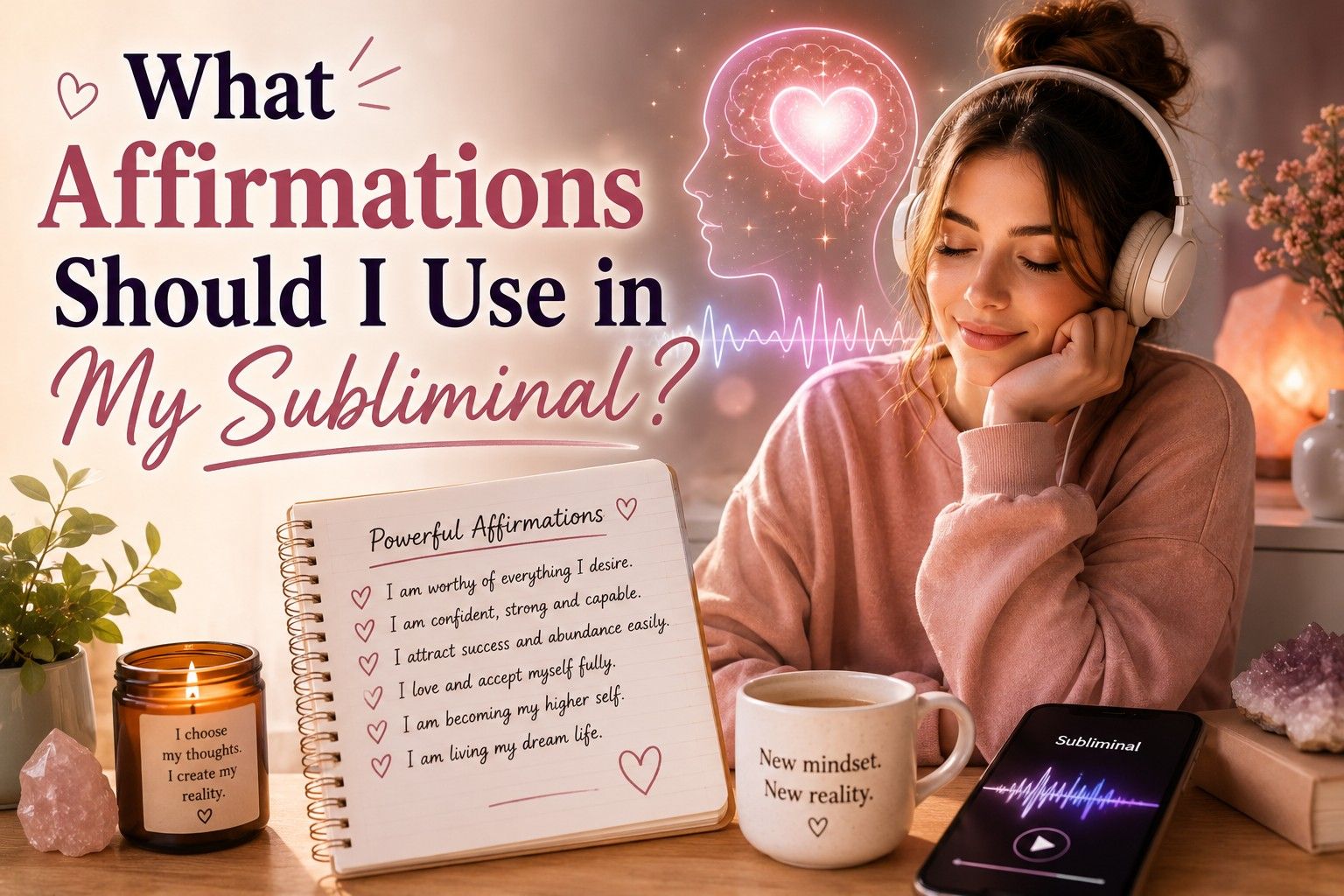
You have decided to make your own subliminal. You have your goal in mind. You know you need affirmations. And then you open a blank document and stare at it, wondering: what exactly am I supposed to write?
This is where most people get stuck — and where most subliminal guides fail them. They tell you to "write positive statements in present tense" and leave it there. But there is far more nuance to writing affirmations that your subconscious actually absorbs than a single sentence of advice can cover.
The truth is, not all affirmations are built the same. Different types work differently. Some hit harder for certain people. Some goals respond better to certain formats. And a subliminal built with the wrong type of affirmation for you specifically can feel like it is doing nothing — not because subliminals do not work, but because the input was not matched correctly to the person receiving it.
This guide breaks down every major type of subliminal affirmation, when to use each one, what makes each format effective, and how to choose the combination that fits your goal and your psychology. By the end, you will have everything you need to write affirmations that your subconscious is actually ready to receive.
First: Understand What Your Subconscious Is Looking For
Before getting into the types, it helps to understand the basic principle your affirmations need to work with.
Your subconscious mind does not evaluate incoming statements the way your conscious mind does. It does not debate, fact-check, or look for proof. It stores. It accepts what is consistently and repeatedly given to it and begins to build your automatic responses, habits, self-concept, and identity around whatever it holds as true.
This means the most effective subliminal affirmations share a few non-negotiable qualities regardless of type:
They are stated positively. The subconscious does not process negation cleanly. "I am not anxious" draws attention to anxiety. "I am calm and at ease" does not. Always frame what you want, never what you are moving away from.
They are believable enough not to create resistance. If the gap between your current belief and the affirmation is too wide, the statement creates cognitive dissonance rather than absorption. "I earn ten million dollars a year" stated by someone struggling financially is more likely to produce inner rejection than genuine reprogramming. Stepping-stone statements — ones that feel like a stretch but not a lie — tend to absorb far more effectively.
They are short and clean. Seven to twelve words is a reliable range for subliminal affirmations. Long, complex sentences require more cognitive processing, which works against the whole purpose of bypassing the conscious mind. Simple, direct statements land deeper.
They are specific to your goal. Generic affirmations produce generic results. "I am successful" is far weaker than "I complete my work with focus and ease." The subconscious responds to the precise image you give it.
With those principles in place, here are the main types of affirmations used in subliminals and how each one works.
Type 1: First Person Affirmations ("I Am" Statements)
What they are: Affirmations that speak directly from your own identity using "I," "my," or "me."
Examples:
- I am confident in every room I walk into.
- My mind is focused, clear, and sharp.
- I trust myself completely.
- I am someone who follows through.
- My body is healthy and strong.
Why they work: First person affirmations are the most direct form of identity reprogramming available. When your subconscious receives an "I am" statement repeatedly, it begins to build a self-concept around that statement. This is the core mechanism of subliminal work — installing a new dominant identity at the layer below conscious thought.
The "I am" format is powerful because it does not describe what you want to become. It describes who you already are. That present-tense identity framing is exactly what the subconscious needs to begin reorganising your automatic responses around a new self-image.
Best used for: Self-concept goals. Confidence. Identity shifts. Body image. Personality traits. Any goal where the core work is changing who you believe yourself to be.
Watch out for: Affirmations that feel too far from your current belief. If "I am wealthy" triggers instant inner rejection every time it runs, try "I am becoming more financially confident every day" as a bridge statement before moving to the stronger version.
Type 2: Second Person Affirmations ("You Are" Statements)
What they are: Affirmations written from an outside voice speaking to you — as if someone who completely believes in you is affirming your reality.
Examples:
- You are confident and magnetic.
- You deserve everything you are calling in.
- You are someone people trust and admire.
- You have the strength to follow through on everything you set your mind to.
- You are deeply loved and completely worthy.
Why they work: Second person affirmations bypass a specific form of resistance that first person statements can sometimes trigger. When you say "I am confident," your inner critic can fire back immediately with counter-evidence. When an affirmation arrives in the second person — "you are confident" — it lands differently. It feels less like a claim you are making about yourself and more like an external truth being delivered to you.
Many people in the subliminal community find that second person affirmations feel more believable, especially in the early stages of reprogramming, precisely because they do not activate the same self-referential resistance. The subconscious receives them more like an instruction from a trusted source.
Best used for: People who experience strong resistance to first person statements. Self-worth and self-love goals. Anyone who finds "I am" affirmations feel hollow or triggering in the early stages.
A useful combination: Many effective subliminals blend first and second person affirmations for the same goal. The second person statements soften the pathway; the first person statements anchor the identity. Used together, they cover more psychological angles than either format alone.
Type 3: Present Tense Affirmations
What they are: Affirmations written as if the desired reality is already completely true right now.
Examples:
- I live in the home I have always wanted.
- My relationships are deep, loving, and fulfilling.
- I wake up every morning feeling excited about my life.
- My body is lean, strong, and healthy.
- I have everything I need.
Why they work: The subconscious does not process time the way the conscious mind does. It does not operate on a future/present/past timeline. It simply holds a model of reality and organises your automatic behaviour around it. When you feed it present tense statements consistently, it begins to treat those statements as descriptions of current reality and adjust your internal responses accordingly.
Future tense affirmations — "I will be confident," "I am going to be wealthy" — tell the subconscious that the desired state is ahead of you, not inside you. They reinforce the gap. Present tense closes it.
This is why present tense is the most widely recommended format for subliminal affirmations across the community — and rightly so. It is the format most aligned with how the subconscious actually processes information.
Best used for: Almost everything. Present tense affirmations are the backbone of most effective subliminals regardless of goal.
The one exception: If present tense affirmations consistently produce strong disbelief — if "I am wealthy" feels so far from reality that it creates more inner friction than it resolves — use bridging language: "I am moving toward financial abundance" or "Every day I step more fully into the life I am building." These are still present tense. They just meet you closer to where you currently are.
Type 4: Past Tense Affirmations
What they are: Affirmations written as if the desired reality has already happened and you are reflecting on it from the other side.
Examples:
- I finally let go of the story that was holding me back.
- I have always been someone who follows through.
- My confidence has always been a natural part of who I am.
- I released every belief that said I was not enough.
- I found my way to the life I always knew was mine.
Why they work: Past tense affirmations work on a different psychological lever than present tense. Rather than claiming a current reality, they imply that a transformation has already completed — that the old story is already behind you. This is particularly effective for releasing limiting beliefs, old identities, and deeply held patterns, because it communicates to the subconscious that the old programme is already done. It has already been replaced.
The past tense format also sidesteps resistance in a subtle way. "I have always been confident" does not ask the subconscious to accept a new identity right now. It asks it to accept that this identity was always already there — which often feels easier to absorb, especially for goals tied to deeply ingrained self-concept.
Best used for: Releasing old patterns and limiting beliefs. Healing work. Identity shifts that involve leaving an old story behind. Goals where the core block is a long-held belief about what you are not.
Combine with present tense: Past tense affirmations work best when paired with present tense ones in the same subliminal. The past tense releases the old. The present tense installs the new. Together they create a complete reprogramming loop.
Type 5: Gratitude Affirmations
What they are: Affirmations framed as expressions of genuine thankfulness for the desired reality, stated as if it is already received.
Examples:
- I am so grateful for my healthy, strong body.
- Thank you for the abundance that flows into my life every day.
- I am deeply grateful to be someone who shows up for themselves.
- I feel so thankful for the confidence I carry everywhere I go.
- I am grateful for the life I have built.
Why they work: Gratitude affirmations work at the emotional frequency level in a way that other formats do not. Gratitude is one of the highest-resonance emotional states available — it is inherently present-tense, inherently accepting of what is, and inherently incompatible with the energy of lack. When you express genuine gratitude for something, you are not hoping for it. You are acknowledging it as already real.
This is why gratitude affirmations can be particularly powerful in subliminals. They do not just deliver a new belief — they deliver the emotional state of already having, which is the state most aligned with continued attraction of the desired reality. The subconscious absorbs both the belief and the emotional signal simultaneously.
Best used for: Abundance goals. Manifestation-focused subliminals. Any goal where the emotional frequency of receiving is the primary thing being cultivated. Combining with other types as an emotional amplifier.
An important note: Gratitude affirmations work best when they feel genuinely warmth-producing rather than mechanical. If "I am so grateful for my wealth" feels hollow right now, start with something closer: "I am grateful for every step I have taken toward the life I am building." The feeling matters more than the specific statement.
How Many Affirmations Should Your Subliminal Contain?
This is one of the most common questions in the community — and the answer is simpler than most people expect.
Ten to twenty affirmations is the reliable range for most goals. That number gives each affirmation enough repetition within a standard listening session to actually land, while covering your goal from enough angles to address the belief at multiple layers.
Going significantly over twenty creates dilution. Each affirmation gets less exposure time. The subconscious needs repetition to absorb — spread too thin, nothing sticks with the depth needed for real reprogramming.
Going below five can feel too narrow unless your goal is extremely focused and your affirmations are exceptionally well-written. Five precise, deeply resonant affirmations will outperform fifty generic ones every time.
How to Choose the Right Mix for Your Goal
You do not have to pick one type and stick with it. The most effective subliminals often blend multiple formats to approach the same goal from different psychological angles simultaneously.
A confidence subliminal might include: first person identity statements to anchor the new self-concept, second person affirmations to soften resistance in the early stages, present tense statements to describe the current reality being installed, and gratitude affirmations to cultivate the emotional frequency of already being that person.
A releasing subliminal might weight more heavily toward past tense statements — I have let go of every belief that held me back — combined with present tense affirmations that describe the new identity taking root.
A body-focused subliminal might blend first person identity statements with gratitude affirmations and present tense descriptions of how the desired body looks and feels to inhabit.
The guiding question for every affirmation you include is this: does this statement feel like a genuine stretch toward where I am going, or does it feel so far from my current reality that it creates more inner resistance than absorption? Find the edge of believability and write from there.
That is where subliminal reprogramming is most effective.
Common Mistakes to Avoid When Writing Subliminal Affirmations
Writing in future tense. "I will be confident" is one of the most common mistakes and one of the most impactful to fix. Replace every "will be" with "am." Every "I am going to" with "I." The subconscious responds to now, not later.
Including negatives. "I am not afraid," "I no longer struggle," "I never give up" — all of these contain the thing you are trying to move away from. Write only what you are moving toward. "I am brave." "Everything flows with ease." "I follow through completely."
Packing in too many goals. One subliminal, one goal. A subliminal that tries to cover confidence, financial abundance, body transformation, and relationship healing simultaneously is unlikely to do any of them well. Pick the most pressing goal. Build a focused subliminal around it. Add a second one later if needed.
Using affirmations you do not believe at all. The gap between your current belief and the affirmation matters. A small stretch is productive. An enormous leap creates cognitive dissonance that blocks absorption. Meet yourself where you are and build from there.
Copying generic affirmations that do not match your specific story. "I am wealthy" is not the same as "My specific income grows consistently as I show up more fully in my work." The more precisely an affirmation maps to your actual goal and your actual identity, the deeper it tends to land.
The Difference Between a Generic Subliminal and a Personalised One
Most subliminals available online — on YouTube, on streaming platforms, across the community — are built for a general audience. They are written to resonate with as many people as possible, which means they are written for no one in particular.
Your story is not general. The specific beliefs you are working to replace, the exact identity you are stepping into, the particular way you relate to your goal — none of that is captured in a subliminal built for thousands of people simultaneously. The affirmations inside were chosen by someone who has never heard of you, for a version of your goal that may or may not match yours.
This is not a criticism of those subliminals. They are a genuine starting point and many people in this community have found value in them. But there is a meaningful difference between listening to someone else's version of your goal and listening to a subliminal built entirely around your own story, your own language, your own specific desired reality.
That is the difference between a tool built for everyone and one built for you.
If you are ready to build a subliminal with affirmations that actually match your goal, your identity, and the specific story your subconscious needs to hear, InnerBloom makes it straightforward. You describe your goal, choose your affirmation types, review and personalise the generated script until every line feels genuinely yours, pick a background sound, and download your subliminal. It is completely free to get started.
Your subconscious deserves input that was written for you — not a version of you that a stranger guessed at.

Create Personalized Subliminal
Build your personalised subliminal online at InnerBloom.
Start now ✨Quick Reference: Which Affirmation Type for Which Goal
| Goal | Best Types to Use |
| Confidence and self-belief | First person + second person + present tense |
| Body image and appearance | First person + gratitude + present tense |
| Releasing limiting beliefs | Past tense + present tense |
| Abundance and financial mindset | Gratitude + present tense + first person |
| Self-worth and self-love | Second person + gratitude + present tense |
| Discipline and habits | First person + present tense + past tense |
| Relationships and love | Gratitude + present tense + second person |
Use this as a starting point. Your intuition about which format resonates most for your specific goal is valuable data. The affirmations that produce the strongest feeling when you read them are almost always the ones your subconscious is most ready to receive.
The most important thing is not which type you choose. It is that you choose affirmations that feel like a genuine step toward the identity you are building — specific enough to be real, close enough to be believable, and repeated consistently enough to become the new story your subconscious simply knows as true.
Disclaimer: This article is for informational and educational purposes only. The affirmations, subliminal audio practices, and mindset techniques described are personal development tools used within the self-improvement community and are not presented as scientifically proven methods. No claims are made regarding the effectiveness of affirmations or subliminal audio, and no specific psychological, behavioural, physical, or life outcome is guaranteed or implied by any information contained in this article. References to how the conscious mind, subconscious mind, or identity function are drawn from personal development frameworks and are not intended as clinical, psychological, or neuroscientific statements. Individual experiences with these practices vary significantly. Subliminal audio and affirmation practices are not a substitute for professional mental health support, medical advice, therapy, or any other form of licensed professional care. If you are experiencing mental health concerns, emotional distress, or any medical condition, please consult a qualified healthcare or mental health professional. InnerBloom Subliminal Maker is a personal development tool only and is not a medical, therapeutic, or clinical product or service.
Found this helpful? Share it with someone who needs it 💜