There is a part of you that remembers everything.
The moment someone told you that you were too much, or not enough. The time you reached out for comfort and the room stayed quiet. The years you spent learning to make yourself smaller, quieter, easier to be around, because the version of you that took up full space did not feel welcome. You learned to manage that version of yourself early, and you got very good at it. So good, in fact, that by adulthood the management is automatic, an unconscious internal
representation of yourself as someone who needs to earn love, prove worth, or shrink to belong.
That is what inner child work is actually addressing. Not the past as a story to revisit, but the past as a living program running in the background of your present, shaping how you receive love, handle conflict, respond to rejection, and talk to yourself when no one else is listening.
Inner child affirmations are not about pretending the past did not happen. They are about doing something the child version of you never got to experience: being spoken to with full warmth, full safety, and complete unconditional acceptance. When that voice becomes the dominant one in your inner world, the old programs begin to loosen. Not all at once. Gradually, the way spring works, quietly and then suddenly.
Read these slowly. Some will land gently. Some might catch somewhere unexpected. The ones that do are the ones doing the most important work.
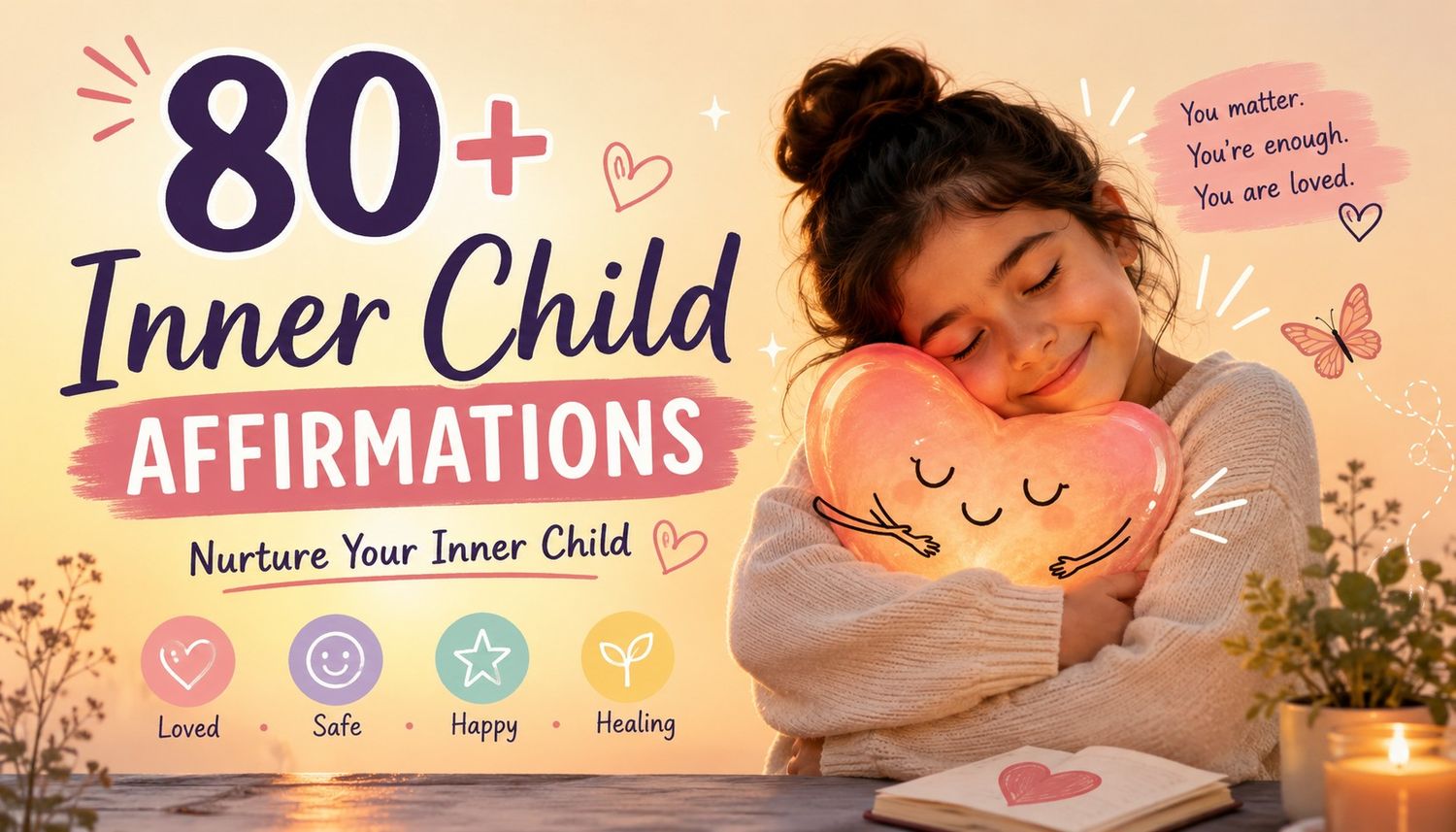
80+ Inner Child Affirmations
Safety and Belonging
- I am safe right now, in this moment, in this body.
- I belong here.
- I am allowed to take up space.
- I am welcome exactly as I am.
- Home is something I carry inside me now.
- I am protected and I am loved.
- The world is safer than the scared part of me believes.
- I do not have to earn my place in any room.
- I am safe to be seen.
- I am surrounded by more goodness than I sometimes let myself notice.
Love and Worthiness
- I am worthy of love without having to do anything to get it.
- I am lovable. I have always been lovable.
- Love does not have to be earned. I know this now.
- I deserve warmth, kindness, and genuine care.
- I am enough, exactly as I currently am.
- I receive love easily and without suspicion.
- I am worthy of people who show up for me.
- The love I needed as a child is something I can give to myself now.
- I am someone worth choosing.
- I matter. My feelings matter. My presence matters.
Forgiveness and Release
- I release the weight of things that were never mine to carry.
- I forgive myself for the ways I coped when I did not know better.
- I am allowed to put down what I have been holding for a long time.
- What happened to me as a child was not my fault.
- I am no longer defined by what I survived.
- I release the belief that I am broken.
- I let go of guilt that does not belong to me.
- I am free to move forward with lightness.
- The past is behind me and it does not control my present.
- I give myself permission to heal at my own pace.
Self-Compassion
- I speak to myself with the kindness I deserved all along.
- I am gentle with myself, especially on hard days.
- I comfort myself the way a loving parent would.
- I do not have to be perfect to be worthy of care.
- My emotions are valid and they are welcome here.
- I allow myself to feel without judging what comes up.
- I am patient with the parts of me that are still learning.
- I hold myself with softness when things feel hard.
- I am on my own side.
- Crying is allowed. Resting is allowed. Being human is allowed.
Trust and Security
- I trust myself to handle what comes.
- I am building a relationship with myself I can rely on.
- My instincts are trustworthy and I listen to them.
- I am learning to feel safe in my own company.
- I trust that I will be okay, even when I am unsure how.
- I am consistent for myself in the ways others were not always consistent for me.
- I keep the promises I make to myself.
- I am someone I can count on.
- Security is something I build from within.
- I come back to myself, every time.
Joy and Playfulness
- I am allowed to feel joy without waiting for the other shoe to drop.
- Delight is something I deserve to experience freely.
- I make room in my life for things that feel genuinely good.
- I play, rest, and create without needing a reason.
- The lighthearted part of me is welcome here.
- I laugh easily and I mean it.
- Fun is not frivolous. Fun is part of how I heal.
- I reconnect with wonder and curiosity every day.
- My inner child and I do things just because we enjoy them.
- Life can feel good and I let it.
Identity and Self-Worth
- I am more than what happened to me.
- My worth is not determined by anyone's past opinion of me.
- I am allowed to have needs and to voice them.
- I am becoming someone who treats myself the way I deserved to be treated.
- I am whole, even in the parts that are still healing.
- I am not what I were told I was by people who were hurting too.
- I define who I am now.
- I am proud of how far I have come.
- I am someone with depth, softness, and quiet strength.
- My story is mine and I get to decide what it means.
Re-parenting and Inner Connection
- I am here for you, little one. I will not leave.
- You did the best you could with what you had, and so did I.
- I see you. I hear you. You are not invisible anymore.
- I am the safe adult you always needed.
- You do not have to perform or shrink or disappear here.
- I will take care of us now.
- We are healing together, gently and without rush.
- You were always worth fighting for. I know that now.
- I am sorry for the times I abandoned myself. I am back.
- We are going to be okay. We already are becoming okay.
Becoming and Growing Forward
- I am allowed to outgrow the version of me that was just surviving.
- I carry my past with compassion, not shame.
- I am healing in ways I cannot always see yet.
- The love I give myself today rewrites what I learned yesterday.
- I am not behind. I am exactly where my healing needs me to be.
- I choose myself, again and again, for as long as it takes.
- I am both the child who was hurt and the adult who heals them.
- Growing feels safe to me now.
- I am becoming someone my younger self would feel safe with.
- I am proud of every small step I take toward myself.
How to Get the Best Results With These Affirmations
Reading these once and feeling moved is a start. But if you want them to do something lasting, there is an honest conversation worth having about why affirmations alone, even powerful ones, are often not enough to complete the work.
The reason most affirmations stall is not that they are poorly written or said without sincerity. It is that they are delivered to the wrong audience. During the day, when your conscious mind is active and alert, it is also running its most familiar job: protecting the identity it already knows. You say "I am worthy of love" and somewhere underneath, a quieter voice runs a quick audit against everything stored in memory that says otherwise. That contrast creates friction. The pattern interrupt that affirmations are supposed to create gets absorbed by the very belief system they are trying to shift.
The conscious mind is not where the old programs live. The beliefs installed in childhood, the ones this article is directly addressing, were written into the subconscious long before your conscious reasoning was developed enough to question them. They sit below the level of language, closer to feeling than thought, operating as automatic responses rather than conscious decisions. This is why you can logically know you are worthy of love and still flinch when someone gets close. Secondary gain keeps the old pattern in place — some part of the system learned, early on, that staying small was a form of safety. Logic does not overwrite that. Repetition at the right depth does.
The subconscious mind is most accessible in specific windows — when you are deeply relaxed, in a meditative state, or in the natural drift just before sleep. In these moments, the critical filter quiets and the inner world becomes genuinely receptive to new input. This is the window subliminal audio is designed to reach. Your inner child affirmations, layered beneath calming sound at a level that bypasses the analytical filter entirely, reach the subconscious layer directly. No resistance. No comparison. Just consistent, gentle, repeated contact with a new story about who you are and what you deserve.
The limitation with most subliminals available on YouTube is that the script is invisible to you. You have no way of knowing whether the affirmations inside match your specific wounds, your specific language, or your specific healing intention. Inner child work is deeply personal. A generic healing track written for a mass audience carries generic affirmations that may not speak to what your particular inner child actually needs to hear.
A personalized subliminal changes this entirely. InnerBloom lets you describe your specific intention, the wounds you are working with, the version of yourself you are calling back, and generates a complete personalized affirmation script around exactly that. Add the lines from this list that landed hardest. Choose a calming voice and a background sound that genuinely relaxes you, and download a lossless .WAV file in minutes. No compression, no unknown scripts, no guesswork about what is reaching the deepest layer of your inner world while you sleep.

Build Your Custom Subliminal
Stop relying on generic YouTube audios. Join InnerBloom AI today to effortlessly turn your favorite affirmations into a personalized, highly effective subliminal track.
Explore Now ✨Play it as you fall asleep. Your subconscious is processing every night regardless. This is simply choosing what it receives.
Practical Habits That Support Your Inner Child Work
Write a letter to your younger self once a week. Not a polished, edited letter. A raw one. Tell them what you wish someone had said. Tell them what you know now that you wish you had known then. The act of writing from your present self to your past self is one of the most effective reframing techniques in inner child practice, and it creates a felt experience of the protective, loving adult presence your inner child can begin to trust.
Notice your emotional triggers and get curious about their origin. When something small produces a response that feels disproportionately large — a critical comment that sends you spiraling, a cancelled plan that feels like abandonment, someone's silence that fills with dread — that is usually the inner child responding, not the adult. Instead of managing the reaction, get curious about it. "What age does this feel like? What situation does this remind me of?" This is a simple form of timeline therapy, tracing present-day responses back to their original context so they can be updated rather than endlessly managed.
Practice anchoring moments of safety in the body. When you feel genuinely calm, safe, or loved, take 10 seconds to consciously notice the physical sensations of that state. Where do you feel it? What does it actually feel like in your chest, your shoulders, your breath? Touch a specific point on your hand or wrist while you feel it. Done consistently, this creates a physical anchor for safety that you can access when the inner child is activated and your nervous system is searching for evidence that the present moment is not the past.
Give yourself permission to need comfort, not just solutions. Many people with wounded inner children learned to become extremely competent, because competence felt safer than vulnerability. When something difficult happens, the first instinct is to fix it, manage it, or push through. Practice the pause instead — before fixing, ask yourself: "Do I need to be held in this right now, even just by myself?" Sitting with a difficult feeling for five minutes, with a hand on your heart and a steady breath, is a form of self-parenting that the inner child registers as genuine care.
Create one small ritual that is purely for joy. Not productive joy. Not self-improvement joy. Simply something the child version of you would have loved. Colouring, dancing in your kitchen, watching a comfort film, eating something purely because it is delicious. The state management value of regular, uncomplicated pleasure in an adult life is routinely underestimated in healing conversations. Joy is not a reward for finishing the healing. It is part of the healing itself.
Speak to yourself with a different tone when you make mistakes. The most immediate and most accessible form of re-parenting is the quality of your internal dialogue when things go wrong. Notice the meta-model violations in your own self-talk: "I always mess things up," "I am so stupid," "of course this happened to me." These are distortions, and they are also the voice of old conditioning replaying itself. Practice the calibration of replacing that voice, not with forced positivity, but with the tone of a patient, loving adult who understands that you are doing your best and that making mistakes is part of being human.
The Bottom Line
Your inner child is not a wound to be fixed. They are a part of you that learned to survive under circumstances they did not choose and did not deserve. What they need from you now is not therapy, not analysis, and not more years of working it out. They need presence. They need consistency. They need to hear, again and again, in the voice of the adult you have become: I see you. I am here. You are safe now.
These affirmations are one way to say that. A personalized subliminal playing as you fall asleep is another — quieter, deeper, reaching the layer where the child version of you actually lives and where the real update can be written.
The parts integration that inner child work is ultimately moving toward — the moment when the wounded younger self and the capable adult self stop operating separately and start moving as one — does not happen in a single breakthrough. It happens in the accumulation of small, consistent moments where you choose yourself. Where you speak kindly. Where you stay.
This is one of those moments. Keep going.
Disclaimer: This article is for informational and personal development purposes only. The affirmations, practices, and NLP-referenced techniques described (including anchoring, reframing, parts integration, timeline therapy, state management, calibration, secondary gain, pattern interrupt, meta-model, submodalities, and internal representation) are presented as popular personal development and self-improvement frameworks and are not presented as clinical interventions, therapy, or scientifically proven treatments. No specific psychological, emotional, or therapeutic outcomes are guaranteed or implied. Inner child affirmations and subliminal audio are mindset tools, not substitutes for professional mental health support. If you are working through significant childhood trauma, grief, or mental health challenges, working with a qualified therapist or counselor is strongly recommended. InnerBloom Subliminal Maker is a personal development tool and does not provide medical, psychological, or therapeutic services. Individual experiences vary and no outcomes are guaranteed.
Found this helpful? Share it with someone who needs it 💜