You lay down to do your SATS practice with every intention of holding the scene. You picture it clearly for the first thirty seconds — vivid, first-person, exactly as you want it. And then somewhere between the second and third loop, your mind goes quiet in the wrong way. Not the drowsy, receptive quiet SATS is supposed to produce. The kind where you simply wake up the next morning, scene half-finished, wondering whether any of it landed before you were fully asleep.
If that is a familiar frustration, you are not doing SATS wrong. You have run directly into the single most discussed problem in the entire Neville Goddard and law of assumption community: SATS asks you to get drowsy enough for the conscious mind to step aside, without getting so drowsy that you lose the scene entirely before it has had time to register. That is a genuinely narrow window, and almost everyone who tries this technique loses it more nights than they hold it.
This is the complete SATS Neville Goddard guide — what State Akin to Sleep actually is, why Neville Goddard considered it one of the most direct techniques in the entire law of assumption framework, exactly how to practice it correctly, why so many people fall asleep before finishing it, and what to do about that specific problem so your practice actually reaches the layer it is meant to reach.
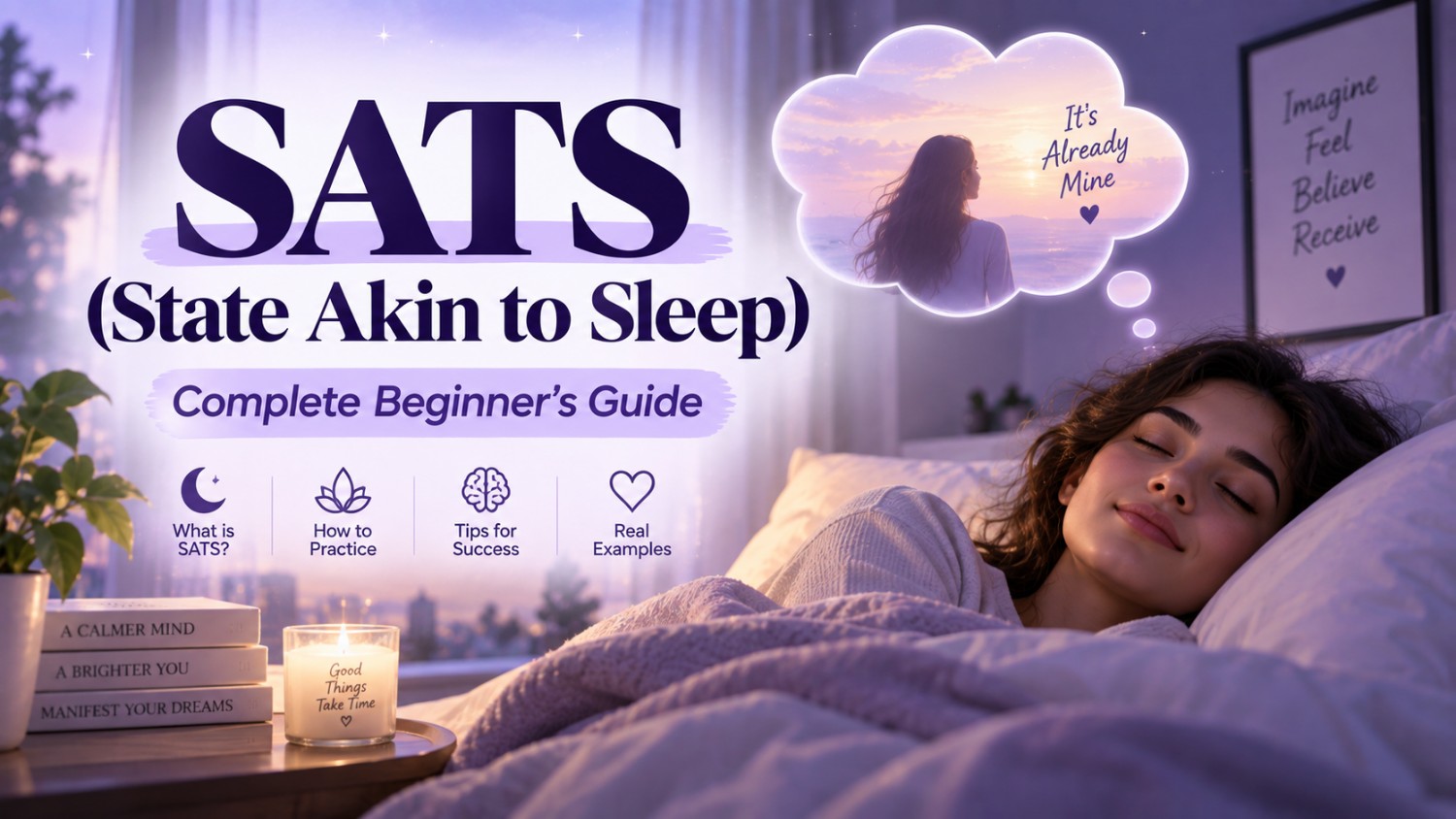
What SATS (State Akin to Sleep) Actually Is
SATS stands for State Akin to Sleep — a term Neville Goddard used to describe the drowsy, half-awake state that sits just before true sleep. In that window, the analytical, critical, defended part of the conscious mind quiets down, while the subconscious mind stays receptive. According to Neville Goddard's teaching, this state is the most fertile ground available for planting a new assumption, because the very part of the mind that normally argues with a desired scene — the part that says "but this is not true yet" — is the part that goes quiet first.
The technique itself is simple to describe and genuinely difficult to execute consistently: as you lie down to sleep, you construct one short, vivid, first-person scene that implies your desire is already fulfilled, and you loop that scene gently in your imagination as you drift toward sleep, allowing the feeling of the wish fulfilled to carry you the rest of the way into rest.
This is different from a general visualization or vision-boarding exercise. SATS is specifically anchored to the physiological transition into sleep, because that transition is what does the actual work of lowering the conscious mind's resistance. Neville Goddard consistently taught that the assumption held right at the edge of sleep is the one most likely to be accepted by the deeper mind as true — which is exactly why this single technique shows up as the foundation underneath nearly every other law of assumption practice, from manifesting a specific person to manifesting a career shift to reshaping a limiting self-concept.
Why SATS Is Considered the Core Neville Goddard Technique
Ask anyone active in the law of assumption or r/NevilleGoddard community which technique they were taught first, and SATS is almost always the answer. It is treated as the foundational skill everything else builds on top of, for a specific reason: unlike scripting, which works primarily on the conscious mind, or affirmations, which require sustained daytime repetition, SATS delivers the desired assumption directly to the subconscious in the one window each day when that layer is naturally most open.
The scene you choose for SATS should be small, specific, and sensory — not a sweeping movie of your entire future, but one contained moment that could only exist if your desire were already real. Feeling a ring on your finger. Hearing a specific voice say a specific sentence. Seeing a number on a screen. The smaller and more concrete the scene, the easier it is to hold and re-enter as drowsiness sets in, and the more convincing it becomes to a subconscious mind that responds far more to felt detail than to abstract wishing.
The Real Problem: Falling Asleep Before the Scene Registers
Here is the part most SATS guides skip past, and the part almost everyone practicing this technique actually struggles with: falling asleep too quickly.
SATS depends on holding a scene in that narrow, drowsy, pre-sleep window long enough for the feeling of the wish fulfilled to genuinely settle in — not for two seconds before your mind goes fully dark. But that exact drowsy state is, by definition, right next to actual sleep, and most people practicing SATS at the end of a long day fall straight through the window they are trying to work in. One loop of the scene, maybe two, and then nothing until morning.
This shows up constantly in discussions across the manifestation and law of assumption community: people report starting their scene with real intention, only to wake up hours later with no memory of finishing it, wondering whether the practice even counted. Others report the opposite problem — staying alert enough to hold the scene clearly, but never actually reaching the receptive, defended-mind-quiet state SATS depends on, because they never relaxed enough to get there in the first place.
Both problems point to the same underlying tension: SATS asks you to walk a very specific line, tired enough to bypass resistance, awake enough to hold the assumption — and most nights, without some kind of structure, you overshoot in one direction or the other.
How to Practice SATS the Right Way, Step by Step
Step 1: Choose one small, specific scene. Not your whole future. One moment. The physical sensation, the sound, the sight that would only be true if your desire were already fulfilled. Keep it simple enough to re-enter quickly if your attention drifts.
Step 2: Get physically comfortable and let your body settle first. SATS is not something you force. Lie down the way you normally would to sleep, breathe slowly, and let your body begin its natural wind-down before you start actively working the scene.
Step 3: Enter the scene in first person, not as an observer. You are not watching yourself receive the good news. You are inside the moment, feeling it directly — the ring on your finger, not a picture of a ring. This first-person, sensory detail is what Neville Goddard repeatedly emphasized as the difference between a technique that works and one that stays purely conscious and surface-level.
Step 4: Loop the scene gently, without straining. Let the same small moment repeat, softly, rather than constructing a long, evolving story. The repetition itself is part of what settles the assumption in — a looped scene is easier to sustain into drowsiness than a scene that keeps demanding new conscious effort to build.
Step 5: Let sleep take you from inside the scene, not after it. The goal is not to finish the scene and then fall asleep separately. The goal is to still be inside the felt sense of the wish fulfilled at the exact moment sleep arrives, so the assumption is the last thing the conscious mind hands off to the subconscious.
Common SATS Mistakes That Make This Harder Than It Needs to Be
Building a scene that is too long or too complex. An elaborate, multi-part scene requires ongoing conscious effort to construct, which fights against the very drowsiness SATS depends on. Simpler holds longer.
Practicing SATS wide awake, early in the evening. Without genuine physical drowsiness already present, the conscious, analytical mind stays fully online, and the practice becomes closer to a normal visualization exercise than true SATS.
Trying too hard to "feel" the scene. Straining for an emotional reaction often produces the opposite of the relaxed, settled state SATS requires. The feeling of the wish fulfilled tends to arrive more easily when you stop reaching for it and simply rest inside the scene.
Giving up after one inconsistent night. Some nights you will hold the scene clearly for several minutes. Other nights you will lose it after ten seconds. Both are normal parts of this practice, and the law of assumption community consistently frames consistency over time, not a perfect single session, as what actually shifts the underlying assumption.
Why Falling Asleep Too Fast Undoes the Point of the Practice
This is worth sitting with directly, because it is the exact reason so many people feel like SATS "isn't working" for them. The entire mechanism behind the technique depends on the scene being held, however briefly, inside that narrow drowsy window — not simply intended and then lost the moment real sleep begins. A scene abandoned after two seconds because sleep arrived too fast has not had the chance to do the specific work SATS is built around, according to how the technique is described throughout the manifestation community.
This does not mean the practice failed, or that manifestation itself does not work — plenty of practitioners describe partial or inconsistent SATS sessions still contributing to a gradual shift over time, especially when paired with a daytime mental diet and consistent affirmation practice. But it does mean the version of SATS most people are actually managing to complete most nights, cut short by sleep arriving too quickly, is a thinner version of the technique than the one Neville Goddard originally described.
How a Custom Subliminal Helps You Hold the Scene Without Needing to Stay Awake
This is exactly the gap a personalized subliminal is built to close, and it is worth understanding mechanically rather than mystically. SATS depends on your chosen scene, or the affirmations that carry the same assumption, being present in that pre-sleep and early-sleep window. The problem is that once you are unconscious, you cannot keep constructing that scene yourself. A subliminal can.
A personalized subliminal — your exact SATS affirmations or inner-conversation script, layered beneath a calming background sound — keeps playing after your conscious mind has let go of the scene. It functions as an audio anchor: something external carrying the same assumption you were holding internally, so the moment your own visualization drifts because sleep has arrived, the subliminal is still delivering the identical assumption directly into the exact receptive window SATS is designed to use. You do not need to stay awake to keep working the scene, because the track keeps the scene going for you.
This is why so many in the law of assumption and subliminal community pair the two practices rather than treating them as separate techniques. You do the active SATS work consciously — building the scene, entering it in first person, feeling it as real — for as long as you can hold it. And the subliminal picks up exactly where your conscious effort naturally ends, carrying the same affirmations through the rest of the night rather than leaving eight hours of sleep completely unguided.
With InnerBloom subliminal maker, you describe the exact scene, the specific words, and the desired state your SATS practice is built around, and the platform generates a personalized affirmation script matched to that exact assumption — not a generic subliminal with unrelated wording. You review every line, choose a calming background sound, and download a lossless WAV file you can play as you begin your SATS session, so the same scene you are holding consciously is still being reinforced acoustically long after your own visualization has given way to sleep.
Create Your SATS Nightly Subliminal
Hold your desired scene effortlessly through the twilight state. Create your custom subliminal in two minutes to claim your fulfilled reality.
Create My Subliminal ✨A Simple Nightly SATS Routine
Before bed: Choose your one specific scene and, if you are using one, start your personalized subliminal playing softly as you settle in.
As you lie down: Let your body relax fully before actively working the scene — SATS is not meant to start the moment your head hits the pillow.
Entering SATS: Build your scene in first person, feel it as though it is already true, and loop it gently rather than constructing something new each time.
As drowsiness increases: Let the scene simplify naturally. This is normal — a shorter, quieter version of the same feeling is still doing the work, according to how this stage is typically described in the community.
As sleep arrives: Let go of active construction and allow the subliminal, if you are using one, to carry the same assumption through the transition into deeper sleep, rather than trying to force yourself to stay conscious longer than your body is ready for.
Frequently Asked Questions
What does SATS mean in Neville Goddard's teaching?
SATS stands for State Akin to Sleep — the drowsy, relaxed state just before true sleep, where Neville Goddard taught that the conscious, analytical mind quiets and the subconscious becomes most receptive to a new assumption. It is considered one of the foundational techniques in the law of assumption framework.
Why do I keep falling asleep before finishing my SATS practice?
This is extremely common and is widely discussed throughout the manifestation and law of assumption community. SATS intentionally works in the narrow window right before sleep, which means overshooting into full sleep before the scene has settled in is one of the most frequent obstacles people run into with this specific technique.
Is it bad if I fall asleep during SATS?
Falling asleep is technically the intended endpoint of the practice — the goal is to fall asleep from inside the scene. The issue is falling asleep too abruptly, before the scene has had time to genuinely settle, rather than falling asleep gradually while still holding the felt sense of the wish fulfilled.
How long should a SATS session last?
There is no fixed rule, and sessions vary night to night depending on how quickly drowsiness sets in. Many practitioners describe anywhere from a few minutes to fifteen minutes of active scene-holding before sleep takes over, with consistency over many nights mattering more than the exact length of any single session.
Can a subliminal replace SATS entirely?
Most people in the community treat a subliminal as a complement to active SATS practice rather than a replacement for it — the conscious, first-person scene work is considered a core part of the technique itself. A subliminal is most useful for the specific gap SATS creates: continuing the same assumption through the hours after your own conscious visualization naturally gives way to sleep.
What is the best type of scene to use for SATS?
Neville Goddard consistently emphasized small, specific, sensory scenes over long or elaborate ones — a single moment, felt in first person, that could only be true if the desire were already fulfilled. A scene that is simple enough to hold and quickly re-enter tends to be easier to sustain into the drowsy SATS window than a long, evolving story.
The Bottom Line
SATS is widely regarded as the single most important technique in the entire Neville Goddard and law of assumption framework, and also, according to nearly everyone who has actually tried to practice it consistently, one of the hardest to execute the way it was originally taught. The window it depends on is narrow by design, and falling asleep before the scene has settled in is less a personal failure and more the single most common obstacle this specific technique presents.
Build your scene small and specific. Practice entering it in first person, gently, without straining. And when your own conscious effort naturally gives way to sleep, let something continue the work you started — whether that is simply trusting the process, or reinforcing the same exact assumption with a personalized subliminal built to carry it the rest of the way through the night.
Disclaimer: This article is for informational and personal development purposes only. The SATS technique and other practices described are mindset and self-concept tools used in the law of assumption and manifestation community and are not presented as scientifically proven methods. No specific outcomes are guaranteed or implied. Individual results and experiences vary. This content does not constitute medical or sleep-health advice; if you have concerns about your sleep, please consult a qualified professional. InnerBloom Subliminal Maker is a personal development tool, not a medical or therapeutic service.
Found this helpful? Share it with someone who needs it 💜