You know what you want. You just do not know how to say it in a way your subconscious will actually believe.
That gap is where most people get stuck. You have spent months listening to other people's subliminals. At some point you realised that someone else's desired face is not your desired face.
Someone else's confidence affirmations do not describe the version of you that you actually see in your mind. You opened a blank document, ready to write your own subliminal affirmations, and froze.
Nobody ever gave you the real rules.
Here is what most guides on how to write affirmations for subliminals miss: affirmation writing is not one thing. There are multiple types of subliminal affirmations, each working differently, each more powerful in specific situations. First person. Second person. Third person. Exaggerated. Past perfect.
Present continuous. Why-based. Every one of these reaches the subconscious mind through a slightly different door — and knowing which door to use, and when, is the difference between a subliminal script that produces results and a list of sentences you repeat until you give up.
By the end of this guide, you will know every major subliminal affirmation type, understand when each one is most powerful, see real examples of all of them, and be able to write a complete subliminal script from scratch. Let's get into it.
Why the Way You Write Subliminal Affirmations Actually Matters
Most people assume that if the intention is right, the exact wording does not matter much. This is the single most common reason subliminal scripts underperform.
The subconscious mind does not process language the way the conscious mind does. It responds to certain structures differently. It receives some framings more easily than others. A poorly worded affirmation does not just underperform — it can create resistance at the exact layer you are trying to reach. Understanding how to write affirmations for subliminals correctly is the difference between a script your subconscious absorbs and one it quietly rejects.
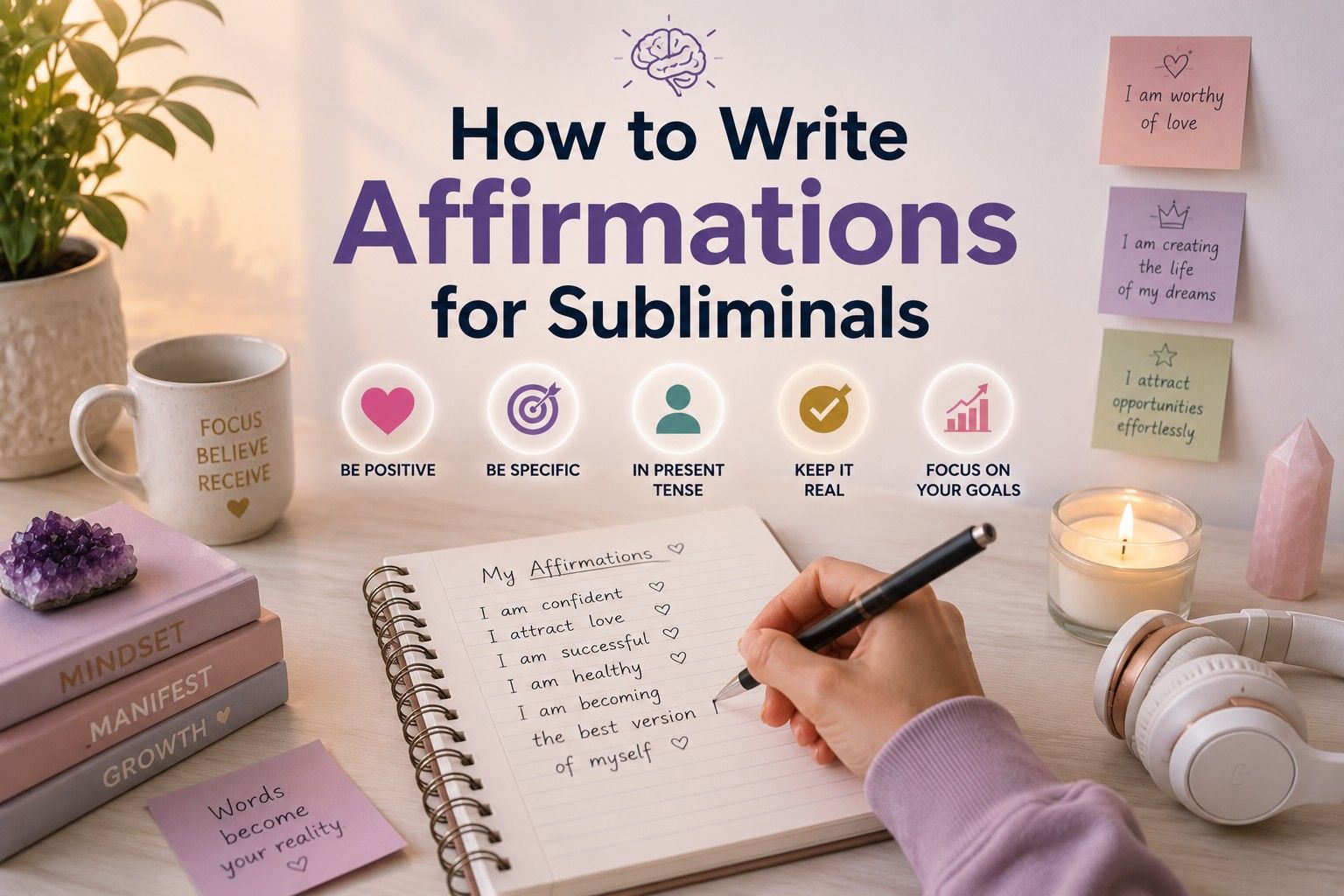
Before you learn the individual types, three principles apply to every subliminal affirmation you will ever write, regardless of style.
Principle 1: Always present tense, never future tense. "I will be confident" is a future statement. It tells the subconscious that confidence is coming but not here yet — and the subconscious files it exactly that way. "I am confident" places the identity in the present. The subconscious accepts what it is told about right now far more readily than what it is promised about later. This is non-negotiable when writing affirmations for subliminals.
Principle 2: No negatives, ever. The subconscious does not process the word "not." When you write "I am not insecure," the subconscious hears "insecure" and files that as the signal. Reframe everything positively. "I am not anxious" becomes "I am calm." "I do not feel ugly" becomes "I am radiant and beautiful." Every word in your subliminal script should describe what you want — never what you are moving away from.
Principle 3: Specificity beats generality. "I am beautiful" is a seed. "I have a defined jawline, clear glowing skin, and bright captivating eyes" is a garden. Generic subliminal affirmations produce generic results. The more precisely your script describes your desired reality, the more precisely your subconscious knows what to work toward. This is the single biggest advantage of writing your own subliminal affirmations over using a YouTube subliminal — you can be as specific as you want.
Your subconscious does not evaluate whether something is true. It simply accepts what it hears repeatedly and clearly. Give it a clear picture and it will work toward that picture every night while you sleep.
Type 1: First-Person Subliminal Affirmations — The Identity Foundation
First-person subliminal affirmations use "I am," "I have," "I feel," "I look." These are identity declarations delivered directly from you about yourself. This is the most foundational affirmation type and the one most people start with when learning how to write subliminal affirmations, because it feels the most natural.
Why it works: First-person statements are identity declarations. When the subconscious receives "I am" repeatedly, it begins to accept that identity as its baseline truth. This is the foundation of Neville Goddard's work on self-concept. The "I AM" is the creative power — what you attach to it becomes your subconscious self-image.
Best for: Self-concept work, appearance goals, confidence, abundance, and any area where you are claiming a new identity.
Examples for your subliminal script:
- Generic: "I am beautiful."
- Specific and powerful: "I am effortlessly beautiful. My face is symmetrical, clear, and naturally glowing. I am the most radiant version of myself."
- Self-concept: "I am deeply loved. I am chosen. I am someone who receives love easily and naturally."
- Abundance: "I am wealthy. Money flows to me consistently and easily. I have more than enough."
The believability principle is the key to writing first-person subliminal affirmations that land rather than bounce. "I am the most beautiful person on earth" creates conscious resistance for most people. "I am becoming more beautiful every day" is a believable stretch — close enough to current reality to slide past the conscious gatekeeper and far enough to move the needle.
This is one of the most important concepts in how to write affirmations for subliminals. The goal is not to write the most extreme claim possible. It is to write the most powerful claim your subconscious will accept without immediately arguing back.
Type 2: Second-Person Subliminal Affirmations — The Outer Voice
Second-person subliminal affirmations use "you" instead of "I," as if someone else is speaking directly to you. "You are beautiful." "You are magnetic." "You are deeply loved and chosen." This is the style used by many of the most popular subliminal creators in the community — and there is a real reason for it.
Why it works: The subconscious is conditioned from childhood to receive and trust statements that come from outside itself. Parents, teachers, authority figures. The instructions we absorbed most deeply as children arrived in second person. When subliminal affirmations arrive in second person, they land with that same external-authority energy. There is less internal debate because the statement sounds like it is coming from someone who already knows.
Best for: Appearance goals, self-concept, SP (specific person) work, confidence. Especially effective in the pre-sleep SATS window when the subconscious is highly receptive and the analytical conscious mind is quieting.
Examples for your subliminal script:
- Appearance: "You are stunning. Your face is symmetrical and glowing. Everyone who sees you notices your beauty immediately."
- Confidence: "You walk into every room with magnetic presence. People are drawn to your energy."
- SP work: "You are deeply loved by your specific person. They think about you constantly. They feel completely drawn to you."
Second-person subliminal affirmations are the community's preferred style for SP work specifically. The "you" framing reinforces the assumption that you are someone who is already loved and chosen, without the internal resistance that "I" statements sometimes create when the belief gap is large.
Type 3: Third-Person Subliminal Affirmations — The "Talking About You" Technique
Third-person subliminal affirmations refer to you by name or as "she/he/they," as if someone is describing you from the outside. "[Your name] is effortlessly beautiful." "She wakes up every day glowing and confident." "Everyone who meets her is immediately struck by her natural magnetism."
Why it works: Research in self-talk consistently finds that people who address themselves in second or third person experience less internal resistance than those who use first person. By creating a small psychological distance between "me right now" and the person being described, the subconscious can accept the description without triggering the identity gatekeeper. It is not arguing with who you are. It is simply describing someone. The subconscious gradually closes the gap between "that person being described" and the self-concept it currently holds.
Best for: People with strong conscious resistance to direct self-claims, deep-seated limiting beliefs, or anyone who finds first-person subliminal affirmations triggering immediate internal argument. Also excellent for desired face and physical transformation goals where the gap between current and desired reality feels wide.
Examples for your subliminal script:
- "[Name] has the most beautiful face. Her skin is clear and glowing. Her features are perfectly defined. Everyone who sees her is struck by how effortlessly stunning she is."
- "She is the kind of woman who walks into a room and changes the energy. She is magnetic, radiant, and completely comfortable in her own skin."
If "I am beautiful" consistently feels like a lie when you hear it, third person might be the door that actually opens.
Type 4: Exaggerated Subliminal Affirmations — The "Turn It Up" Technique
Exaggerated subliminal affirmations push the description beyond realistic — into the territory of "most," "everyone," "insanely," "beyond imagination." This style is extremely common in desired face and glow-up subliminal scripts. "You are the most beautiful person anyone has ever seen." "Everyone who looks at you is stunned by your perfection."
Why it works: The subconscious does not have a reality-checking function for incoming signals. It simply receives and absorbs. Exaggerated subliminal affirmations give the subconscious a very clear, very intense signal about the direction of change — more extreme than any conscious belief can argue against, because the conscious mind eventually stops trying to argue with something that extreme.
The result is often faster movement in the right direction, even if the final outcome lands somewhere between the exaggerated affirmation and current reality.
Best for: Desired face, glow-up, confidence, magnetism, and any goal where you want to move quickly and boldly. Less ideal for self-concept or relationship work where emotional believability matters more.
Examples for your subliminal script:
- "You are the most beautiful person you have ever seen in your life."
- "Everyone who looks at you is immediately struck by how insanely attractive you are."
- "Your skin is so clear, so luminous, so perfectly smooth that people assume you use a heavy filter."
- "You are so magnetic that people cannot stop thinking about you after they meet you."
One important note: exaggerated subliminal affirmations work best as a secondary layer, not your entire script. Pair them with grounded first or second-person affirmations for the most complete and balanced subliminal script.
Type 5: Past Perfect Subliminal Affirmations — The "Always Have Been" Technique
This is the most advanced subliminal affirmation type — and one of the most powerful when used correctly. Most guides on how to write affirmations for subliminals never mention it at all.
Past perfect affirmations are written as if the desired identity has always been true — as if it is your permanent, unchanging baseline, not a new belief you are trying to install. "I have always been effortlessly beautiful." "I have always attracted love easily." "I have always had clear, glowing skin." "My face has always been perfectly symmetrical."
Why it works: This is the deepest identity claim possible in subliminal script writing. It does not say "I am becoming." It says "this is who I have always been." The subconscious responds to past perfect framing by treating the belief not as a new installation but as a memory — something being recalled rather than claimed for the first time. This is Neville Goddard's revision technique applied directly to affirmation writing. You are not layering a new belief on top of an old one. You are replacing the root.
Best for: Deep-seated limiting beliefs, old identity wounds, beliefs about yourself that feel like they have been true your whole life — unworthiness, chronic insecurity, longstanding physical insecurities. Past perfect subliminal affirmations work on the root, not just the surface.
Examples for your subliminal script:
- "I have always been naturally beautiful. My features have always been perfectly defined. Clear, glowing skin has always been my natural state."
- "I have always been someone who is deeply loved and chosen."
- "Money has always come easily to me. Abundance has always been my natural state."
- "I have always walked into rooms with effortless confidence. This has always been who I am."
You are not trying to become someone new. You are remembering who you have always been underneath every limiting belief that told you otherwise.
Type 6: Present Continuous Subliminal Affirmations — The "Becoming" Bridge
Present continuous subliminal affirmations describe an ongoing process. "I am becoming more beautiful every day." "My skin is clearing and glowing more each morning." "I am growing into the most confident version of myself."
Why it works: Present continuous affirmations are the bridge between where you are and where you want to be. They acknowledge movement without requiring the subconscious to fully accept an identity that currently feels untrue. For someone with a very large belief gap — where "I am beautiful" creates strong internal resistance — "I am becoming more beautiful every day" is the believable stretch that gets through the subconscious gatekeeper.
The real answer to the "becoming vs. being" debate: use simple present ("I am") when the belief gap is moderate and you can claim the identity without strong conscious pushback. Use present continuous ("I am becoming") when the gap is large and first-person statements trigger immediate internal argument. The best subliminal scripts use both — the continuous affirmation eases the gatekeeper open, the simple present plants the final identity.
Examples for your subliminal script:
- "I am becoming more beautiful every single day. My skin is clearing and glowing more with every morning I wake up."
- "I am growing into my most confident self. My presence is becoming more magnetic with every passing week."
- "My ideal face is emerging more clearly every day. My desired features are coming in naturally and effortlessly."
Type 7: "Why" Subliminal Affirmations — The Reason That Bypasses Resistance
This is the most underused subliminal affirmation type — and one of the most powerful for breaking through belief resistance. Almost no guide on how to write affirmations for subliminals ever covers it.
"Why" affirmations, also called reason-based or "because" affirmations, attach a reason to the identity claim. "I am beautiful because my features are naturally symmetrical." "I am confident because I know my own worth deeply." "I attract love easily because I am deeply worthy of it."
Why it works: The conscious mind is a logic machine. When it hears a bare claim like "I am beautiful," it can argue. But when it hears a claim with a reason attached, the logical structure satisfies the conscious gatekeeper enough to let it through. You are not just asserting the identity — you are explaining why it is true. The subconscious receives the whole package: the identity and the evidence for it. The "because" makes the affirmation feel inevitable rather than wishful.
Best for: Any goal where the conscious mind is running strong counter-arguments. High-resistance situations like financial limiting beliefs, deep confidence issues, chronic self-doubt. Also excellent for self-concept work where the goal is to build an unshakeable internal case for the new identity.
Examples for your subliminal script:
- "I am beautiful because my features are harmonious, my skin is clear, and my presence is magnetic."
- "I am worthy of deep love because I bring warmth, loyalty, and genuine care to every relationship."
- "Money flows to me easily because I am someone who creates real value and receives real reward."
- "I am confident because I know exactly who I am and I trust myself completely."
Give your subconscious the reason and it stops looking for an argument. "Because" is one of the most quietly powerful words in a subliminal script.
How to Combine Types and Write a Complete Subliminal Script
The most powerful subliminal scripts are not written in a single affirmation type. They layer multiple types to cover the same identity from different angles — deep past-perfect roots, present identity claims, continuous movement affirmations, exaggerated direction, and reason-based reinforcement.
Each type reaches the subconscious in a slightly different way. Together, they create a complete, multidimensional subliminal signal.
The layering principle: Think of your subliminal script as building a house. Past perfect affirmations are the foundation — establishing that this identity has always been yours. First and second-person present affirmations are the walls — the main identity claim. Present continuous affirmations are the windows — acknowledging the light coming in. Exaggerated affirmations are the ceiling — reaching as high as possible in the direction of the goal. Why affirmations are the locks on every door — the reasons the whole structure holds.
Complete Sample Subliminal Script: Clear Skin and Glow-Up (30 Affirmations)
Use this as a template when writing your own subliminal affirmations — replace the specifics with your own desired reality.
Foundation: Past Perfect
- I have always had naturally clear, glowing skin.
- My features have always been perfectly symmetrical and defined.
- I have always been someone people describe as effortlessly beautiful.
- Radiant, healthy skin has always been my natural state.
Identity Core: First Person
- I am effortlessly beautiful in every light, from every angle.
- My skin is smooth, clear, and naturally luminous.
- I have a perfectly defined jawline and naturally arched, expressive brows.
- My eyes are bright, captivating, and full of life.
- I am the most beautiful version of myself right now.
- I glow. My skin reflects health, youth, and pure radiance.
Second Person Layer
- You are stunning. Everyone who looks at you is immediately drawn to how beautiful you are.
- Your skin is so clear and glowing that people ask what your skincare routine is.
- You have the kind of face that people remember long after you have left the room.
- Your beauty is effortless, natural, and completely, undeniably yours.
Third Person Anchor
- [Name] is one of those people who genuinely turns heads. Her skin is flawless. Her features are striking and perfectly balanced.
- She wakes up beautiful. The kind of natural beauty that needs no effort and no filter.
Present Continuous Bridge
- My skin is clearing and glowing more with every passing day.
- My ideal features are emerging naturally and effortlessly.
- My beauty is becoming more visible, more defined, and more radiant every morning.
- I am growing into the most glowing, magnetic version of myself.
Exaggerated Reach
- You are so beautiful it is almost unreal. Your skin is porcelain-clear, your features perfectly defined.
- Everyone who sees your face is stunned. You are that person.
- You are the most beautiful version of yourself imaginable, and it is effortless.
- Your glow is so undeniable that people assume you just came back from somewhere extraordinary.
Why Anchors
- I am beautiful because my skin is healthy, my features are harmonious, and my energy is magnetic.
- I glow because my body reflects my inner alignment — clear skin, bright eyes, and natural radiance.
- I am radiant because beauty is my natural state, not something I have to earn.
Closing Identity Statements
- I am exactly who I wanted to become. My face, my skin, my presence. All of it is mine.
- Beauty comes naturally to me. It always has.
- I look in the mirror and I love what I see. This is me.
The Resistance Test: How to Know If Your Subliminal Affirmations Will Land
Before adding any affirmation to your subliminal script, run it through the resistance test. Say it once — out loud or in your head — and notice what happens.
If it feels true, powerful, or even slightly exciting: it belongs in your subliminal script.
If it triggers immediate internal argument — "that is not true" or "yeah right" — it is too far beyond the current belief gap for that type. Do not delete the affirmation. Rewrite it. Turn it into a present continuous or past perfect version and work your way toward the direct claim over time.
"I am the most beautiful person alive" → becomes → "I have always had the kind of beauty that people notice" → becomes → "I am becoming more visibly beautiful every single day."
The resistance test is not about settling for smaller desires. It is about choosing the entry point that actually gets the signal through to your subconscious.
Words and Mistakes That Kill Subliminal Affirmations
Using future tense. "I will be confident" places the goal in an unreachable future. Always present tense, always — this is the most fundamental rule in how to write affirmations for subliminals.
Using negatives. "I am not insecure" / "I do not feel ugly" / "I no longer struggle with confidence." The subconscious ignores "not" and "no longer." Rewrite every negative as a positive.
Being vague when you could be specific. "I am pretty" when you could write "I have a defined jawline, naturally arched brows, and clear luminous skin." Specificity is the difference between a clear signal and background noise.
Affirmations that conflict with each other. Writing "I am at peace" alongside "I am obsessively focused on my goal" creates internal contradiction. Your subliminal script should feel coherent — like every affirmation describes the same person living the same reality.
Affirmations too far beyond the belief gap. Start with the believable stretch. Move toward the exaggerated subliminal affirmations as the identity installs over time.
Copying someone else's script word for word. Someone else's desired face is not your desired face. Someone else's self-concept language may not resonate with your inner voice. Your subliminal script should feel like you wrote it specifically for you — because the resonance of the language is part of what makes it work.
When You Do Not Want to Write Your Subliminal Script Yourself
Writing a complete, layered subliminal script using all seven affirmation types takes time, thought, and a genuine understanding of your own goal. Some people love this process. Others know exactly what they want and simply want the script written correctly, completely, and immediately.
That is exactly what InnerBloom was built for.
You describe your desired reality — as specifically as you want — and InnerBloom's AI generates a complete personalised subliminal affirmation script written around your exact goal. You read every line. You add anything that resonates. You remove anything that does not feel aligned. Then you choose your voice and your background sound — Gentle Rain, Ocean Waves, Forest Birds, Cozy Fireplace, or Meditation Bells — and download a lossless WAV file in minutes. No compression. No unknown scripts. Every subliminal affirmation exactly what you chose to feed your subconscious.

Create Your Custom Subliminal Audio
Skip the guesswork of scriptwriting. Create your custom subliminal audio in two minutes to safely align your subconscious mind with your exact goals.
Create My Subliminal ✨Frequently Asked Questions
What is the best way to write affirmations for subliminals?
The most effective approach is to use a combination of subliminal affirmation types — first person, second person, past perfect, and present continuous — all written in present tense, with no negative words, and specific enough to describe your exact desired reality. Layer multiple types in the same script to create a multidimensional signal that reaches the subconscious from several angles simultaneously.
Should subliminal affirmations be in first or second person?
Both work — and the best subliminal scripts use both. First-person affirmations ("I am beautiful") are powerful identity declarations. Second-person affirmations ("You are beautiful") land with an external-authority energy that reduces internal resistance. When the belief gap is large, second person often produces less pushback from the conscious mind. Most complete subliminal scripts layer both styles throughout.
Can I use negative words in subliminal affirmations?
Never. The subconscious does not process "not," "no longer," or "do not." It simply hears the word that follows. "I am not insecure" becomes "insecure" at the subconscious level. Rewrite every negative as a positive: "I am not anxious" becomes "I am calm and grounded." This is one of the most important rules in how to write affirmations for subliminals.
How long should a subliminal affirmation script be?
For a single-goal subliminal, 20 to 40 affirmations is a strong range. You want enough variety across types to create a complete signal, but not so many that the script becomes diluted or repetitive. Quality and specificity matter far more than volume when writing subliminal affirmations.
Do subliminal affirmations need to be specific?
Yes — and this is one of the most important factors in a well-written subliminal script. Generic affirmations produce a vague subconscious signal. Specific affirmations give the subconscious a precise picture to work toward. "I have a defined jawline, clear skin, and bright eyes" is dramatically more powerful than "I am attractive."
What is the difference between first-person and second-person subliminal affirmations?
First-person subliminal affirmations ("I am," "I have," "I feel") are identity declarations you make about yourself directly. Second-person affirmations ("You are," "you have") arrive as if spoken by an external voice — which can reduce internal resistance because the subconscious is conditioned to trust voices that come from outside. Both are effective and the best subliminal scripts use both throughout.
What are past perfect affirmations and why are they so powerful?
Past perfect subliminal affirmations are written as if the desired identity has always been true: "I have always been beautiful," "I have always attracted love easily." They work by framing the new belief not as something being installed but as something being remembered — which bypasses the resistance that comes from feeling like you are trying to claim something completely new. Many experienced subliminal users consider this the most powerful type for deep-seated limiting beliefs.
Can I use multiple affirmation types in one subliminal script?
Not only can you — you should. A subliminal script using only one type creates a one-dimensional signal. Layering first person, second person, past perfect, present continuous, exaggerated, and why-based affirmations creates a complete, multi-angle signal that reaches the subconscious in several ways at once. The sample script in this guide shows exactly what that looks like in practice.
How do I know if my subliminal affirmations are working?
The clearest early signs are subtle: a reduction in internal resistance when you hear the affirmations, a quiet sense that the identity is starting to feel familiar rather than foreign, small external shifts that reflect the beliefs you have been installing. Affirmations that used to trigger immediate internal argument start to pass through without pushback. That is the sign the subliminal signal is landing at the subconscious level.
The Final Word
There is no single correct way to write affirmations for subliminals. There is only your way — the specific combination of types, language, and detail that describes your desired reality so clearly that your subconscious stops looking for counter-evidence and starts working toward the picture you have given it.
You now have the complete toolkit for how to write subliminal affirmations: all seven types, when to use each one, the resistance test, the mistakes to avoid, and a complete sample script you can model. Use it to write your own script, layer your own types, and build something that is genuinely yours.
Or let InnerBloom generate it for you and go straight to the listening.
Your subconscious is not waiting for perfect affirmations. It is waiting for clear ones. Give it the picture tonight.
This article is for informational and personal development purposes only. The affirmation types and writing techniques described are based on widely shared community practices and are not presented as scientifically proven methods of psychological change. Individual results vary and no specific outcomes are guaranteed. InnerBloom Subliminal Maker is a personal development tool and does not provide medical or psychological treatment.
Found this helpful? Share it with someone who needs it 💜