You have stood in front of the mirror, looked yourself in the eye, and said "I am confident. I am beautiful. I am enough." And somewhere in the back of your mind, a quiet voice replied: "Are you though?"
That moment of internal argument is not a failure of will. It is not a sign that affirmations do not work. It is not evidence that you are broken or doing it wrong. It is the conscious mind doing exactly what it was designed to do: protect the story it already knows. And until you understand why that happens and what to do about it, you will keep running into that same ceiling, no matter how many affirmations you say or how loudly you say them.
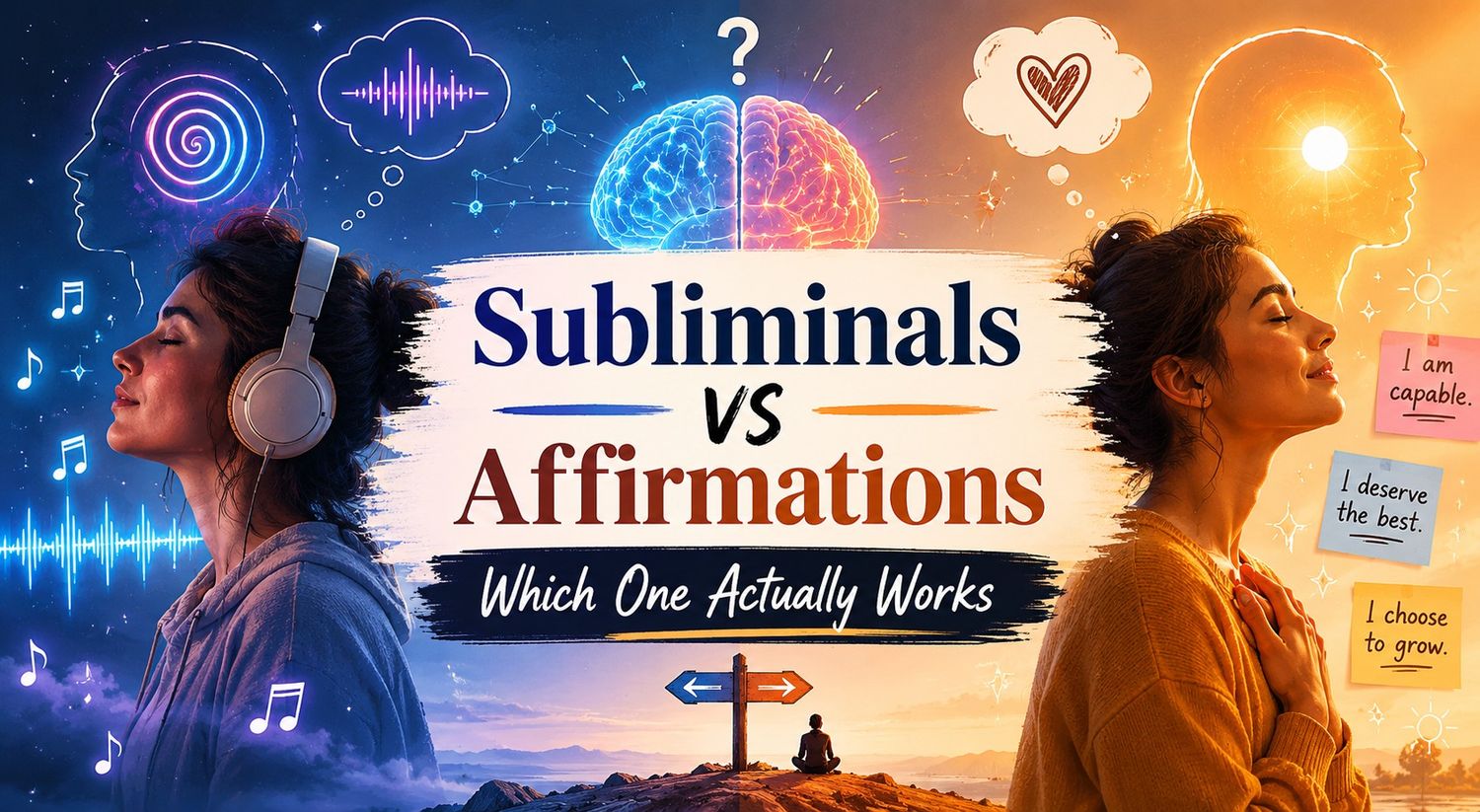
Here is what most guides on subliminals vs affirmations miss entirely: these are not competing methods. They are not alternatives where you pick one and abandon the other. They work on completely different layers of your mind, in completely different ways. The most experienced practitioners in the subliminal and manifestation community have known for years that the real power comes from using both strategically, at the right times, for the right reasons.
By the end of this article you will understand exactly what each method does, why affirmations vs subliminal audio is not really a competition, which one to use in which situation, and how to build a complete daily practice where both work together. No vague "both are great, do what feels right." The real answer.
What Affirmations Actually Are — And Why They Sometimes Feel Hollow
Affirmations are conscious, intentional statements spoken or written in the present tense: "I am confident," "I am loved," "money flows to me easily." They work by repeatedly presenting the conscious mind with a new identity statement until that statement gradually becomes the default inner voice.
The key word is gradually. Affirmations work through the conscious layer of the mind, the part that is awake, analytical, and actively engaged when you say them. And this layer has a gatekeeper.
The gatekeeper evaluates every incoming statement against what it currently believes to be true.
When an affirmation aligns with existing beliefs, like "I am a hard worker" for someone who genuinely works hard, it lands smoothly, almost invisibly. When it conflicts with existing beliefs, like "I am wealthy" for someone staring at an overdraft, the gatekeeper pushes back. Sometimes loudly. Sometimes with a full internal catalogue of evidence to the contrary.
That internal argument is not a sign of failure. It is the mechanism of the conscious mind working exactly as designed. The discomfort of saying an affirmation that feels untrue is the gap between your current self-concept and the identity you are claiming. That gap is exactly what you are closing, but it requires repetition, consistency, and enough emotional conviction to gradually wear down the gatekeeper's resistance.
What affirmations do best: Setting conscious intention for the day. Redirecting negative thought spirals in real time. Building identity through active, engaged practice. Creating the "believable stretch," which moves you incrementally toward a new self-concept rather than trying to leap across the gap in one go.
The honest limitation: Affirmations require conscious engagement, which means they require energy. On the days when you are most exhausted, most depleted, most emotionally triggered, the gatekeeper is at its strongest and affirmations meet the most resistance. The tool that requires the most from you precisely when you have the least to give has a built-in ceiling.
"Affirmations are how you talk to yourself. The question is whether the part of you that most needs to hear the message is actually listening."
What Subliminals Actually Are — And Why the Community Swears by Them
Subliminal audio contains affirmations layered beneath background sounds like rain, ocean waves, ambient music, forest, and fireplace, at a volume the conscious mind cannot clearly register. You hear the background sound. The affirmations play beneath it, below the threshold of conscious awareness.
Because the conscious mind is not actively processing the words, the gatekeeper does not engage. There is no "but that is not true." There is no internal debate. The affirmations reach the subconscious layer directly and repeatedly. That is the same layer where your actual beliefs, automatic behaviours, emotional responses, and identity programs live.
This is what the subliminal community means when they talk about bypassing resistance. It is not bypassing your ability to think. It is delivering the message at a time and in a way that the analytical filter does not intercept.
The key insight the subliminal community has long understood: the subconscious mind does not evaluate. It absorbs. It does not compare incoming messages against current evidence. It does not argue. It simply receives what it is repeatedly given, especially in relaxed, receptive states. Once a belief is installed at that level, it begins to shape everything that flows from it: your automatic thoughts, your choices, your posture, and how you move through the world.
What subliminals do best: Delivering affirmations during the highest receptivity windows, especially the period before sleep. Reaching beliefs that conscious practice alone has struggled to shift. Working completely passively with no energy required, no willpower, no engagement. Creating gradual identity-level shifts that feel less like effort and more like quietly becoming someone slightly different.
The honest limitation: Because the process is passive, you cannot confirm what script is playing in a subliminal you did not create. This is the subliminal community's most consistent and legitimate concern, and we will address it directly in a moment.
"Subliminals do not require you to believe. They only require you to listen. Night after night, while you sleep, while you rest, the new identity installs itself quietly, without argument, without resistance, without you having to do a thing."
The Real Difference — Two Doors Into the Same Room
Here is the framework that no other guide on subliminals vs affirmations has articulated clearly, and the one that will change how you think about both methods.
Imagine your mind as a building. Your subconscious is the basement: the foundation, the wiring, the infrastructure that everything else runs on. Every belief you carry about yourself, every automatic pattern, every deep identity program lives down there. Your conscious mind is the ground floor, active, busy, always on.
Affirmations knock on the front door. You ring the bell. Sometimes it opens immediately. Sometimes the gatekeeper looks through the window and asks for credentials. On a hard day, when you are tired and anxious and flooded with evidence that the old story is true, the door does not open at all.
Subliminals go through the basement window. There is no door. There is no gatekeeper. They arrive directly at the foundation where the real wiring lives, quietly, repeatedly, without needing permission.
Neither is superior. They are two different points of entry into the same architecture. Using one without the other is like renovating the ground floor while leaving the basement untouched, or rewiring the basement while the ground floor is still running the old program.
Here is how they compare directly:
Affirmations Where they work: Conscious mind How delivered: Spoken or written, fully heard Requires engagement: Yes, active repetition needed Best time to use: Morning, during the day, before high-stakes moments Meets resistance: Sometimes, especially on difficult days Speed of shift: Gradual, dependent on belief gap Requires belief: Ideally yes, believable stretch is most effective You know the script: Yes, you wrote it
Subliminals Where they work: Subconscious mind How delivered: Layered beneath sound, below conscious awareness Requires engagement: No, passive listening only Best time to use: Before sleep, during rest, low-focus tasks Meets resistance: Rarely, gatekeeper is bypassed Speed of shift: Can feel faster because resistance is lower Requires belief: No, works even without conscious belief You know the script: Only if you created it yourself
The subliminal affirmations difference is not about which is more powerful in the abstract. It is about which layer of the mind you are reaching and whether that layer is currently open or defended. When people ask "do subliminals work better than affirmations," they are asking the wrong question, because it depends entirely on which layer needs the most work right now. When people debate subliminal messages vs affirmations as if one must win, they miss the point that both are always available to you, for different jobs.
When to Use Affirmations — And When to Reach for Subliminals
This is what most people actually want to know. Here is the honest, practical answer.
Use affirmations when:
You are in a calm, grounded, energised state. This is when the conscious mind is most receptive and the gatekeeper is most likely to let the new belief in. A good morning, before the day's noise arrives, is the ideal affirmation window.
You need an immediate reset. Caught in a spiral, heading into a presentation, about to have a difficult conversation — affirmations are instant. You can redirect your inner narrative in real time, anywhere, without any setup. This is one of conscious affirmations' most powerful advantages over subliminal audio.
You are actively building a new identity through deliberate practice. Mirror work, journaling, spoken affirmations: these engage your conscious attention in a way that builds familiarity with the new self-concept over time.
You want to set conscious intention before you engage with the world. Programming your focus, your energy, and your inner story before the outside world begins to shape them.
Use subliminals when:
You are going to sleep. The hypnagogic state, the window just before sleep where your conscious resistance is at its lowest, is the most receptive window your subconscious has all day. Subliminals during this window reach deeper than almost anything else.
Your conscious practice is hitting a wall. If you have been saying affirmations consistently and the gatekeeper keeps winning, if the inner voice keeps pushing back and the belief gap feels too wide, subliminals bypass that argument entirely. You do not need to fight your way through the front door when the basement window is open.
You want to work on deep-seated beliefs passively. Patterns that have been running for years, tied to old memories and emotional experiences, live below the level that daily conscious practice quickly reaches. Subliminals work at exactly that depth.
You want your mindset work to continue during sleep. Your subconscious is processing throughout the night regardless. Subliminals give that processing intentional, aligned direction.
Which should you start with?
If you are new to mindset work, start with affirmations. Build the conscious habit first. Get familiar with the new identity through daily practice. Then add subliminals once the conscious foundation is laid.
If you have been doing affirmations and hitting a wall, the resistance is real and subliminals are the natural next step. Your conscious practice laid the groundwork. Now let the subconscious catch up.
If you want the most complete practice, use both. Affirmations by day, subliminal by night. This is the system the most experienced practitioners in the community use, and there is a reason for that. Both doors open at once.
The YouTube Subliminal Problem — Why Most People Are Not Getting the Full Benefit
This is the section the community most relates to, because most people have been through exactly this.
When you search YouTube for a subliminal, you are handed a black box. The affirmations playing beneath the audio are invisible to you. You have no idea what the script says. Some creators are careful, ethical, and deeply aligned with the community's values. Others are not. The script might include lack-based language, obsessive framing, or affirmations that have nothing to do with your actual goal. You are feeding your subconscious, during its most receptive window, content you have never read.
Beyond the script problem, YouTube compresses audio to MP4 format. This degrades the audio frequencies the subliminal is built on. What your subconscious receives is a lower-quality version of what was originally created. For something as important as subconscious reprogramming, that compression matters.
And there is the generic problem: a "confidence subliminal" written for millions of people is not written for you. Your specific blocks, your specific language, your specific desired identity — none of that is in a generic script. The most powerful subliminal you will ever use is one built around your exact goals, in your own language, with the affirmations that resonate most deeply with the shift you are trying to make.
This is exactly why the most serious subliminal practitioners in the community create their own. If you want to understand the full process of building a personalised subliminal from scratch, this guide on how to make your own subliminal audio covers every step clearly.
Can You Use Both at the Same Time?
Yes, but with one important distinction.
Saying affirmations out loud while simultaneously listening to subliminals is not recommended. The conscious engagement required for spoken affirmations — the focus, the feeling, the active attention — pulls you away from the relaxed, receptive state that makes subliminals most effective. You are working against both tools at once. Neither gets your best.
The powerful combination is sequential and time-based. It creates a complete daily practice that covers both layers of the mind.
Morning: Spoken affirmations, active and intentional, out loud or in your journal. You are setting the conscious tone for the day and building the new identity through deliberate, engaged practice.
During the day: Mental affirmations, redirecting thought patterns in real time and keeping your inner narrative aligned with the new story whenever the old one surfaces.
Evening: Transition from active practice to calm. Release the effort of the day. Wind down.
Before sleep: Subliminal audio, passive, receptive, deep. The conscious mind quiets. The subconscious opens. The new identity installs at the layer where lasting change actually lives. This is the most powerful window in the entire day, and most people are letting it pass unused.
Affirmations lay the conscious groundwork. Subliminals deepen and reinforce it at the level where the foundation is actually built. Day and night. Both doors open. This is the complete practice.
Signs Each Method Is Working
Signs your affirmations are working:
The statements start feeling less like a lie and more like something you are genuinely growing into. You catch yourself thinking in the new story without effort, automatically, without consciously choosing to. Your emotional response to challenges begins to shift; you bounce back faster and doubt gets quieter. Other people start reflecting the new identity back to you in small ways, in how they treat you and what they say. The affirmations you once had to force start feeling almost obvious.
Signs your subliminals are working:
You notice internal shifts before you can explain them. You feel calmer, more confident, less reactive, and are not entirely sure why. Dreams begin reflecting the new identity or desired reality. The old thought patterns feel less automatic; there is more space between the trigger and the response, a pause where there was none before. You find yourself making choices that align with the new identity without consciously deciding to. Something in your relationship with yourself has quietly changed. You just feel different about who you are.
"The most common report from experienced subliminal users is not a dramatic moment of change. It is a quiet morning when they realise they have been thinking differently for weeks, and they cannot pinpoint exactly when it shifted. That is how deep work feels. Not like a thunderstorm. Like a tide coming in."
Common Mistakes That Limit Results From Both Methods
Using affirmations that are too far beyond current belief. Saying "I am a millionaire" when the belief gap is enormous creates more resistance than shift. The most effective affirmations are a genuine stretch: far enough to move the self-concept, close enough that some part of you can actually accept them.
Using YouTube subliminals without checking the creator's transparency. If you cannot read the script, you do not know what your subconscious is receiving. This is not a small problem during the most receptive window of your day.
Expecting subliminals to work without any conscious engagement. The combined approach, affirmations by day and subliminal by night, is always more powerful than subliminals alone. The conscious work lays the groundwork the subliminal deepens.
Giving up on either method within 21 days. Identity shifts at the subconscious level require consistent repetition over time. Most people quit two weeks before something starts to move.
The Complete Nightly Practice — Where Both Methods Come Together
Every method in this guide converges on the same insight: the most powerful window available to any mindset practitioner is the ten to fifteen minutes before sleep.
This is what Neville Goddard called the Nativity, the hypnagogic threshold where conscious resistance is at its lowest and subconscious receptivity is at its highest. It is not a coincidence that every tradition of inner work returns to this window. It is the architecture of the mind.
During the day, your affirmations build the conscious story: the new identity you are choosing, the new assumptions you are installing through deliberate practice. At night, that story needs to sink all the way in, past the conscious layer, past the gatekeeper, into the foundation where lasting beliefs actually live.
This is exactly the problem that InnerBloom was built to solve.
Making your own subliminal used to mean hours of audio editing, Audacity plugins, decibel adjustments, and technical knowledge most people do not have, all to produce something that may or may not have held quality. So people defaulted to YouTube, got generic scripts and compressed audio, and wondered why the results felt incomplete.
InnerBloom removes all of that. You describe the identity shift you are working on, your specific goal in your own language, and the AI writes your personalised affirmation script. You review every single line, add anything from your conscious affirmation practice that resonates, and remove anything that does not feel aligned. Then you choose a voice and a background sound: Gentle Rain, Ocean Waves, Forest Birds, Cozy Fireplace, or Meditation Bells. Download a lossless .WAV file. No compression. No unknown scripts. No guesswork about what is reaching your subconscious at the deepest window of your day.
Your affirmations by day. Your personalised subliminal by night. Both layers of your mind working toward the same new identity. This is the complete practice, and this is how combining subliminals and affirmations produces results that neither method produces alone.
Create Your Custom Subliminal Audio
Tired of conscious resistance? Create your custom subliminal audio to safely align your subconscious mind with your desired identity while you sleep.
Create My Subliminal ✨Frequently Asked Questions
Are subliminals more effective than affirmations?
Neither is universally more effective because they work on different layers of the mind. Affirmations engage the conscious layer through active repetition. Subliminals reach the subconscious layer passively, during receptive states. The most effective practice combines both: affirmations during the day and subliminal audio before sleep. Asking which is better is like asking whether the ground floor or the basement matters more. You need both.
Can I use subliminals and affirmations together?
Yes, but sequentially rather than simultaneously. Saying affirmations while listening to subliminals works against both tools. The powerful combination is affirmations in the morning and during the day, with subliminal audio in the evening and before sleep. This is the complete daily practice that covers both the conscious and subconscious layers.
Why do my affirmations feel like they are not working?
The most common reason is conscious resistance. The gap between what you are saying and what you currently believe is large enough that the gatekeeper pushes back. This is not failure. It is the mechanism. Solutions: choose affirmations that are a genuine but believable stretch, use them during calm receptive states rather than anxious ones, and consider adding subliminal audio to work on the same beliefs at a deeper level where resistance is lower.
Do subliminals work while you sleep?
Yes, and this is one of the most widely reported findings in the subliminal community. The period before and during sleep is considered one of the most receptive states available, as conscious resistance is at its lowest. Playing a subliminal as you fall asleep delivers affirmations during the window where the subconscious is most open. Many users report their most noticeable shifts from consistent overnight subliminal practice.
How long does it take to see results from subliminals vs affirmations?
Both methods require consistent practice over time. Twenty-one days is the community's widely cited minimum, with many practitioners reporting deeper shifts at 30, 60, and 90 days. Subliminals can sometimes feel faster because they bypass conscious resistance, but individual experience varies significantly depending on the depth of the belief being shifted and the consistency of the practice.
Do subliminals require you to believe in them?
No, and this is one of the key differences between subliminals and affirmations. Affirmations are most effective when you can find at least a partially believable stretch in what you are saying. Subliminals bypass the evaluation step entirely, so they do not require conscious belief to work. The subconscious receives what it is repeatedly given regardless of what the conscious mind currently accepts.
What is the best time to say affirmations?
The most powerful times are the first ten minutes after waking, before the day's noise arrives and while your mind is still close to the receptive state of sleep, and before high-stakes moments that require a specific inner state. Avoid saying affirmations when you are highly anxious or emotionally flooded. The gatekeeper is strongest in those states and the resistance is highest.
Are subliminals just affirmations?
Yes, subliminals are affirmations delivered below the threshold of conscious awareness. The core statements are the same. The difference is entirely in the delivery method and which layer of the mind they reach. A spoken affirmation reaches the conscious mind first and must pass through the gatekeeper. A subliminal affirmation bypasses the gatekeeper and reaches the subconscious directly. Same message, different door. If you want to build a subliminal from your own affirmation practice, InnerBloom Subliminal Maker generates a personalised subliminal from your exact goals in minutes.
Can subliminals replace affirmations completely?
Not for most people, and the community generally does not recommend trying. Affirmations serve conscious functions that subliminals do not: real-time redirection of negative thought spirals, intentional identity-building through active engagement, setting the conscious tone of the day. Subliminals work best when the conscious practice has laid the groundwork they are deepening. Used together, the results are consistently stronger than either method alone.
How do I know if subliminals are working?
The signs are often subtle before they become obvious: a gradual feeling of inner calm about things that previously triggered anxiety, automatic thoughts that align with the new identity without effort, choices and behaviours that reflect the new self-concept without conscious decision. The most common report is a quiet realisation, weeks into consistent practice, that something has shifted internally and the person cannot pinpoint exactly when it happened. That slow, quiet tide is how deep subconscious work tends to feel.
The Bottom Line
Subliminals and affirmations are not competitors. They are partners, two methods designed to reach the same destination through different doors.
Affirmations speak to the conscious layer: the active, engaged, deliberate part of you that is building the new story through intention and repetition. Subliminals reach the subconscious layer, the deep quiet foundation where your actual beliefs live and where lasting change is installed.
Use affirmations to build the story consciously during the day. Use subliminals to let it sink in at night, when the conscious mind rests and the subconscious opens. Together, they cover the full architecture of the mind.
Your conscious mind has been trying to change the story. Tonight, let your subconscious join the conversation. 🌸
Disclaimer: This article is for informational and personal development purposes only. The comparisons and descriptions of affirmations and subliminal audio are based on community practices and personal development frameworks. They are not presented as scientifically proven methods of psychological change. Individual results vary and no specific outcomes are guaranteed. This content does not constitute medical or psychological advice. InnerBloom Subliminal Maker is a personal development tool and does not provide medical or psychological treatment.
Found this helpful? Share it with someone who needs it 💜