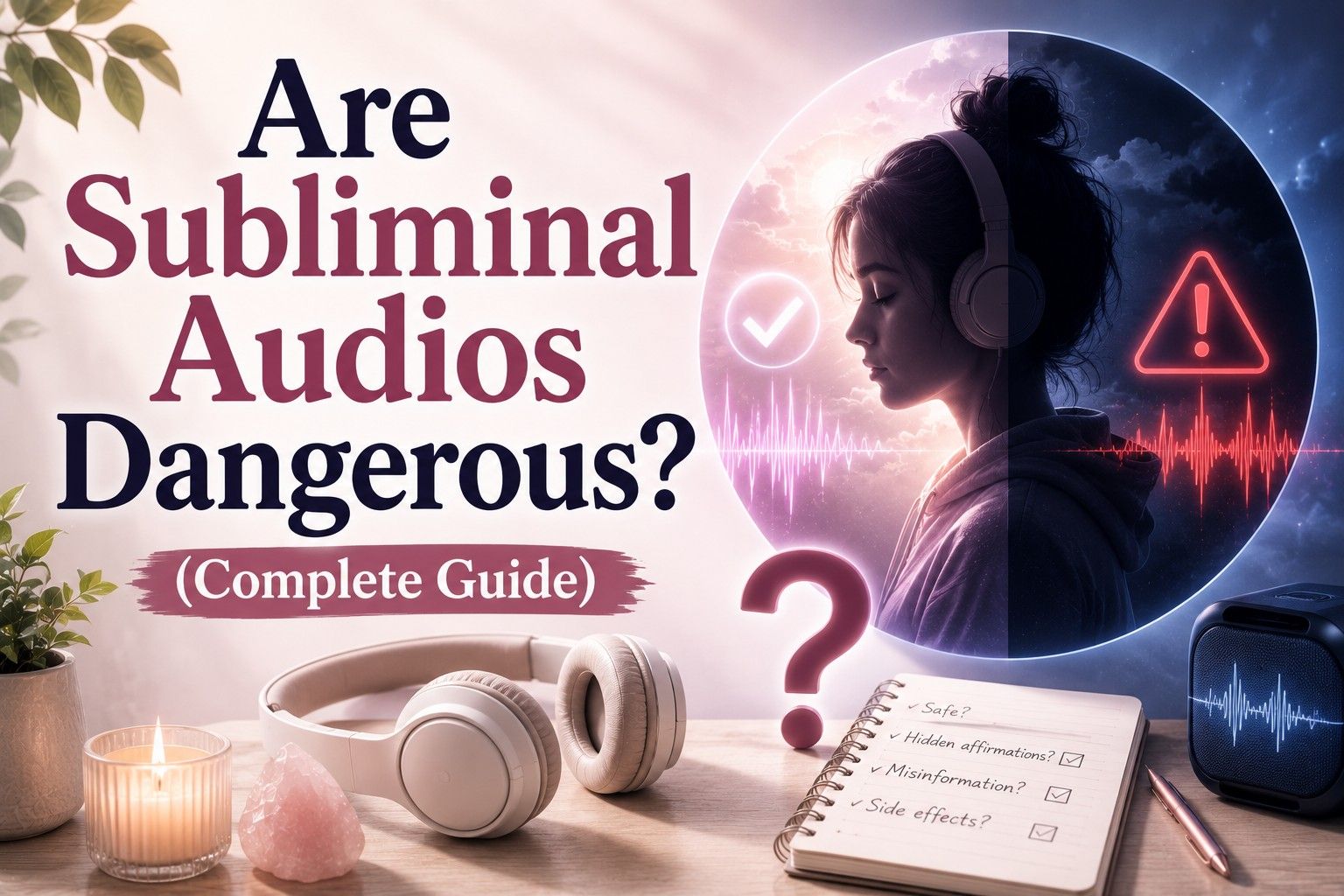
If you have spent any time in the subliminal community, you have probably asked this question at least once. Maybe a friend warned you. Maybe you came across a Reddit thread that made you uneasy. Maybe you have been listening to subliminals for a while and started wondering what is actually going into your subconscious while you sleep.
It is a completely valid question. And it deserves a straight, honest answer — not the kind that dismisses every concern to sell you something, and not the kind that catastrophises the whole practice to scare you away from it.
Here is the truth: subliminal audio as a concept is not inherently dangerous. The real question — the one that actually matters for your safety — is not whether subliminals are dangerous. It is whether you know what is inside the specific subliminal you are listening to.
That distinction is everything. And by the end of this article, you will understand exactly why.
What a Subliminal Actually Is
Before getting into what can go wrong, it helps to be clear on what a subliminal actually is — because a lot of the fear around them comes from misunderstanding the format.
A subliminal is simply affirmations recorded beneath background sounds like rain, ocean waves, music, or white noise. The affirmations are mixed at a volume low enough that your conscious mind does not clearly register them while you are listening. That is the whole product. There is no hypnotic trance, no brainwave manipulation device, no technology capable of overriding your personality or forcing you to act against your values.
At its core, a subliminal is a delivery method. What makes it worth discussing from a safety standpoint is not the format itself. It is the content inside — the affirmations you cannot clearly hear — and the fact that with most subliminals available online, you have no way to verify what that content actually is.
The Real Danger: Hidden Affirmations You Cannot Hear or Verify
This is the part of the conversation that most subliminal content glosses over. And it is the part that matters most.
When you press play on a YouTube subliminal or download a track from an unknown creator, you are agreeing to receive input directly into your subconscious — input that you cannot consciously hear, cannot independently verify, and have to take entirely on trust.
Most creators are well-intentioned. The majority of subliminals on YouTube are built by people who genuinely want to help their audience. But most is not all. And in a completely unregulated space where anyone can create and publish a subliminal in an afternoon without disclosing a single affirmation, the potential for harmful content to reach unsuspecting listeners is real.
The subliminal community itself has documented this.
The Mind Power Incident (2017) is the most widely reported case in the community's history. Mind Power was one of the most prominent subliminal channels on YouTube at the time, with a large and dedicated following. In 2017, an online petition signed by over 740 people accused the channel of embedding harmful hidden messages in its videos.
Signatories reported disturbing dreams and severe psychological distress, with some claiming they had visited the emergency room after extended listening. Mind Power was shut down in December of that year. The creator denied all allegations, and the situation remains contested — but the conversation it sparked about creator accountability and hidden content has never fully settled in the community since.
Rose Subliminals is a separate and more clear-cut case. Unlike the Mind Power situation, this was not an allegation. Rose Subliminals, another creator in the space, publicly admitted to embedding negative affirmations in her videos before closing her account. A creator confirmed they had deliberately hidden content their audience believed was positive.
These cases are not presented here as proof that every YouTube subliminal is hiding something harmful. They are presented because they illustrate a genuine structural problem: the format that makes subliminals work is the exact same thing that makes unverified content a real risk. You cannot hear what is there. You are trusting completely on faith.
Other Real Risks Worth Knowing About
Hidden affirmations are the most serious concern, but they are not the only one. Here are the other risks that come up consistently in the community and are worth understanding before you build your listening practice.
Sleep disruption from overnight listening. Playing audio all night is one of the most common ways people use subliminals — and one of the most common sources of problems that have nothing to do with the content. Running audio through the entire night can fragment your sleep architecture, leading to morning grogginess, unrefreshing rest, or unusually vivid and unsettling dreams. The fix is simple: use a sleep timer so the audio runs for 60 to 90 minutes as you fall asleep rather than playing all night.
Volume that is too high. If you can clearly make out the affirmations while you are awake, the volume is too high for safe extended listening — particularly through earbuds overnight. Subliminals are designed to be played softly. The affirmation layer should be essentially inaudible at normal listening levels. Ear fatigue, discomfort, or ringing after a session are signals to reduce the volume significantly.
Binaural beats and frequency-based side effects. Many subliminals on YouTube incorporate binaural beats or low-frequency tones alongside the affirmations, marketed as tools for deepening the subconscious state. Some listeners report headaches, dizziness, or heightened anxiety when listening to tracks that use these elements — particularly those with sensitivity to audio stimulation. If a track consistently leaves you feeling worse rather than better, the binaural component may be the issue even if the affirmations themselves are fine.
Psychological sensitivity. This is an important one that tends to get skipped over in most subliminal content. People with bipolar disorder, psychosis, severe anxiety, PTSD, or nightmare-prone sleep can experience elevated distress with suggestion-based overnight audio. Subliminals are a personal development tool, not a therapeutic intervention. Anyone experiencing significant mental health challenges is best served by working with a qualified professional rather than relying on audio tools designed for general wellbeing.
Mixing too many goals at once. This is less a safety concern and more a practical one, but it comes up often enough to include. Listening to numerous subliminals covering several different goals simultaneously is unlikely to produce focused results and may create a sense of internal confusion or overwhelm. One goal, one subliminal, consistent repetition — that is the framework the community consistently points to for the best experience.
The Myths That Are Not Worth Worrying About
It is just as important to know what is not a real concern as it is to know what is.
Subliminals cannot brainwash you or control your behaviour. This is one of the most common fears, particularly among people new to the practice. Subliminal audio can influence the beliefs and assumptions you hold about yourself — which is the whole point — but it cannot remove your rational thinking, erase memories, overwrite your core personality, or force you to act against your values. Your subconscious has its own protective filtering mechanisms. Input that is fundamentally misaligned with who you are is not simply absorbed without any resistance.
The audio format itself is not harmful. The background sounds — rain, ocean waves, music — are neutral. The mixing process that places affirmations beneath that audio does not alter frequencies in ways that damage your mind or body. The format is safe. The content is the variable.
Subliminals are not hypnosis. They use repetition and reduced conscious resistance to deliver input — which is related to but meaningfully different from clinical hypnosis. You do not enter a trance state when listening. You remain aware and in control throughout.
So Are Subliminal Audios Dangerous?
Here is the most honest answer: the format is not inherently dangerous for most people. The content is what determines safety — and in most of the subliminal landscape, the content is invisible to the listener.
Think about it this way. You would not consume something without knowing what is in it. The same standard makes sense for input going directly into your subconscious mind — the layer that holds your deepest beliefs, your self-concept, and the assumptions your automatic behaviour runs from every day.
A subliminal built around affirmations you have personally reviewed and approved carries essentially the same risk profile as repeating those affirmations aloud. The risk is minimal. A subliminal built around affirmations you cannot see or verify carries an unknown risk that no number of positive comments or a creator's reputation can fully eliminate — as the community has learned more than once.
This is not a reason to avoid subliminals. It is a reason to care about what is in them.
How to Use Subliminals Safely: A Practical Checklist
Whether you are new to subliminals or have been using them for a while, these practices reduce the real risks without requiring you to abandon the practice.
Only listen to subliminals where the affirmations are fully disclosed. If a creator does not publish their affirmation list, you have no basis for trusting the content. The community standard of trusting a creator's reputation is not sufficient — both major incidents discussed above involved creators with established followings before problems emerged.
Use a sleep timer rather than listening all night. Set your audio to run for 60 to 90 minutes as you fall asleep and switch off automatically. This protects your sleep quality while still giving the subconscious input during the most receptive pre-sleep window.
Keep your volume genuinely low. The affirmations should be effectively inaudible when you are awake and listening actively. Comfortable background sound is the target. If you can make the words out clearly, it is too loud.
One subliminal, one goal at a time. Pick the goal that matters most to you right now. Build your practice around it consistently for at least 21 to 30 days before introducing anything else.
Stop immediately if something feels wrong. Persistent anxiety, worsening mood, disturbing dreams that do not resolve, or any consistent distress connected to listening are signals to stop. They are not a normal part of the process. They are your nervous system telling you something is not right — whether that is the content, the volume, the schedule, or something else entirely.
Never use subliminals as a replacement for professional support. Subliminals are a personal development practice for people in generally stable mental health. They are not an appropriate primary tool for managing diagnosed conditions, processing trauma, or navigating significant mental health challenges. A qualified professional is always the right resource for those situations.
The Safest Subliminal Is One You Built Yourself
The entire safety conversation points toward one conclusion: the more control you have over the content going into your subconscious, the safer and more effective the practice becomes.
When you know every affirmation — when you wrote it, reviewed it, edited it, and approved it before a single second of audio was created — there is nothing hidden. Nothing assumed. Nothing left to trust on faith. The content is yours because you saw all of it first.
This is exactly what InnerBloom was built around. You describe your goal. Your affirmations are generated around your specific story and the identity you are building. You review and edit every single line until the list feels completely yours. You choose your background sound. You download your subliminal. Full transparency, before the audio exists.
For anyone who has had concerns about what might be hidden in subliminals they have listened to in the past — or who simply wants to know exactly what is going into their subconscious — this is the most straightforward answer available.
Create Personalized Safe Subliminal
Build your personalised subliminal online at InnerBloom — full affirmation transparency, always.
Explore Now ✨Disclaimer: This article is for informational and educational purposes only and is not intended as medical, psychological, or clinical advice. The discussion of subliminal audio reflects community experiences and general personal development frameworks and does not constitute a scientific or clinical assessment of subliminal technology. The incidents referenced involving specific YouTube channels are drawn from publicly reported community accounts and published news sources and are presented as alleged community experiences, not verified clinical findings. Individual experiences with subliminal audio vary significantly. People with diagnosed mental health conditions, trauma histories, or psychological vulnerabilities should consult a qualified healthcare or mental health professional before engaging with any suggestion-based audio tools. Subliminal audio is a personal development practice and is not a substitute for professional mental health support, medical treatment, or therapy of any kind. InnerBloom Subliminal Maker is a personal development tool only and is not a medical, therapeutic, or clinical product or service.
Found this helpful? Share it with someone who needs it 💜