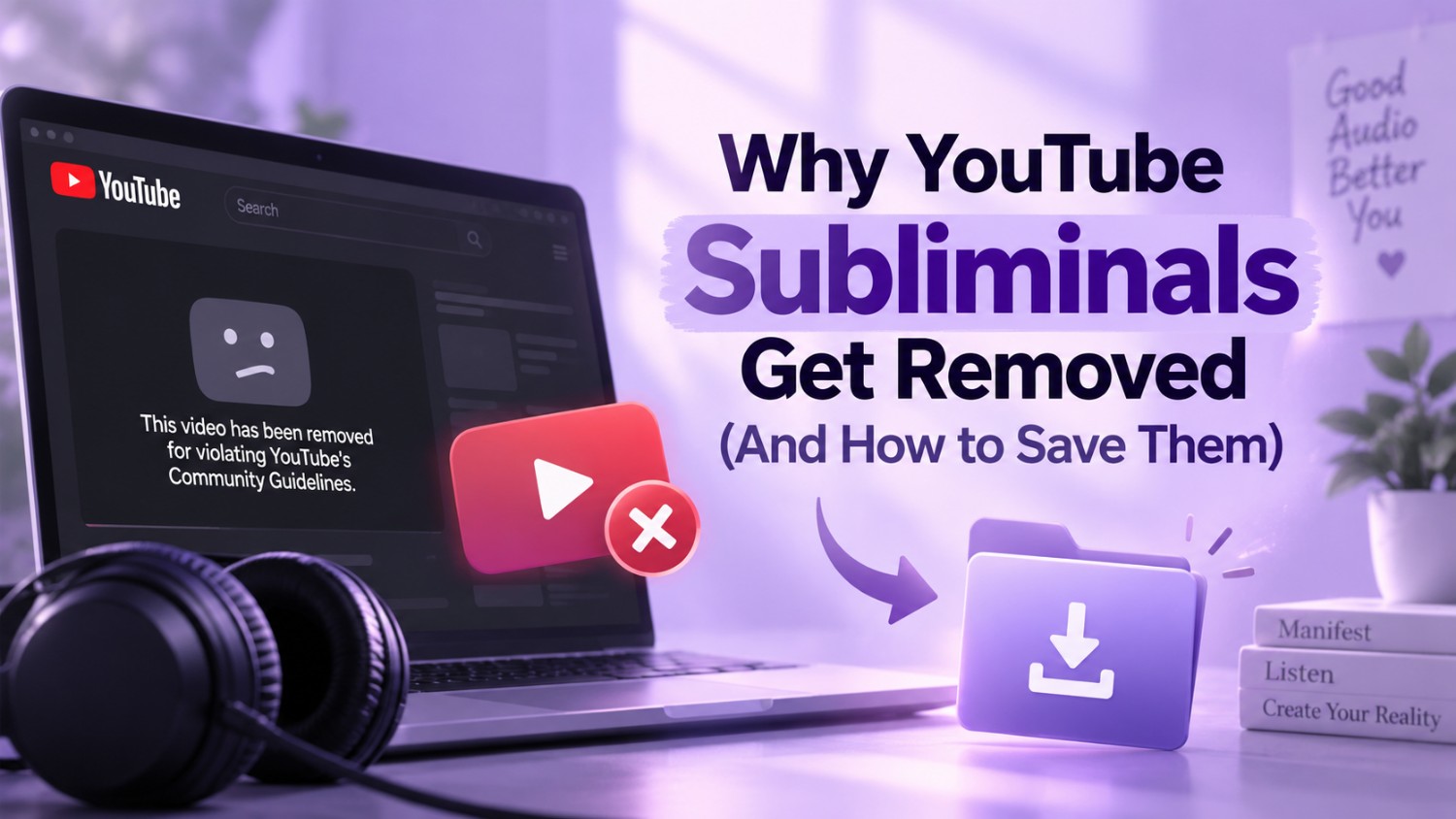
You have been listening to the same subliminal every night for three weeks. You are finally starting to notice the shift — the affirmations feel less like a stretch, the old story is getting quieter, something is actually moving. And then one evening, you go to press play and the video is gone. Channel terminated. Playlist empty. No warning, no explanation, no way to get it back.
If you make subliminal content, or you rely on a specific creator's uploads for your nightly practice, this is not a hypothetical. It is happening constantly, and it is happening more in 2025 and 2026 than at any point before — because of exactly how subliminal audio is built, uploaded, and formatted.
This article breaks down the real, documented reasons subliminal creators and subliminal channels are getting flagged, demonetized, and banned right now — and why the single most important thing you can do to protect your own subliminal practice is stop depending on a platform entirely and start saving your subliminal audio offline.
Why Subliminal Channels Are Uniquely Vulnerable to Platform Bans
Subliminal content is not being singled out on purpose. But the exact format that makes subliminal audio effective is also, unfortunately, the exact format that current platform policies are built to catch. Here is what is actually driving the bans.
1. The "Inauthentic Content" Policy Was Built to Catch Content That Looks Like a Subliminal
In mid-2025, YouTube renamed and expanded what used to be its "reused content" policy into a broader "inauthentic content" policy. The core definition: a channel where the content is so similar from video to video that viewers can barely tell the difference — content that looks like it was made from a template, with little to no meaningful variation, and that is easily replicable at scale.
Read that definition again and think about how a typical subliminal channel is actually built. A static background image or a slow-looping visual. The same rain, ocean, or ambient sound bed reused across dozens of uploads. A different affirmation script layered underneath each time, but delivered in the same synthetic or recorded voice, at the same pacing, in the same structure. From a policy-enforcement standpoint, that is close to a textbook example of templated, low-variation content — even though, from inside the subliminal community, every one of those tracks represents genuinely different intentional work.
This policy applies to the whole channel, not just one video. Which means a subliminal channel does not need a single controversial upload to lose monetization or face removal — it can be flagged purely on the pattern of how the content is produced across the whole library, regardless of how much care went into each individual script.
2. Copyright Claims on Background Sounds Are Extremely Common
Rain, ocean waves, white noise, ambient tones — almost every subliminal relies on a background sound bed, and a huge number of creators source these from YouTube itself, free sample packs, or other uploaders without confirming the actual licensing terms. When that background track is claimed by its original rights holder through Content ID, the result ranges from lost monetization on that video to a formal copyright strike on the channel.
Enough strikes, and the entire channel — years of uploads, an entire subliminal library, your whole subscriber base — is gone.
This is a particularly cruel risk for subliminal creators specifically, because the background sound is not a small decorative element of the video. It is half the track. A copyright claim does not just knock out one upload; it can knock out the specific sound identity a whole channel has built its subliminal library around.
3. Misleading or Deceptive Claims Policies Catch Body and Health-Adjacent Subliminals
Subliminal content frequently promises specific, visible outcomes — a fuller chest, clearer skin, rapid weight loss, a changed face shape. Platforms have steadily expanded their policies around misleading claims and content that could be interpreted as making unverified physical or health-adjacent promises. A subliminal script that reads more like a guaranteed physical transformation than a mindset or self-concept practice puts that content closer to the line these policies are designed to catch — even when the creator's actual intent is squarely in the self-improvement and manifestation space rather than anything medical.
4. Spam and Repetitious-Content Strikes Can Terminate the Whole Channel, Not Just One Video
Under YouTube's strike system, three strikes within a 90-day window can result in full channel termination — not a warning, not a demonetized video, the entire channel gone. For a subliminal creator uploading frequently, in a format that already sits close to the "templated content" definition above, it takes far fewer individual mistakes to accumulate three strikes than most creators realize. And once a channel is terminated, every video on it — every subliminal anyone has ever bookmarked, saved to a playlist, or built a nightly habit around — disappears with it, instantly and usually without meaningful warning.
What Actually Happens When a Subliminal Channel Gets Banned
This is the part that gets overlooked, because most articles about platform bans are written for creators worrying about ad revenue. But if you are the listener — the person who has spent three weeks building a nightly practice around one specific subliminal — a ban or termination affects you just as much as it affects the creator.
The video does not get paused or hidden. It gets removed. The playlist you built your whole SATS routine around empties out overnight. There is no download button after the fact, no warning email to you as a viewer, no way to recover the exact track your subconscious had started to sync with. Whatever momentum you built — the 21 days of consistent listening the subliminal community consistently points to as the minimum for real change — resets to zero, through no fault of your own, because of a policy decision made about someone else's channel.
And this is not a rare edge case. Between expanded inauthentic-content enforcement, routine copyright claims on shared background sound libraries, and the ordinary churn of channels changing niches, going private, or shutting down entirely, relying on any single platform for something as consistent and personal as a nightly subliminal practice is a genuinely fragile setup.
Why You Must Save Your Subliminal Audio Offline
This is the actual takeaway, and it applies whether you make subliminal content or simply listen to it every night: you do not own anything you only have access to through a platform. You own what you have downloaded.
An offline subliminal audio file — sitting on your own phone or laptop as an actual file, not a link, not an embed, not a bookmarked video — cannot be demonetized. It cannot be hit with a copyright claim. It cannot disappear because a channel accumulated three strikes in a policy area that has nothing to do with you. It is not subject to an algorithm change, a platform's shifting stance on manifestation content, or a sweep of channel terminations that happens to catch a creator you have listened to for months.
Offline audio also solves a second, quieter problem: consistency. A subliminal only works with repetition — the self-improvement and manifestation community consistently points to a minimum of 21 consecutive days before a real shift in self-concept becomes noticeable. A file saved on your device is available every single night, with no buffering, no ads, no "this video is unavailable in your country," and no dependency on your internet connection at 11pm when you are already in the SATS window and the last thing you want is a loading spinner.
If you are a subliminal creator, the same logic protects your work at the source. A channel is not a library — it is a rented shelf on someone else's platform, and the rules for what is allowed to sit on that shelf can change without your input. Your actual subliminal library, your affirmation scripts, your finished audio — the only version of that library you truly control is the one saved as files you hold yourself.
How InnerBloom Solves This From the Start
This is exactly the gap InnerBloom was built to close. Instead of publishing your subliminal practice to a platform and hoping it stays up, InnerBloom generates your personalized subliminal and hands you the finished, lossless WAV file to download directly to your own device.
There is no channel to strike, no background sound to get Content ID claimed, no "inauthentic content" review, because your subliminal is never a public upload in the first place — it is a private, personal audio file generated around your own goal, in your own words, that belongs to you the moment it downloads. You listen to it exactly the way a saved file works: offline, anytime, with no platform in between you and your practice.
Once you download your subliminal from InnerBloom, it is yours permanently. No subscription required to keep listening to a track you have already generated, no dependency on a video staying up, no risk of your nightly routine disappearing because of a policy update you had nothing to do with. Generate it once, save it to your phone or laptop, and it is available for as long as you want to keep listening — tonight, next month, or a year from now.
Frequently Asked Questions
Can a subliminal video really get removed even if it does not break any obvious rules?
Yes. Under YouTube's inauthentic content and repetitious content policies, enforcement looks at a channel's overall pattern — how similar videos are to each other, how much variation exists between uploads — rather than judging each video purely in isolation. A subliminal channel can be flagged based on the format itself (a repeated background sound with a changing voice track) even if no individual video contains anything that looks like an obvious violation.
Why do subliminal channels get copyright claims so often?
Because the background sound is such a central part of every subliminal, and a large amount of freely available rain, ocean, and ambient audio online is not actually licensed for reuse the way creators assume. When the original rights holder issues a Content ID claim, it can affect monetization on that video or escalate into a formal copyright strike on the channel, depending on how it is filed.
If I download a subliminal, is it mine to keep forever?
Once an audio file is downloaded to your own device, it is a local file you control — it does not require an internet connection, a platform, or continued access to any account to keep listening to it, unless you delete it yourself. This is the core advantage offline audio has over anything only accessible through a streaming link or embedded video.
Does InnerBloom require an ongoing subscription to keep my downloaded subliminal?
No. Once you generate and download your personalized subliminal as a WAV file through InnerBloom, the file is saved to your device and yours to keep listening to for as long as you want — offline, with no dependency on your account remaining active or the file staying hosted anywhere.
Is it better to listen to subliminals through YouTube or through a downloaded file?
For a consistent nightly practice, a downloaded file is significantly more reliable. YouTube videos can be removed, geo-restricted, demonetized, or taken down entirely due to channel-level policy issues that have nothing to do with you as a listener. A downloaded WAV file removes all of that risk — it plays the same way every single night, indefinitely, regardless of what happens to the channel it originally came from.
The Bottom Line
Subliminal content is not being unfairly targeted — but the exact format that makes it effective (a repeated sound bed, a changing voice track, frequent uploads) also happens to be the exact pattern current platform policies were built to catch. Channels get demonetized. Videos get copyright claimed. Accounts get terminated. And when that happens, every subliminal anyone ever built a nightly practice around disappears with it, instantly, with no warning and no way to get it back.
The fix is not complicated. Stop depending entirely on a platform for something as personal and consistent as your subliminal practice, and start owning the actual audio file. That is exactly what InnerBloom gives you — a personalized subliminal, generated around your own goal, downloaded once as a lossless WAV file, yours to listen to offline for as long as you want, completely independent of whatever happens to any channel, platform, or policy update.
Your practice deserves better than a video that could vanish overnight.
Disclaimer: This article is for educational and informational purposes only. Platform policies referenced are based on publicly available information and are subject to change; always refer to each platform's current terms of service for the most accurate guidance. Subliminal audio is a personal development tool used in the self-improvement community and is not presented as a scientifically proven method of behavioural or psychological change. No specific outcomes are guaranteed or implied. InnerBloom Subliminal Maker is a personal development tool, not a medical or therapeutic service.
Found this helpful? Share it with someone who needs it 💜