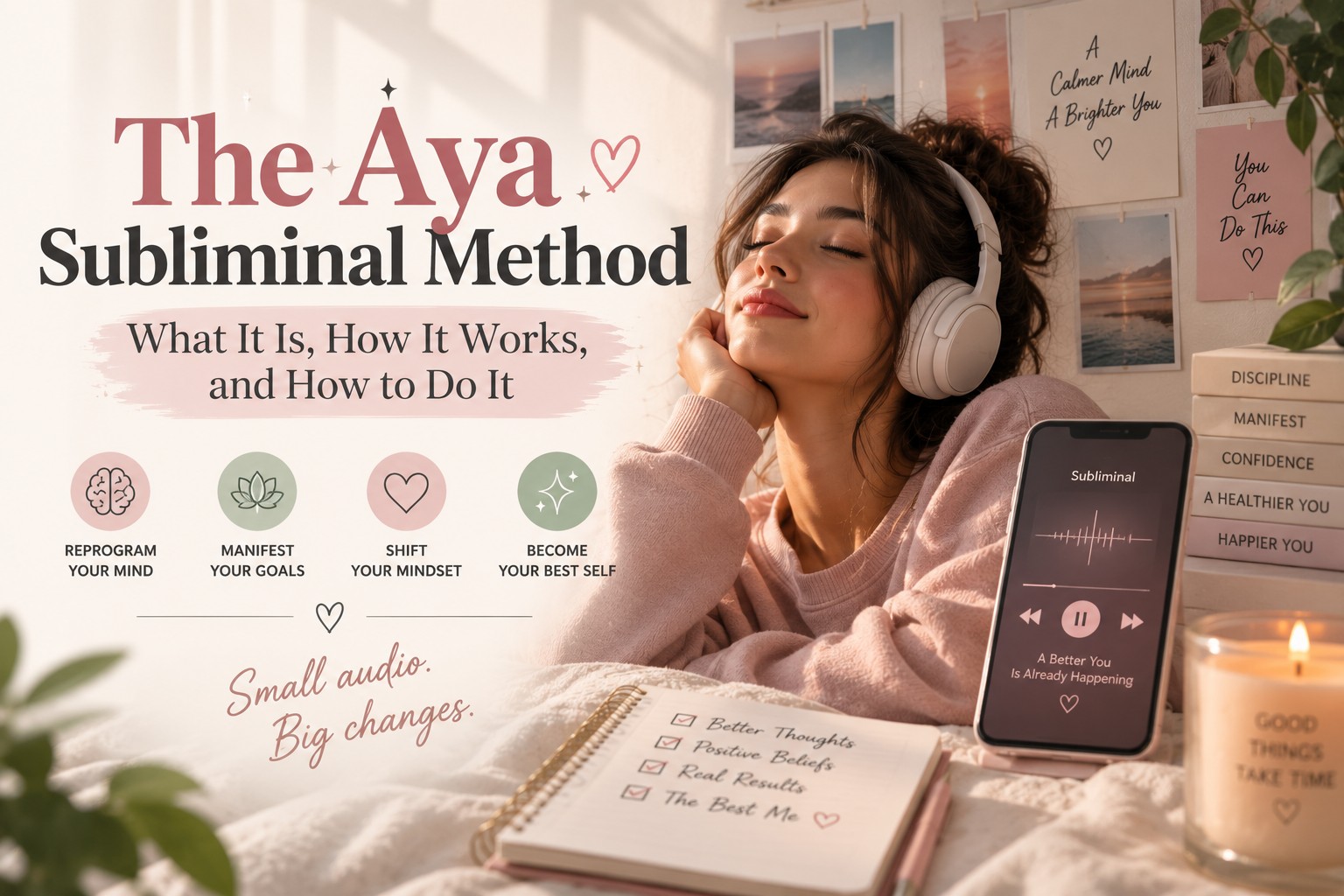
Every few months, the subliminal community converges on a named technique. The pillow method had its season. The robotic affirmation technique cycled through Reddit. The VIX method dominated TikTok for weeks. And now, in mid-2026, the conversation has shifted to something new — the Aya subliminal method.
If you saw a 30-second video and came here wanting the full picture, this is it.
The Aya method is not complicated. But the fragments circulating on short-form video leave out the reasoning behind each step, the psychology that makes it work, and the practical details that determine whether it lands or fizzles for you. By the end of this guide, you will understand exactly what the Aya subliminal method is, why it works at the subconscious level, how to do it correctly step by step — and the one thing that makes the difference between doing the method and the method actually working.
What the Aya Subliminal Method Actually Is
The Aya subliminal method is a two-phase manifestation and subliminal technique built around a specific sequence: you spend several minutes in active emotional saturation with a single affirmation — feeling into the desired reality as if it is already true — and then you transition into passive subliminal audio playback, releasing conscious effort entirely as the track does the subconscious work beneath your awareness.
The name appears to originate from TikTok creator @gabribow3gk, who posted a series of videos walking through the protocol in July 2026. Other creators including @jen_ayaaaaaa and @manifestwithlynn picked it up and produced their own variations within days, and the method spread fast enough to generate its own discover page before a single comprehensive written guide existed anywhere online.
What makes the Aya method different from what came before it is the emphasis on the emotional saturation phase that precedes the audio. Most subliminal practices are either purely active — like robotic affirmation, where you repeat a statement hundreds of times with conscious effort — or purely passive, like standard subliminal looping, where you simply press play and let the track run. The Aya subliminal method is deliberately neither. It is a sequence that uses both: deep conscious engagement first, followed by complete surrender to the subliminal layer. That contrast is the whole mechanism.
Why the Aya Method Works — The Psychology Behind the Sequence
The Aya subliminal method is not as new as it feels. The sequence it describes maps directly onto established research in cognitive psychology — even though the TikTok creators almost certainly did not design it with Rogers, Kuiper, and Kirker's 1977 self-reference effect study in mind.
That study demonstrated something important for anyone who uses affirmations: information processed in relation to the self is encoded into memory more deeply and durably than information processed at a surface level. When you spend several minutes genuinely feeling into what your affirmation would be like if it were already true — when you are not just reading words but inhabiting the emotion of the desired reality — you are running a self-referential processing loop. You are experiencing yourself as the person the affirmation describes. The subconscious encodes that experience at a completely different depth than mechanical repetition achieves.
The release phase adds the second layer. Subliminal audio has always operated on the principle that stimuli presented below the conscious perception threshold still influence cognition and behaviour — Cheesman and Merikle established this in 1984. When you move from active emotional engagement into passive subliminal listening, you are transitioning from deep conscious encoding to subthreshold reinforcement. The emotional saturation phase primes the neural pathways. The subliminal repetition strengthens them through volume — the same mechanism Hebb described in 1949 as neurons that fire together wiring together.
In practice, the Aya method runs both encoding strategies in sequence rather than relying on either one alone. Neither phase is magic. Both are structurally sound. And stacking them produces a deeper subconscious impression than either would create on its own.
How to Do the Aya Subliminal Method: Step by Step
Step 1: Choose One Affirmation — Not Five
The Aya subliminal method works because it concentrates all of your emotional energy on a single statement. Not a list. Not a paragraph. One sentence, written in present tense, that describes the version of reality you are moving toward as though it already exists.
"I have clear, glowing skin that I feel beautiful in" works. "I want better skin" does not. The precision matters because vague statements give your subconscious nothing specific to encode through the self-reference effect. The more exact and personally resonant the affirmation, the deeper the impression it makes during the saturation phase.
If you are new to writing affirmations for subliminals, the key rules are: always present tense, never future tense; always positive framing, never negative; specific enough to create a clear inner image of the desired reality.
Step 2: The Emotional Saturation Phase — This Is the Heart of the Method
Sit somewhere quiet. Close your eyes. Begin repeating your single affirmation internally — not mechanically, not like you are reading it off a card for the hundredth time, but with the full emotional weight of what it would feel like if it were already true.
Feel the relief. Feel the ease. Feel the specific sensations that accompany the reality you described — the physical warmth, the quiet confidence, the settled knowing of someone who already has what the affirmation describes. You are not watching yourself from the outside. You are inside the experience. You are the person this affirmation describes, right now, for these minutes.
This phase typically lasts three to five minutes. Duration is not the point. Saturation is the point. You are soaking your nervous system in the emotional texture of the desired reality before any audio enters the picture. When the saturation feels genuine — when the emotion is real, not performed — the phase is complete.
Step 3: Press Play and Release — Completely
Now press play on your subliminal audio track. The track should contain your affirmation or closely related ones — more on why this matters below.
As the audio begins, consciously let go of the effort. Stop repeating. Stop visualising. Stop trying to feel anything. Let the subliminal do the work below your conscious awareness while you relax, drift, or sleep. Your job in this phase is simply to receive — not to control, not to check, not to reinforce.
This release is not optional. It is what distinguishes the Aya method from simply doing emotional affirmations followed by more emotional affirmations. The conscious tension you release creates the exact space the subconscious needs to absorb the subliminal input without interference. Hold on, and you undermine the second phase entirely. Let go, and the two phases work together rather than against each other.
The Most Common Aya Method Mistakes
Treating the saturation phase as visualisation. Visualisation and emotional saturation are related but not identical. You can visualise a detailed mental scene without feeling anything. You can also feel the full emotional weight of an outcome without constructing a single clear image. The Aya subliminal method prioritises the feeling — not the picture. If you find yourself building an elaborate mental movie but staying emotionally flat, the saturation phase has not landed. Start again. Find the feeling first.
Using more than one affirmation. The method works precisely because it focuses all emotional energy on a single statement. When you try to saturate yourself with five different affirmations simultaneously, you dilute the depth of each one. One affirmation per session. If you have multiple goals, rotate them across different days rather than stacking them into a single session.
Skipping the release. Some people do the emotional saturation phase and then continue actively trying to feel the outcome throughout the entire subliminal listening session. The release is the method. Holding on creates conscious tension that works against subliminal absorption at the subconscious level. If you struggle with letting go, remind yourself: the saturation already did the encoding work. The subliminal phase handles the reinforcement. Your only job now is to get out of the way.
Using a subliminal that does not match the affirmation you saturated with. This is the biggest practical mistake — and the one most people make because they are using generic YouTube subliminals. You spend five minutes feeling into "I attract deep, reciprocal love" and then play a subliminal whose hidden affirmations say something completely different. Your subconscious receives conflicting signals. One message from the saturation phase. A different message from the audio. The mismatch undermines both.
The Aya Method and the Subliminal Transparency Problem
This is the part that most discussions of the Aya subliminal method avoid.
The method works best when the subliminal audio contains the exact affirmation you saturated yourself with during phase one. But most subliminals available online — on YouTube, on streaming platforms, across the community — are built around affirmations you cannot read, verify, or confirm. You are taking it on trust that the track says what the creator says it says. And as the subliminal community has learned more than once, that trust is not always warranted.
When you practice the Aya method with a subliminal you cannot verify, you are running a precise emotional priming phase and then handing the reinforcement work to an audio whose contents are invisible to you. That is the exact opposite of the intentionality the method is designed to create.
The most effective version of the Aya subliminal method — the version that actually uses the full power of the self-reference effect — is one where the affirmation you felt during saturation is the exact affirmation reinforced during the subliminal phase. Every line of it, chosen by you, known to you, aligned with the emotional experience you cultivated.
This is exactly where InnerBloom becomes the most natural tool for the Aya method. You describe your goal — the same single affirmation you are building your saturation phase around — and InnerBloom generates a full personalised affirmation script from your exact words. You read every line before any audio is created. You edit anything that does not feel aligned. You choose your background sound, download your lossless WAV subliminal, and play it in phase two knowing precisely what is reaching your subconscious during the reinforcement phase.
No hidden scripts. No mismatch between what you primed yourself to feel and what the audio is actually saying. The Aya method working exactly as it was designed to — with complete alignment between the emotional saturation and the subconscious reinforcement.
Build your personalised Aya method subliminal at InnerBloom.
How the Aya Subliminal Method Compares to Other Named Techniques
The VIX method uses intention-setting and visualisation before subliminal playback — similar to the Aya method's saturation phase. The difference is emphasis. VIX focuses on mental clarity and directed visual imagery. The Aya subliminal method focuses on emotional saturation, treating the feeling as the primary vehicle rather than the mental image. If you connect more through feeling than through visualising, the Aya approach may produce more natural results.
Robotic affirmation uses massive conscious repetition — saying an affirmation hundreds or thousands of times in a single session. The Aya method shares the repetition principle but moves it below consciousness after the initial saturation phase. Robotic affirmation is exhausting by design. The Aya method is intense briefly, then effortless.
The pillow method uses a physical ritual anchor — writing an affirmation on paper and sleeping with it beneath your pillow. It creates a tangible connection to the intention. The Aya subliminal method is entirely internal. No props, no journals, no physical ritual. Just your mind, your feelings, and the audio.
Standard subliminal looping is purely passive — you press play and let the track run, sometimes for hours, with no active engagement beforehand. The Aya method uses the same passive subliminal phase but adds the emotional saturation step first, which the cognitive research suggests produces significantly deeper encoding before the subthreshold reinforcement begins.
Practical Tips for Getting the Most From the Aya Subliminal Method
Do the saturation phase in the morning before the day builds momentum. Your mind is freshest in the first thirty minutes after waking. The emotional saturation work lands differently when the analytical inner critic has not yet been activated by the day's noise. Use that window deliberately.
Do the subliminal phase in the pre-sleep window. The ten to fifteen minutes before you fall asleep is when your subconscious is most open to new input and the conscious mind's resistance is at its lowest. After the morning saturation session, play your subliminal audio as you drift off at night. The two windows together — morning saturation, pre-sleep subliminal — create a complete daily practice that works on the desired reality from both directions.
One goal per session. The Aya subliminal method is designed around single-pointed focus. If you have multiple goals you want to work on simultaneously, rotate them across days rather than trying to run multiple affirmations through a single saturation session. Depth over breadth, every time.
Run the method for a minimum of 21 consecutive days before assessing anything. Neural pathways are built through consistent repetition over time. The first week will feel like you are going through the motions. The second week will begin to feel more natural. By the third week, the desired reality you have been saturating yourself with will start to feel less like something you are reaching for and more like something you simply know. That shift is the subconscious identity update happening. Do not stop before it arrives.
Stay out of the mirror during the process. The biggest mistake after doing a Aya subliminal method session is immediately scanning for external evidence that it worked. The method operates at the subconscious identity level first. The outer changes follow. Checking immediately creates the exact "I do not have this yet" energy that undermines the subconscious work the session just accomplished. End every session, close your eyes for one breath, say internally "it is done," and release it.
Frequently Asked Questions
What is the Aya subliminal method?
The Aya subliminal method is a two-phase manifestation technique where you spend three to five minutes in active emotional saturation with a single present-tense affirmation — genuinely feeling the desired reality as already true — and then transition into passive subliminal audio playback while releasing all conscious effort. The active phase primes neural pathways through the self-reference effect. The subliminal phase reinforces them through subthreshold repetition. Together they produce deeper subconscious impression than either approach alone.
Who created the Aya method?
The Aya subliminal method appears to originate from TikTok creator @gabribow3gk, who posted a series of videos walking through the protocol in July 2026. Other creators including @jen_ayaaaaaa and @manifestwithlynn produced their own variations within days and the method spread rapidly through the subliminal community.
How long does the Aya method take?
The emotional saturation phase runs three to five minutes per session. The subliminal playback phase can run as long as you want — including overnight as a sleep loop. Most practitioners do one session per day, ideally using the morning for the saturation phase and the pre-sleep window for the subliminal playback.
Does the Aya subliminal method actually work?
The sequence maps onto established cognitive research. The self-reference effect demonstrates that information processed in relation to the self is encoded more deeply than surface-level processing. Subliminal audio research shows that subthreshold stimuli can still influence cognition and behaviour. Neither element is magic — both are structurally sound. The results most practitioners report align with what the psychology would predict: a gradual but real shift in the automatic assumptions and identity that shape their daily choices and perception.
Can I use any subliminal for the Aya method?
Technically yes, but ideally no. The Aya method works best when the subliminal audio contains the exact affirmation you saturated yourself with. Using a generic YouTube subliminal creates a mismatch between the feeling you primed during phase one and the affirmations playing during phase two. Building your own subliminal — one where you know and have chosen every affirmation — eliminates that mismatch and aligns both phases of the method around the same desired reality.
How is the Aya method different from just using subliminals normally?
Standard subliminal practice is entirely passive — you press play and let the audio run without any deliberate mental engagement beforehand. The Aya subliminal method adds the active emotional saturation phase before playback, which the self-reference effect research suggests produces significantly deeper encoding of the target belief before the subthreshold reinforcement begins. The contrast between the active and passive phases is what makes the Aya approach structurally more effective than standard subliminal looping.
Can I do the Aya method for multiple goals at once?
The method is designed for single-pointed focus. One affirmation, one session, one desired reality at a time. If you have multiple goals, rotate them across different days rather than trying to split the emotional saturation phase between several different outcomes. The depth of the single-goal session is what makes the technique work.
The Bottom Line
The Aya subliminal method is genuinely new as a named technique — but the mechanism it uses is not new at all. Emotional priming followed by subthreshold repetition is a combination that cognitive research supports independently of whatever TikTok calls it next month.
The reason the method is spreading the way it is comes down to one thing: it actually makes sense. Not in a vague spiritual way. In a specific, mechanistically coherent way that explains exactly why the sequence works and what each phase is doing at the neural level. That clarity is rare in the subliminal community, and it is why this particular technique is sticking where so many others have faded.
Do the saturation phase with genuine feeling. Release into the subliminal phase completely. Use audio whose affirmations you have personally chosen and can verify. Run it consistently for at least 21 days.
And let the subconscious do what it has always been built to do — absorb what it receives repeatedly, and quietly reshape the identity that your outer life organises itself around. 🌸
Disclaimer: This article is for informational and personal development purposes only. The Aya subliminal method and the practices described are mindset tools used in the self-improvement community and are not presented as scientifically proven methods of psychological change. References to cognitive research are presented for informational context only and are not intended as clinical endorsements. Individual results vary and no specific outcomes are guaranteed. InnerBloom Subliminal Maker is a personal development tool, not a medical or therapeutic service.
Found this helpful? Share it with someone who needs it 💜