If you have spent any time in the self-improvement or manifestation space, you have almost certainly come across both of these terms. Affirmations. Subliminals. People talk about them like they are interchangeable, and sometimes like they are completely opposite things. They are actually neither.
Both work on your mindset. Both aim to shift the beliefs running beneath your conscious awareness — what the community calls subliminals vs affirmations. But the difference between subliminal and affirmation practices is more significant than most people realize — they reach different parts of your mind, work better at different times, and serve different purposes. Understanding that distinction is not just interesting — it is genuinely useful. Because once you know how each one actually works, you stop guessing which one to use and start using both more intentionally.
This article breaks it all down clearly. No fake science. No dramatic claims. Just an honest explanation of what affirmations and subliminals are, what actually separates them, when each one tends to work best, and how most people in the community eventually end up using both.
What Are Affirmations?
Affirmations are conscious, intentional statements you repeat to yourself to reinforce a belief or identity you want to hold. You say them out loud, write them in a journal, or repeat them in your head. You are aware of every word. The message is clear, deliberate, and fully audible.
The idea behind affirmations is straightforward. The thoughts you repeat most often shape the beliefs you carry. If you have spent years thinking "I am not good enough" on a loop, replacing that loop with "I am capable and worthy," done consistently and with genuine feeling, can begin to shift the inner narrative over time.
Most people in the mindset and manifestation community start here. Affirmations are accessible. They require no equipment. You can do them in the mirror every morning, in the car, before a nerve-wracking situation, or last thing at night. They put you in an active, intentional relationship with your own inner dialogue, and that alone has real value.
Where affirmations can hit a wall is when the belief gap is large. If you have a deep long-standing belief that conflicts with what your affirmation is saying, the conscious mind sometimes pushes back. Hard. You say "I am confident and financially abundant" and a quieter voice underneath immediately counters with reasons that is not true. Many people in the community describe this as their affirmations "not landing" — the words are right but something underneath them is not cooperating.
That is not a failure of affirmations. It is a signal about which layer of the mind needs the most attention.
What Are Subliminals?
Subliminals are affirmations delivered below the threshold of conscious awareness. In audio form — which is what most people mean when they talk about subliminals — the affirmations are layered beneath background sound like rain, ocean waves, or ambient music, at a volume your conscious mind cannot clearly register. You hear the background. You do not consciously process the words beneath it.
The reason this matters is the gatekeeper.
Your conscious mind has a filter — call it the internal gatekeeper. It is constantly evaluating incoming information against what it already believes. This is why subliminal messages work differently from spoken affirmations. When you say a positive affirmation out loud, it passes through that gatekeeper. The difference between affirmations vs subliminals is essentially the difference between talking to the gatekeeper and going around them. If the affirmation aligns with your current self-concept, it reinforces it smoothly. If it conflicts, the filter pushes back, and that resistance can make the affirmation feel hollow, unconvincing, or even a little absurd.
Subliminals bypass that resistance entirely. Because the conscious mind is not actively processing the words, the inner critic has nothing to argue with. The affirmations are understood to reach the subconscious layer more directly — the same layer where your automatic beliefs, habits, emotional responses, and deeply held self-concept actually live.
This is why many people in the subliminal community describe the experience of subliminals as quieter but deeper. You do not feel the immediate conscious engagement of saying an affirmation. Instead, what many people report over weeks of consistent use is a subtle but real shift in automatic thoughts and default responses — changes that feel less like something they did and more like something that gradually became true.
The Core Difference: Which Layer of Your Mind They Reach
This is the thing most articles on subliminal vs affirmation completely skip, and it is the most important thing to understand.
Your mind operates on at least two levels simultaneously.
The conscious level is the one you are using right now, reading this sentence. It is analytical, deliberate, and aware. It processes language, evaluates meaning, and maintains your current sense of identity. Affirmations work at this level. They engage your conscious attention, ask you to claim a new belief deliberately, and work through repetition and emotional engagement to gradually shift the story the conscious mind is running.
The subconscious level is where most of your actual programming lives. It runs automatically, below awareness, and holds the beliefs, patterns, and emotional associations that were formed long before you had the ability to consciously choose them. It is not evaluating or comparing. It simply receives what it is exposed to repeatedly and treats it as normal. Subliminals are understood by the community to work primarily at this level, not by convincing your subconscious of anything, but by repeatedly exposing it to a new signal until that signal starts to feel familiar.
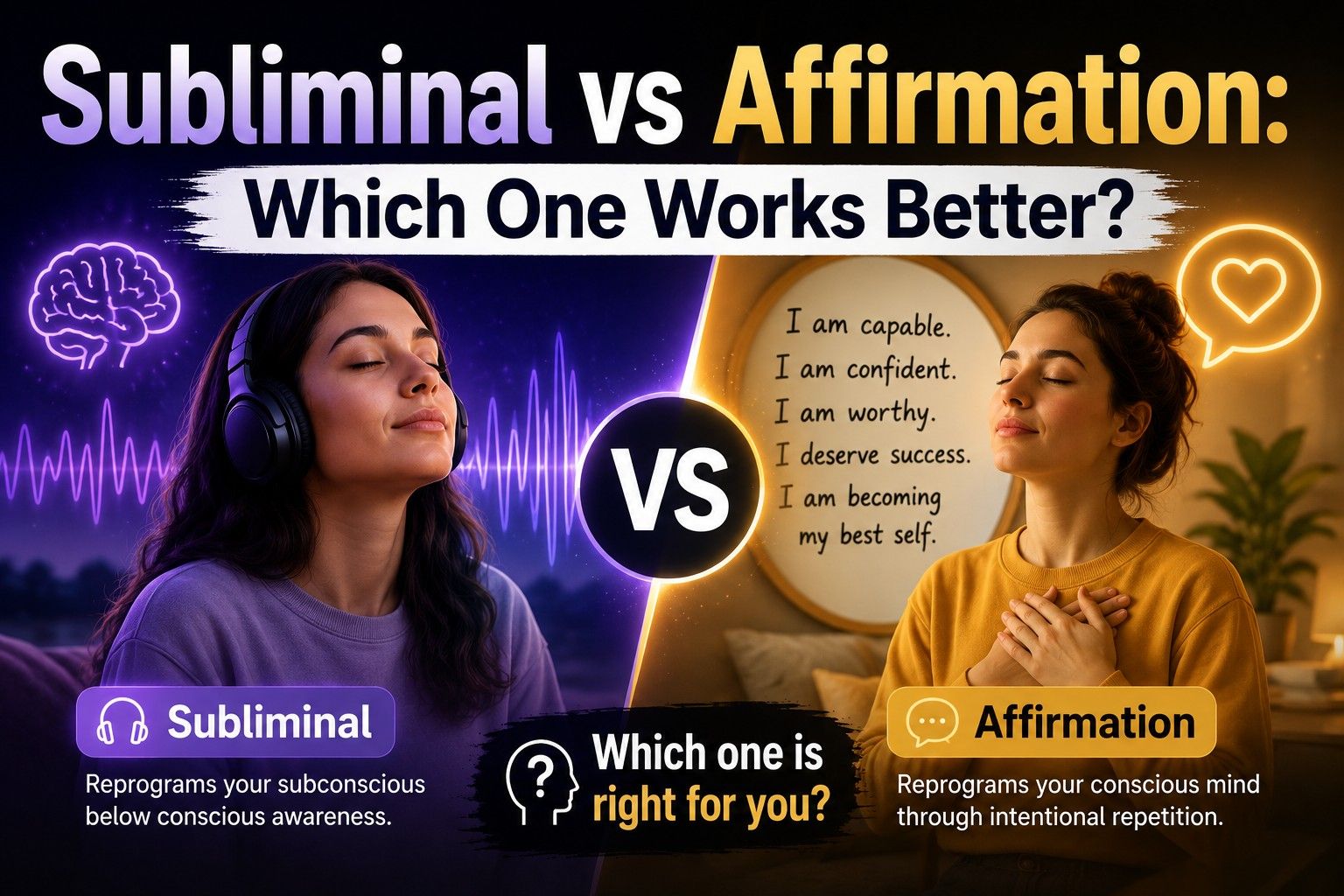
Think of it this way. Affirmations are a conversation with yourself. Subliminals are more like background music for your inner world. One requires your participation. The other works while you rest.
Neither is inherently more powerful. They just reach different places.
When Affirmations Work Best
Affirmations tend to be most effective in specific conditions.
When the belief gap is small: if an affirmation feels like a genuine stretch but not an outright lie, your conscious mind can accept it. "I am becoming more confident every day" is believable for almost anyone. "I am the most successful person who has ever lived" probably triggers more resistance than it resolves. The closer an affirmation sits to the edge of your current belief — a stretch, not a fantasy, the more effectively it lands.
When you are in a calm, receptive state. Saying affirmations while anxious, rushed, or emotionally activated tends to produce mixed results because the nervous system is already primed for self-protection rather than openness. The most effective affirmation practice tends to happen in quiet, relaxed windows — early morning, before the day's noise starts, or in the evening when things have settled. Many people in the manifestation community swear by saying affirmations out loud in a calm, grounded state rather than racing through a list while half-distracted.
When you mean them. This is the part that cannot be shortcut. An affirmation said mechanically without any feeling or intention behind it is not much more than words. The emotional quality — the genuine sense of "yes, this is where I am going" — is what gives the repetition real weight.
When Subliminals Work Best
Subliminals tend to be most effective in different conditions.
During passive states. The period just before sleep is consistently reported as the most powerful window for subliminal listening. In that drowsy, hypnagogic state between wakefulness and sleep, the conscious mind's filter is at its weakest. The subconscious is wide open. Playing a subliminal during this window means the affirmations beneath the sound reach the deepest, most receptive layer available at any point in the day. Many people in the community also use subliminals during light tasks — walks, gentle housework, reading — when the mind is relaxed and not actively focused.
When the belief gap is large. If you have a deep, entrenched belief that your conscious affirmations keep running into, around money, worthiness, body image, or relationships, subliminals offer a way around that resistance rather than through it. Instead of repeatedly telling your conscious mind something it keeps arguing with, you let the subconscious absorb the new belief gradually, without triggering the defensive comparison.
For deep identity-level shifts. Beliefs about who you fundamentally are, your confidence, your worth, your identity in love or career or life, tend to live at the subconscious level. Getting to them through conscious-only practice is possible but slow. Subliminals are understood by consistent practitioners in the community to reach those beliefs more directly.
Can You Use Both at the Same Time?
Yes. And most people who have been in the mindset and manifestation community long enough eventually do.
The way many practitioners describe their combined practice is simple: affirmations during the day and subliminals at night. Affirmations to actively engage with the new belief consciously — to reinforce it, say it with intention, build it into your daily self-talk. Subliminals during sleep and rest to let the same belief settle into the subconscious layer, past the filter, into the place where it becomes automatic rather than effortful.
The two approaches are not competing. They are complementary. They just work different rooms in the same house.
The conscious practice through affirmations gives you agency, intention, and a daily relationship with the beliefs you are building. The subliminal practice gives those same beliefs a deeper install, reaching the layer that conscious repetition alone takes longer to move.
The Personalization Problem With Subliminals
One thing the subliminal community has been vocal about for years is the problem with generic YouTube subliminals.
When you listen to a "confidence subliminal" created for a mass audience, you are receiving a script written to cover the broadest possible interpretation of confidence. It may not match your specific situation, your specific blocks, your specific language for what you want. And because the affirmations are layered beneath sound at an inaudible level, you have no way to check what the script actually says.
What many people in the community have found is that the more specific and personally aligned a subliminal is — the more closely the affirmations match their exact goal, in language that genuinely resonates with them — the more effective the experience tends to be. A subliminal built around your exact intention, in your own words, reviewed line by line, simply has more to work with than one written for millions of different people at once.
This is exactly what InnerBloom is built for. You describe your goal — whatever it is — and the AI generates a personalized affirmation script around your specific intention. You read every line, keep what resonates, remove anything that does not feel right, and download a high-quality, lossless audio file in minutes. No unknown scripts. No guessing. Just your own words, reaching the part of your mind that is most ready to receive them.
Build Your Custom Subliminal
Bypass conscious doubt and align with your desire. Create your custom subliminal in two minutes to unlock effortless daily manifestation power.
Create My Subliminal ✨Subliminal vs Affirmation: A Clear Side-by-Side
| Affirmations | Subliminals | |
| How they work | Conscious repetition of intentional statements | Affirmations delivered below conscious awareness |
| Which layer they reach | Conscious mind primarily | Subconscious mind primarily |
| Requires active engagement | Yes | No |
| Best used when | Calm, receptive, belief gap is moderate | Relaxed, passive, belief gap is large or entrenched |
| Best time of day | Morning, waking windows, intentional practice | Pre-sleep, passive background during light activity |
| Level of control over content | Complete | Complete only if you create your own |
| Works best for | Conscious identity building, real-time mindset shifts | Deep belief installation, passive subconscious work |
Which One Should You Choose?
Honestly? The framing of "which one" is part of what makes this confusing.
They are not rivals. They are tools. And like any set of tools, they work best when you understand what each one is actually for.
If you are brand new to this space and you have never worked with either, affirmations are the natural starting point. They are immediate, require nothing, and begin building the habit of intentional inner dialogue. Start there.
If you have been using affirmations and feel like something is not sticking, the conscious practice is happening but the deep shift is not, that is usually a signal that the subconscious layer needs more direct attention. That is when subliminals tend to make the most noticeable difference.
If you want to build something genuinely sustainable, combining both tends to produce more movement than either alone. The affirmation practice keeps the conscious mind actively engaged in the new identity. The subliminal practice deepens that identity at the layer where the automatic thoughts and default responses are stored.
The subliminal community's most consistent practitioners are almost never using just one of these. They are using both, at different times, for different purposes, as part of a single intentional practice.
Frequently Asked Questions
Are subliminals just affirmations?
At their core, yes. Subliminals are affirmations that have been recorded and then layered beneath background sound at a volume below conscious perception. The content is the same — positive, intentional statements. The delivery method is completely different. The key distinction is that affirmations are processed consciously and subliminals are designed to bypass conscious processing and reach the subconscious more directly.
Do subliminals actually work?
Many people across the self-improvement and manifestation community report meaningful shifts from consistent subliminal use — changes in automatic thinking patterns, emotional responses, confidence levels, and overall self-concept. There is no universal guarantee, and individual experience varies significantly depending on consistency, receptivity, and how well the subliminal aligns with the listener's specific goal. What the community consistently finds is that personalized subliminals — built around the listener's specific intention — tend to produce a noticeably different experience than generic ones.
Can I listen to subliminals while sleeping?
Yes, and sleeping is widely considered one of the most effective listening windows available. Just before sleep and during the early stages of rest, the conscious mind's filter is at its weakest and the subconscious is most receptive. Many practitioners in the community play their subliminals as they drift off, at a comfortable volume, allowing the affirmations to reach the subconscious through the entire sleeping window.
How long does it take for affirmations or subliminals to work?
The honest answer is that it depends on the depth of the belief you are working with and the consistency of the practice. Surface-level mindset shifts can happen quickly — sometimes within days of a new affirmation practice. Deeper, more entrenched beliefs — around identity, worth, money, or long-standing patterns — typically require weeks to months of consistent work. The community generally points to 21 days as the minimum threshold for a genuine shift to begin feeling automatic rather than effortful.
Should I use affirmations or subliminals for manifesting a specific person?
Many people in the law of assumption and manifestation community use both simultaneously for SP work. Affirmations during the day focused on self-concept (how they see themselves in love and relationships) and a subliminal at night built around the same self-concept and desired reality. The combination addresses both the conscious and subconscious layers of the belief work that specific person manifestation tends to require.
What is the best time to say affirmations?
The two most consistently recommended windows in the community are first thing in the morning, before the day's noise activates the critical mind, and just before sleep. Morning affirmations set the conscious tone for the day. Pre-sleep affirmations work in a window closer to the subconscious's natural receptivity, especially if followed by a subliminal as you drift off.
What makes a subliminal more effective?
Three things come up consistently in community discussion: specificity (affirmations that match your exact goal rather than a broad category), audio quality (lossless WAV rather than compressed MP4 or MP3), and listening consistency (daily use, especially in the pre-sleep window). Generic subliminals score lower on the first two. A personalized subliminal addresses all three.
The Bottom Line
Affirmations and subliminals are not the same thing. They work differently, reach different layers of the mind, and tend to excel in different conditions. Affirmations engage your conscious intention and build your active relationship with the beliefs you are choosing. Subliminals deliver those same beliefs to the subconscious layer during states of low resistance — most powerfully during sleep.
The question is not which one is better. It is understanding what each one is actually doing, so you can use both intentionally rather than guessing.
Most people who stick with this practice long enough arrive at the same conclusion: conscious affirmations during the day, a personalized subliminal at night. One builds the story at the surface. The other lets it settle into the foundation.
Disclaimer: This article is for informational and personal development purposes only. The comparisons and explanations of affirmations and subliminal audio are based on community practices and widely shared personal development frameworks. They are not presented as scientifically proven methods of psychological change. Individual experiences vary and no specific outcomes are guaranteed. InnerBloom Subliminal Maker is a personal development tool and does not provide medical or psychological treatment.
Found this helpful? Share it with someone who needs it 💜