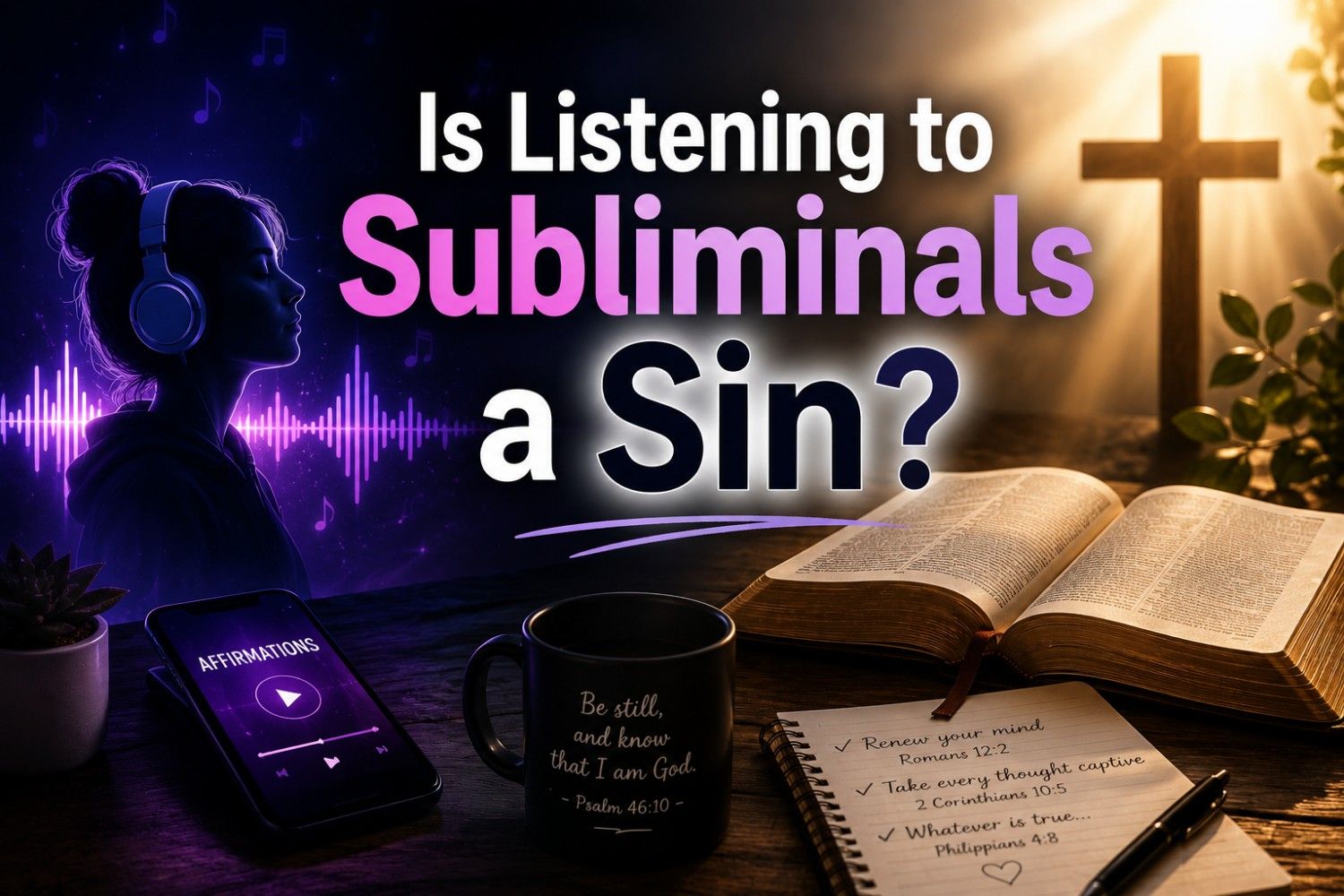
If you're a Christian who's curious about subliminals, there's a good chance you've already searched some version of this question and gotten completely conflicting answers. One creator will tell you subliminals are pure science and a gift from God for renewing your mind. Another will tell you to stay far away from anything to do with manifestation, subconscious programming, or "new age" tools entirely. Both will quote scripture. Both will sound convinced.
That's not because one side is obviously right and the other is obviously wrong. It's because this is a genuinely disputed question within the Christian community, and it deserves a more careful answer than either "it's totally fine" or "it's demonic."
This article lays out both sides honestly, walks through the biblical framework most relevant to questions like this one, and gives you a practical way to think it through for yourself — rather than just telling you what to believe.
What Are Subliminals, Exactly?
A subliminal is audio that contains spoken affirmations, often layered underneath music or calming background sound, at a volume too quiet for your conscious mind to clearly register. The idea is that while you consciously hear only the music, your subconscious still picks up the words underneath it.
Subliminals are typically built around a specific intention — confidence, healing, abundance, a relationship, a habit — using repeated, present-tense statements like "I am" or "I have." People often listen to them while sleeping, studying, or relaxing, on the belief that the mind is more receptive to new input during those quieter states.
Why This Question Divides Christians
The disagreement isn't really about whether subliminals "work" in some psychological sense. It's about three separate concerns that tend to get bundled together:
- The mechanism — is it manipulative or deceptive to feed your mind something it isn't consciously aware of?
- The content — what is the subliminal actually saying, and where did those words come from?
- The association — subliminals emerged from, and are still marketed alongside, law of attraction and new age manifestation communities that many Christians have real concerns about.
Separating these three threads is where most existing content on this topic falls short. Let's take them one at a time.
The Case That Subliminals Can Be Used Faithfully
Christians who use subliminals generally build their position on a few core ideas.
The Subconscious Mind Is Part of God's Design
Scripture repeatedly addresses the importance of what we allow into our minds — not because the mind is dangerous, but because it's powerful and worth stewarding well. Passages like Romans 12:2, which calls believers to be transformed by the renewing of their mind, and Philippians 4:8, which instructs believers to dwell on what is true, pure, and lovely, are often cited as evidence that intentionally shaping your thought patterns is not just permitted but encouraged.
Under this view, a subliminal is simply a tool for repetition — no different in principle from writing scripture on notecards, listening to a sermon on repeat, or memorizing a verse until it becomes automatic.
It's a Tool, and Tools Are Morally Neutral
This camp draws a comparison to everyday things Christians don't typically question — skincare routines, exercise, makeup, or self-help books. The argument is that using a tool to support your mind, body, or habits isn't inherently spiritual or anti-spiritual; it depends on what the tool contains and why you're using it.
Repetition and Mindset Are Already Biblical Concepts
Concepts like speaking life instead of death (Proverbs 18:21), taking every thought captive (2 Corinthians 10:5), and faith coming by hearing (Romans 10:17) are frequently referenced by Christians who use subliminals, as evidence that intentional, repeated, spoken belief has scriptural precedent — as long as what's being repeated aligns with scripture rather than replacing it.
The Case for Caution
Christians who avoid subliminals raise different, equally serious concerns.
Self-Glorifying Affirmations Can Slide Into Idolatry
A common critique is that many popular affirmations — "I am a goddess," "I am always chosen," "I attract everything I want" — center the self in a way that can quietly compete with worshiping God. Under this view, the concern isn't the audio format itself, but a broader worry that manifestation culture teaches people to seek control, identity, and fulfillment from their own mind rather than from God.
The Origins and Associations Matter
Subliminals as a category grew out of, and are still frequently sold alongside, law of attraction content, tarot, and other new age or occult-adjacent practices. Christians in this camp argue that even a "neutral" tool can be worth avoiding if the broader ecosystem it comes from conflicts with their faith — the same reasoning some Christians apply to yoga, astrology, or certain wellness trends.
"Not Hearing It" Feels Different From "Not Understanding It"
Some Christians distinguish between reading and consciously agreeing with a teaching (which you can evaluate and reject) and absorbing something below the threshold of conscious awareness (which you can't evaluate in the moment). For a tradition that values discernment and testing everything against scripture (1 Thessalonians 5:21), that distinction matters.
The Real Question Isn't the Format — It's the Content and the Source
Here's where a lot of the online debate talks past itself: "are subliminals a sin" isn't really one question. A subliminal built entirely around scripture and God's promises is a very different thing, content-wise, than a subliminal built around new age manifestation language, even though both use the exact same audio format.
This is also the concern one Christian subliminal creator raised herself: when you buy a subliminal from someone else, you genuinely don't know what's inside it. You're trusting a stranger's words to enter your mind without being able to consciously check them against your own convictions first. That's a legitimate, practical concern — regardless of which side of this debate you land on.
What the Bible Actually Says About Disputable Matters
Scripture does address situations like this one directly — questions where believers, in good conscience, land on different conclusions about the same practice. Romans 14 speaks to exactly this kind of disagreement: it instructs believers not to judge one another over disputable matters, while also saying that whatever is not done in faith and full conviction is, for that person, sin.
In other words, the Bible doesn't hand down a universal verdict on every gray-area practice. It puts the weight on conscience, conviction, and motive — which is a very different framework than "this is always fine" or "this is always wrong."
A Discernment Framework, Not a Verdict
Rather than a yes-or-no answer, here's a practical way Christians on both sides of this topic generally suggest working through the decision:
- Pray about it first, rather than starting from either fear or curiosity alone.
- Know exactly what's in the audio. If you can't see the script, you can't test it against scripture.
- Check the content against Philippians 4:8 — is it true, honorable, pure, lovely, and of good report, or does it center you above God?
- Notice your own conviction. Romans 14 puts real weight on whether you personally feel at peace and full of faith about the practice, not just whether someone else has cleared it.
- Be honest about the company you're keeping. If a specific creator or community mixes subliminals with practices your conscience objects to, that context is worth weighing.
- Revisit it if your conviction changes. Several Christian creators who use subliminals today describe going through seasons of stepping away and coming back as their understanding deepened — that kind of reevaluation is normal, not a sign of doing it wrong.
If You Want to Approach It Thoughtfully
If, after working through that, you feel at peace using subliminals or affirmation audio, the practical concern raised earlier — not knowing what's actually in the audio you're listening to — is worth taking seriously either way.
This is where writing your own script, instead of listening to one built by a stranger, solves the actual problem rather than just the discomfort around it. With InnerBloom, you write the intention yourself — including scripture, specific language you're comfortable with, and nothing you haven't personally reviewed — and it's turned into a personalized audio track you can actually read line by line before you ever listen to it. You're never trusting unseen content; you're simply repeating words you already chose and already stand behind.

Create Your Persoanlized Safe Subliminal
Create and review your own affirmation subliminal at InnerBloom.
Start now ✨Frequently Asked Questions
Is listening to subliminals a sin?
Scripture doesn't name subliminals specifically, so this falls into what Romans 14 calls a disputable matter — Christians hold genuinely different, sincerely held convictions about it. The more useful question for most believers is whether the specific content lines up with scripture and whether you can do it in full faith and conscience, rather than whether the format itself is universally right or wrong.
What do Christian subliminal makers actually put in their audio?
It varies by creator, but many who use subliminals as Christians build them around scripture verses, prayer language, and "I am" statements rooted in identity in Christ, rather than generic manifestation content.
Is the law of attraction the same thing as using subliminals?
No, though they're often marketed together. The law of attraction is a broader belief system about thoughts shaping reality that many Christians have specific theological concerns about. Subliminal audio is simply a delivery format — repeated affirmations under sound — and can be built around very different content, including scripture, independent of law of attraction beliefs.
How can I make sure a subliminal aligns with my faith?
The most direct way is to know exactly what words are in it, ideally by writing or reviewing the script yourself rather than listening to unseen content from an unfamiliar source.
The Bottom Line
This isn't a question with a single, tidy answer, and any article that hands you one in either direction isn't being fully honest with you. What scripture does offer is a framework: test the content, examine your own conscience and conviction, and don't let anyone — including a YouTube video — replace your own discernment on a disputable matter. If you land on using subliminals or affirmation audio, knowing exactly what you're feeding your mind is the one part of this decision that isn't up for debate.
Disclaimer: This article is for informational and discussion purposes only and does not constitute theological, pastoral, or spiritual advice. It presents a range of views held within the Christian community and is not intended to argue for or against any specific denomination's teaching. If you have questions about how this topic applies to your own faith, please speak with your pastor, church leadership, or a trusted spiritual counselor. InnerBloom Subliminal Maker is a personal development tool that allows users to write and review their own audio content; it is not a religious, therapeutic, or medical service, and no specific outcome is guaranteed or implied.
Found this helpful? Share it with someone who needs it 💜