If you found this article, there is a good chance you are exhausted. Not just tired — the kind of exhausted that sleep does not fully fix. The kind that follows you into your evenings, sits with you on Sunday nights, and makes you wonder how much longer you can keep running at this pace.
First, something worth saying clearly: you are not weak for feeling this way. You are not failing. You are a human being carrying a genuinely heavy load — tight deadlines, difficult managers, constant notifications, back-to-back meetings, and the quiet but relentless pressure to always do more, all while appearing completely fine.
Here is what chronic work stress actually does: it keeps your mind in a state of constant low-level alert. The body and mind were not designed to sustain that state indefinitely. Over time, the alertness stops feeling like alertness and starts feeling like numbness — the emotional flatness, the detachment, the sense that no matter how much you do it is never quite enough. Most people recognise that as burnout. It is not a character flaw. It is what happens when a person gives more than they are given space to recover.
The path forward is not about pushing harder. It is about deliberately, consistently interrupting the thought patterns that keep you in that activated state long after the actual stressor has passed.
This is where affirmations come in — not as a cure, not as a replacement for real rest or addressing a genuinely toxic environment, but as one of the most accessible tools available for changing the inner narrative that runs on a loop underneath the stress. The stories your mind tells you about whether you are safe, capable, and worthy of rest — those stories are trainable. Affirmations are how you train them.
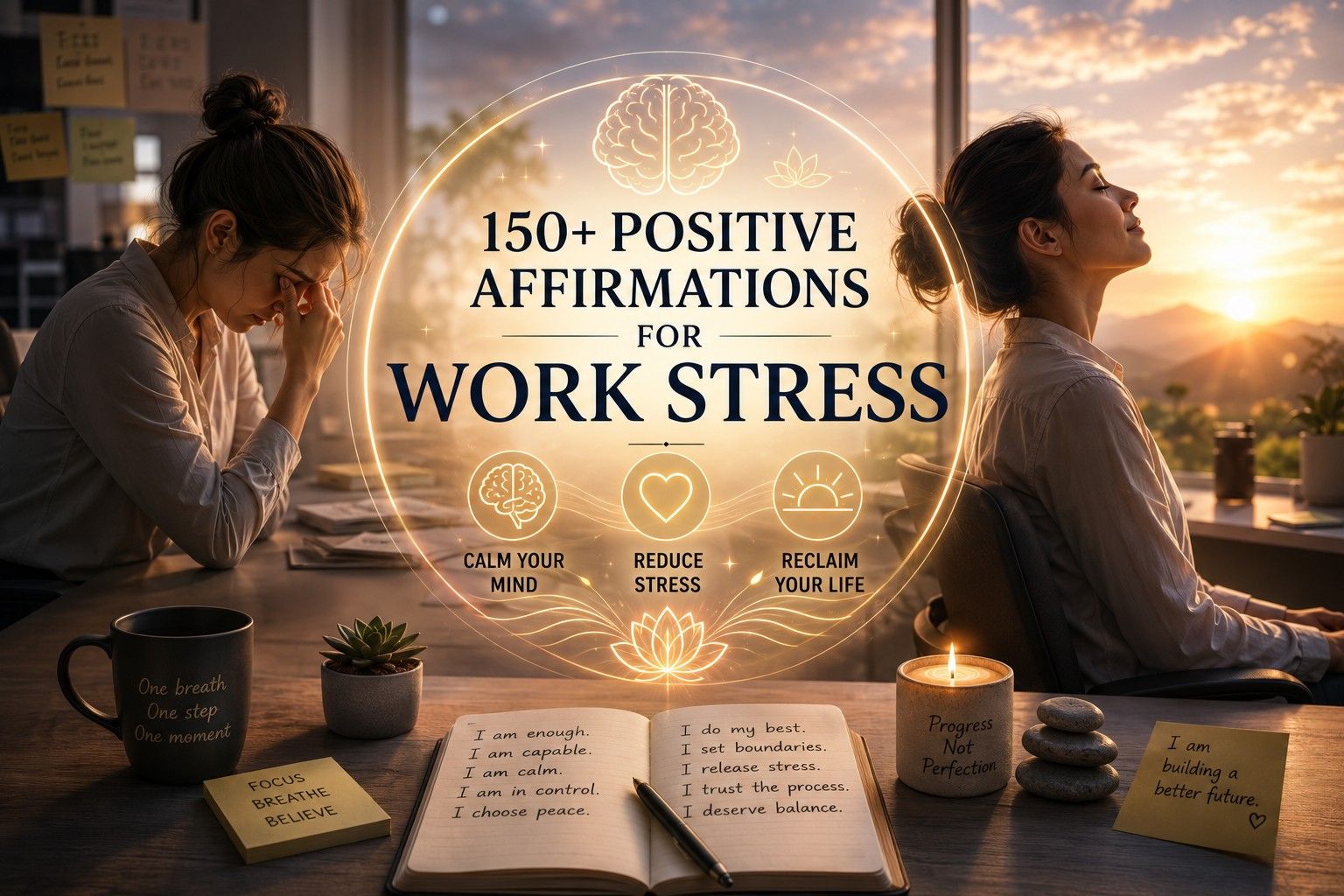
This list has 150+ positive affirmations for work stress, organised by the specific moments that make work hardest. Find the 5 to 10 that feel true enough to hold onto right now and start there.
How to Use Positive Affirmations for Work Stress (The Right Way)
- Pick specific ones, not all of them. The affirmations that are most effective are the ones that feel like a believable stretch — not a comfortable truth, not an outright lie. If "I am completely calm at work" feels impossible, try "I am learning to stay calm under pressure." Match the affirmation to your current level of belief.
- Say them out loud, especially before you open your laptop. The first few minutes before you begin work set the emotional tone for everything that follows. One minute of deliberate self-talk before logging in costs nothing and changes the filter through which you process everything afterward.
- Use them as a pattern interrupt, not just a routine. When you feel the cortisol spike — the shallow breathing, the racing thoughts, the tightening in your chest — that is exactly the moment to pull out an affirmation and breathe through it. You're not trying to suppress the stress; you're giving your nervous system an exit ramp.
- Keep your top 3 somewhere visible. A sticky note on your monitor. A phone note pinned to your home screen. When a difficult moment hits, you won't want to scroll through a list. Make them retrievable in under two seconds.
- Be consistent for at least 21 days. Neuroplasticity doesn't happen in a single session. New neural pathways form through repetition. The research consistently points to 21 days as the minimum threshold for a new thought pattern to begin feeling natural.
1. When You're Overwhelmed and Can't Think Straight
When your mind has too many open tabs — every task feels urgent, nothing feels manageable, and the simple act of deciding where to start feels overwhelming — the worst thing you can do is try to think your way out faster. These affirmations are for that exact moment. They are not about solving the overwhelm. They are about stepping out of it long enough to take the next right action.
- I can only do one thing at a time, and that is enough.
- I am allowed to slow down even when everything around me is moving fast.
- I am calm inside even when my environment is chaotic.
- I am choosing the next smallest step, not the entire mountain.
- I am allowed to pause, breathe, and reset at any point in my day.
- I am more capable than the pressure I feel right now.
- Overwhelm is a signal to slow down, not speed up, and I listen to it.
- I am not behind — I am working through things at a sustainable pace.
- I am releasing the need to have everything figured out immediately.
- My brain works best when I give it space, and I am creating that space now.
- I am taking a breath right now, and that one breath is enough to begin.
- I am allowed to ask for help when my plate is full.
- I do not have to solve everything today — only what truly requires me today.
- I am grounded, even when my thoughts want to spiral.
- I am in control of my response to this moment, even when I cannot control the moment itself.
2. Burnout Recovery Affirmations
If you are burnt out, it is because you cared — probably more than most people around you noticed. You gave a lot. You kept going when you probably should have stopped. You held things together when it was not really your job to hold them. That is not laziness. That is not weakness. That is what burnout actually looks like from the inside. The most important belief to change right now is the one that tells you rest has to be earned — that you can only stop when everything is done. These affirmations are written for exactly where you are: not to rush your recovery, but to gently remind yourself that slowing down is not failure. It is the whole point.
- I am allowed to rest without earning it first.
- My worth is not measured by my output.
- I am in recovery, and recovery takes exactly as long as it takes.
- I am rebuilding my energy slowly and without shame.
- I am allowed to say no to things that deplete me.
- I am not failing — I am healing from an environment that asked too much.
- Rest is productive. Rest is necessary. Rest is something I deserve.
- I am learning to work in a way that does not cost me my health.
- I am releasing the identity of always being busy.
- I am no longer available for the belief that exhaustion equals dedication.
- My nervous system is safe. My body is safe. I am safe to slow down.
- I am worthy of a career that does not hollow me out.
- I am setting a new pace — one that I can sustain for years, not just weeks.
- I am forgiving myself for the time I spent ignoring my own limits.
- I am choosing longevity over urgency, and that is a form of wisdom.
3. Deadline Pressure & High-Stakes Stress
Deadline pressure has a way of collapsing your perspective — suddenly everything feels equally urgent and equally catastrophic. The quality of your thinking drops precisely when you need it most. These affirmations are designed to interrupt that spiral and bring you back to the only place where good work actually happens: the present moment, one task at a time.
- I am focused on what I can complete right now, not everything at once.
- I work with clarity and speed when I am calm, so I am choosing calm.
- I am making steady, real progress with every action I take.
- Pressure reveals my capability, and I am capable.
- I am breaking this down into manageable pieces and moving through them one at a time.
- I have met deadlines before, and I will meet this one too.
- I am resourceful, efficient, and focused when it matters most.
- I am asking for what I need to get this done well.
- I am giving this my best effort, and my best effort is enough.
- I am not paralyzed by pressure — I am sharpened by it.
- I am completing tasks in order of priority, not in order of anxiety.
- I am in control of my attention, and I am directing it where it matters.
- I am protecting my energy so it is available when I need it most.
- I do well under pressure because I have done it before.
- I am finishing this, and then I am resting.
4. Difficult Managers, Toxic Coworkers & Hostile Environments
Interpersonal stress at work is one of the heaviest kinds — not least because you cannot escape it the way you can escape a project. A hostile manager, an undermining colleague, a culture that does not feel safe — these situations are genuinely hard, and minimising them does not help. These affirmations are not about pretending things are fine. They are about protecting your inner state so that what is happening around you does not get to determine who you are at your desk.
- I am not defined by how others treat me at work.
- My value does not depend on my manager's opinion of me.
- I am maintaining my own standards regardless of the environment around me.
- I am able to be professional and boundaried at the same time.
- I am protecting my peace without abandoning my performance.
- I am allowed to document, escalate, and advocate for myself.
- Other people's behavior is a reflection of them, not a verdict on me.
- I am not shrinking to make difficult people more comfortable.
- I am navigating this with composure and quiet strength.
- I am allowed to disengage emotionally from people who are not respectful.
- I am staying focused on my own work, my own growth, and my own path.
- I am not taking other people's stress personally.
- I am choosing not to participate in toxic dynamics that drain my energy.
- I deserve a workplace where I am respected, and I am working toward that reality.
- I am stronger than the environment I am currently in.
5. Imposter Syndrome & Work Self-Doubt
Imposter syndrome is not a sign that you do not belong. It is almost always a sign that you care deeply about doing your work well — and that you are honest enough to know how much you are still learning. The affirmations in this section target the self-concept beneath the doubt — not to manufacture false confidence, but to remind you of what is actually true about your capability when the anxious voice is not the loudest one in the room.
- I earned my place here through real skill and real effort.
- I am allowed to be confident even when I do not know everything.
- Not knowing everything is not a flaw — it is part of doing meaningful work.
- I am growing into this role, and growth takes time.
- I belong in every room I walk into.
- I am allowed to have an opinion and share it without apologizing.
- My perspective brings something to this team that no one else can.
- I have evidence of my competence if I am willing to look at it honestly.
- I do not have to perform certainty to be taken seriously.
- I am more qualified for this than my self-doubt wants me to believe.
- Feeling uncomfortable in a new challenge means I am stretching — not failing.
- I am allowed to take credit for my contributions.
- The version of me that "doesn't belong" is a story, not a fact.
- I am someone who figures things out, and I always have been.
- I am enough for this, today, as I am right now.
6. Setting Boundaries at Work Without Guilt
The inability to set boundaries at work does not come from laziness or indifference. It comes from a deep-seated association between saying no and being seen as less dedicated, less capable, less worthy of your role. That association is learned — and it can be unlearned. These affirmations target the belief system underneath the people-pleasing, and replace it with the identity of someone who protects their capacity precisely because they take their work seriously.
- I am allowed to say no to requests that exceed my capacity.
- Protecting my time is part of doing my job well.
- I can be helpful and boundaried at the same time — these are not opposites.
- Saying no to one thing creates space to say yes to what actually matters.
- My limits are not a weakness — they are information.
- I am allowed to finish one task before taking on another.
- I am not required to be available at all hours to prove my dedication.
- A boundary communicated with respect is a form of self-respect, not selfishness.
- I am allowed to push back on timelines that are not realistic.
- I am advocating for the quality of my work by protecting my energy.
- The people who matter will respect my limits.
- I am done apologizing for having needs like every other human being.
- I am learning that my boundaries make me more sustainable, not less valuable.
- I am not responsible for managing other people's discomfort with my limits.
- Every boundary I hold makes the next one easier to hold.
7. Monday Morning Dread & Pre-Work Anxiety
Sunday evening anxiety is not a sign that something is wrong with your life. It is your mind doing what minds do — projecting forward, scanning for threats, preparing you for what is coming before it arrives. The problem is that the preparation itself becomes the suffering. These affirmations are for the morning alarm, the commute, the moment before the laptop opens — gently redirecting your mind from what might happen this week to what is actually in front of you right now.
- This week is full of possibilities I have not encountered yet.
- I am choosing to begin this day from a grounded place, not an anxious one.
- I have handled every Monday before this one, and I will handle this one too.
- I am allowed to ease into the morning before the day accelerates.
- My pace this morning sets the tone for everything that follows.
- Today I will do meaningful work and then I will rest.
- I am not carrying last week into this week.
- I am open to this day being better than I expect.
- I am bringing calm, competence, and intention to this morning.
- I am allowed to have a slow, quiet start before the world begins demanding things.
- I am focusing only on today, not the entire week.
- I am protected, resourced, and capable of what this day holds.
- Anxiety about work is a habit, and habits can change.
- I am choosing a thought that serves me better right now.
- This day will end, and I will have made it through.
8. After a Mistake, Failure, or Difficult Feedback
A harsh email from a manager can ruin an entire afternoon. A mistake in front of the team can replay in your mind for days. This is not weakness — it is the natural intensity of a social and professional environment that matters to you. These affirmations are for after something went wrong — when the inner critic is at its loudest and self-compassion feels furthest away. They are not about pretending the mistake did not happen. They are about refusing to let one moment write the verdict on your entire career.
- Mistakes are part of every real career — mine included.
- I am not my worst moment, and this moment does not define me.
- I am allowed to feel disappointed without making it mean something catastrophic.
- I am learning something from this that I would not have learned otherwise.
- I can acknowledge what went wrong and still treat myself with respect.
- I am someone who takes feedback, improves, and moves forward.
- This setback is temporary. My resilience is permanent.
- I am not turning one mistake into a verdict on my entire ability.
- I am forgiving myself quickly and recommitting clearly.
- The most successful people I admire have all failed at something significant.
- I am more interested in growing from this than hiding from it.
- I am taking accountability without taking on excessive shame.
- I handled this the best way I knew how at the time.
- Tomorrow is a completely blank slate, and I will use it.
- My career is a long story — this is not the final chapter.
9. Emotional Exhaustion & Compassion Fatigue
Compassion fatigue develops quietly. It is what happens when you give consistently, generously, and without adequate replenishment — until one day you reach for the care that used to come naturally and find the well is lower than you expected. It does not mean you have become less caring. It means you have been carrying other people's weight without enough space to set it down. These affirmations are for anyone whose job requires them to hold space for others — and who needs permission to hold space for themselves too.
- I am allowed to feel moved by the people I serve without being consumed by them.
- I am not responsible for fixing everything — only for showing up with care.
- My empathy is a strength, and I am also allowed to protect it.
- I am replenishing myself so I can continue showing up fully.
- I do not have to absorb other people's pain to prove that I care about them.
- I am creating clear, compassionate limits that allow me to sustain this work.
- My emotional wellbeing is not a luxury — it is a requirement for the work I do.
- I am allowed to debrief, decompress, and disengage at the end of the day.
- I am not a vessel with infinite capacity. I am a human being with real needs.
- I am taking care of myself as carefully as I take care of the people I serve.
- I am proud of the care I bring to this work, and I am also taking care of myself.
- Protecting my energy is how I protect my ability to keep giving.
- I am releasing the emotions I absorbed today. They do not belong to me.
- I am more than my role. I am a full person outside of my job.
- I am enough, even on the days when my best feels like it wasn't.
10. End-of-Day Decompression & Nervous System Reset
One of the most underrated contributors to chronic work stress is the absence of a real psychological boundary between work and rest. When work follows you into your evenings — in your thoughts, your phone, your sense of unfinished obligation — your mind never fully releases the day. These affirmations are a deliberate off-ramp. A signal that the workday is complete and the rest of your life is allowed to begin.
- The work I did today was enough. I am releasing it now.
- I am no longer the employee right now. I am the person.
- My mind is allowed to stop solving problems until tomorrow.
- I am not taking this stress to bed with me tonight.
- I am proud of what I completed today, even if the list isn't empty.
- My body needs rest, and I am giving it permission to have that rest.
- I am transitioning out of work mode with intention and care.
- Everything that wasn't finished today will still be there tomorrow, and that is fine.
- I am releasing the events of this day with compassion for myself.
- Tonight belongs to me — not to my job, not to my inbox.
- I am present in my life outside of work. This is not a distraction — it is the point.
- I am noticing my breathing slowing, my shoulders dropping, my jaw unclenching.
- I did real, meaningful work today. I deserve to fully rest now.
- I am not the sum of my productivity. I am a person, and this evening is mine.
- Tomorrow I will return to work rested, clearer, and more capable. Tonight, I rest.

Work Stress Reduction Subliminal
Release deadline pressure and rewire your subconscious for deep daily calm. Design your custom stress relief subliminal with calming soundscapes.
Explore Now ✨Why Repeating Affirmations Out Loud Sometimes Isn't Enough
Saying these affirmations consistently is a genuine practice — and done daily, the shift is real. You will notice it first in the small moments. The email you read without catastrophising. The meeting you leave without replaying for an hour. The evening you actually managed to be present in.
But here is the layer that makes the shift happen faster and with less friction.
During the day — especially on the high-stress days when you need affirmations most — your conscious mind is already overwhelmed. It hears "I am calm and in control" and immediately cross-references it against the forty unread emails and the manager who did not respond. That gap between the affirmation and the current experience creates resistance. Not because the affirmation is wrong — but because the conscious mind defends its current story aggressively when it is under pressure.
The subconscious mind operates completely differently. It does not argue, cross-reference, or compare. It absorbs what it receives repeatedly — especially in the quiet before sleep when the day's noise has finally settled — and it acts on it. This is the layer where your deepest beliefs about whether you are safe, capable, and deserving of rest actually live. And this is the layer that subliminal audio is designed to reach.
When your work stress affirmations are layered beneath calming background sounds — rain, brown noise, gentle frequencies — at a volume your conscious mind is not actively processing, the resistance simply does not engage. The affirmations reach the layer beneath — quietly, consistently, without the gap between what you are saying and what you currently believe getting in the way.
The self-improvement community has long used subliminal audio specifically for stress and burnout recovery because the results are felt before they are consciously understood. People report sleeping better before they can articulate why. The mental replay of difficult moments shortens. The emotional weight of the workday starts lifting at the door instead of following you to bed.
The how-to subliminal article link fits naturally here — add it as follows:
If you want to create your own work stress subliminal from scratch, we have put together a complete step-by-step guide on how to make your own subliminal audio — no software, no audio editing, and under two minutes from start to download.
Create a Custom Work Stress Subliminal That's Built for You
If you want to take the affirmations from this list further — to have them reach you at the subconscious level while you sleep, rest, or decompress — InnerBloom AI makes it simple to do that without any technical skill or audio knowledge.
You enter your specific goal — something like "manage work stress" or "stop burnout" or "set boundaries without guilt" — and the AI generates a personalized affirmation script for you. You can also paste in any of the affirmations from the sections above that resonated most. Then you choose a calming voice and a background track — brown noise, gentle rain, frequency audio — and download a clean .WAV file in seconds.
Play it during your end-of-day decompression routine, while you fall asleep, or quietly in the background during low-focus tasks. Your subconscious is processing something during those hours regardless. Make it something that works in your favor.
You deserve to feel okay at work. Not just functional — actually okay. Calm in your body. Confident in your ability. Present in your life at the end of the day rather than just depleted by it. That's not too much to ask for. It's just going to take some gentle, consistent work to get there.
The positive affirmations for work stress in this list are a place to start. Come back to them on the hard days. Use them when the voice in your head is unkind. Let them be the thing you say to yourself instead of the things the stress tries to say.
You've been carrying a lot. You're allowed to put some of it down now.
Disclaimer: The information in this article — including all affirmations, guidance, and references to psychological concepts — is provided for educational, informational, and mindset-development purposes only. It is not a substitute for professional mental health care, therapy, counseling, or medical advice. If you are experiencing symptoms of severe burnout, workplace-related anxiety, depression, or any other mental health condition, please consult a qualified healthcare professional or licensed therapist. References to neurological and psychological concepts (including the RAS, cortisol response, amygdala activation, and neuroplasticity) are presented in general, simplified terms for accessibility and do not constitute clinical guidance. InnerBloom AI is a personal development and mindset tool and does not provide medical or psychological treatment. Individual results from affirmation and subliminal practice will vary based on consistency, individual circumstances, and other lifestyle factors.
Found this helpful? Share it with someone who needs it 💜